Horseman's Hammer
ca. 1550 (made)
| Artist/Maker | |
| Place of origin |
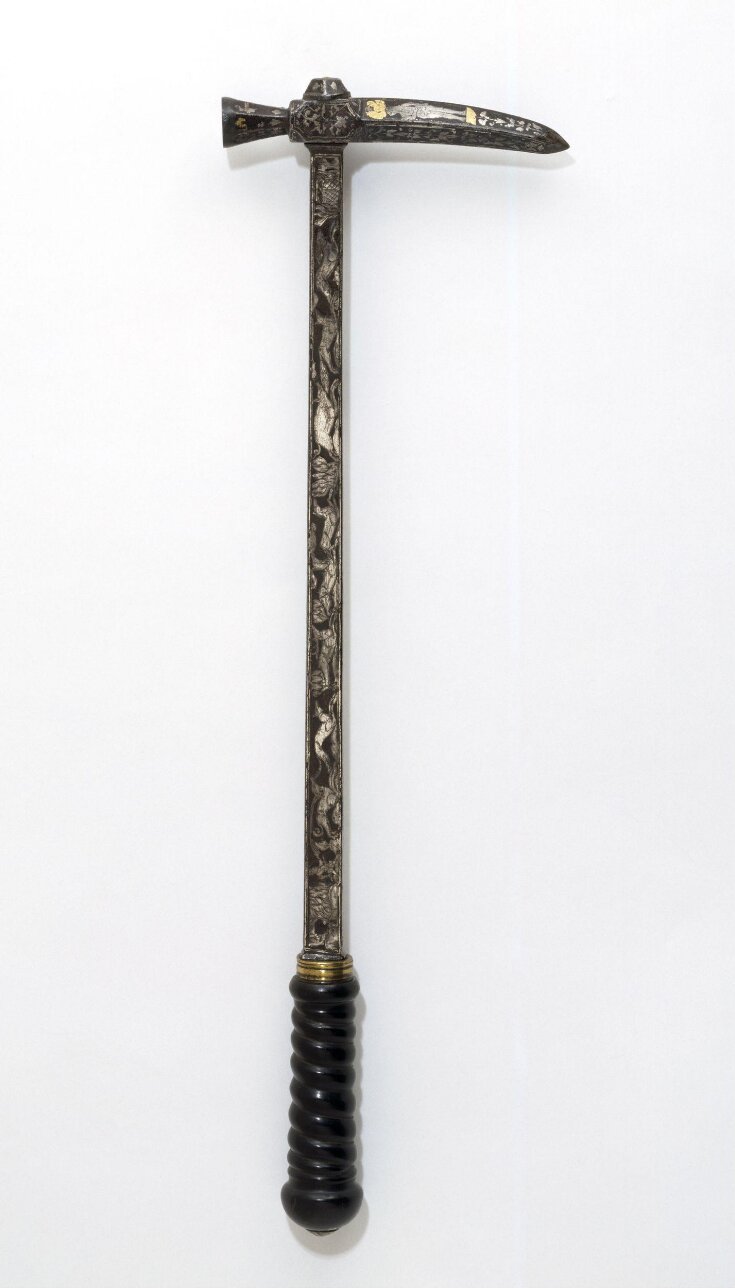
The hammer was made in Germany in around 1550 for use in war. War hammers were designs to pound and tear at armour. Wear and tear on both points of the hammer head suggest it has seen use, although it is possible this damage was sustained by later collectors.
The hammer as a weapon of war was in continuous use in Europe from around 1300 until the seventeenth century. During the medieval period three basic types of warhammers were in use: 1) the throwing hammer, a derivative of the short throwing hatchet; 2) the short hammer, a single-handed weapon often used by mounted warriors from the 13th to the 16th century and sometimes called "horseman's hammer"; and 3) the long-handled footman's hammer (poleaxe) which was a longer version of the short hammer and was in use from the 14th to the 16th century.
War hammers are closely related to pole-axes used in foot combat at the lists. These usually had an additional spike on the top and may have an axe blade or a hammer head counter-balancing the beak shaped fluke on the opposite side.
The hammer as a weapon of war was in continuous use in Europe from around 1300 until the seventeenth century. During the medieval period three basic types of warhammers were in use: 1) the throwing hammer, a derivative of the short throwing hatchet; 2) the short hammer, a single-handed weapon often used by mounted warriors from the 13th to the 16th century and sometimes called "horseman's hammer"; and 3) the long-handled footman's hammer (poleaxe) which was a longer version of the short hammer and was in use from the 14th to the 16th century.
War hammers are closely related to pole-axes used in foot combat at the lists. These usually had an additional spike on the top and may have an axe blade or a hammer head counter-balancing the beak shaped fluke on the opposite side.
Object details
| Categories | |
| Object type | |
| Materials and techniques | Chiseled steel overlaid with silver and gold and nielloed |
| Brief description | Chiseled steel horseman's hammer overlaid with silver and gold and nielloed, Germany, about 1550 |
| Physical description | Chiseled steel overlaid with silver and gold and infilled with niello. Slightly curved fluke of stiff diamond section, small faceted hammer both made in one with a central block from which a flat belt hook extends down the shaft. The head fits over a bolt on top of the shaft to which it is secrued by a faceted nut. The shaft tapers slightly and is of rectangular section terminating in a spirally fluted wooden grip, at each end of which is a brass collar and washer decorated with radiating grooves. All the iron parts are decorated with silver overlay picked out with small parts of gold on the head. The designs included foliage and strapwork with on the head figures of Adam and Eve. On one of the two wider faces of the shaft there is a battle scene of charging cavalry attacking from opposing towns and on the other a man leading dogs into a hunt of deer, boar and hare. |
| Dimensions |
|
| Gallery label | Arms and Armour Gallery:
HORSEMAN'S HAMMER
Chiselled steel overlaid with silver and gold, the ground of the design filled with niello
GERMAN; about 1550
M.538-1956(to 2002) |
| Object history | The hammer was made in Germany in around 1550 for use in war. War hammers were designed to pound and tear at armour. Wear and tear on both points of the hammer head suggest it has seen use. The hammer was purchased by the Museum in 1956 from Mr. M. Drinkwater (R.F. 56/3722) for £80 using funds from the Farquharson Bequest of 1927. Its provenance before Drinkwater's ownership is unknown. Historical significance: This is a finely decorated example of a war hammer. It is unusual for such a weapon to be inlaid with silver and gold and it is possible that it was used primarily as a signalling baton for the leader of an army. Although the wear and tear on the hammer head and point of the fluke suggest it has been used in anger, it is possible this damage was sustained by later collectors. |
| Historical context | The hammer as a weapon of war was in continuous use in Europe from around 1300 until the seventeenth century. This type of short handled hammer was for use on horseback. During the medieval period three basic types of warhammers were in use: 1) the throwing hammer, a derivative of the short throwing hatchet; 2) the short hammer, a single-handed weapon often used by mounted warriors from the 13th to the 16th century and sometimes called "horseman's hammer"; and 3) the long-handled footman's hammer (poleaxe) which was a longer version of the short hammer and was in use from the 14th to the 16th century. War hammers are closely related to polaxes used in foot combat at the lists. These usually had an additional spike on the top and may have an axe blade or a hammer head counter-balancing the beak shaped fluke on the opposite side. |
| Subjects depicted | |
| Summary | The hammer was made in Germany in around 1550 for use in war. War hammers were designs to pound and tear at armour. Wear and tear on both points of the hammer head suggest it has seen use, although it is possible this damage was sustained by later collectors. The hammer as a weapon of war was in continuous use in Europe from around 1300 until the seventeenth century. During the medieval period three basic types of warhammers were in use: 1) the throwing hammer, a derivative of the short throwing hatchet; 2) the short hammer, a single-handed weapon often used by mounted warriors from the 13th to the 16th century and sometimes called "horseman's hammer"; and 3) the long-handled footman's hammer (poleaxe) which was a longer version of the short hammer and was in use from the 14th to the 16th century. War hammers are closely related to pole-axes used in foot combat at the lists. These usually had an additional spike on the top and may have an axe blade or a hammer head counter-balancing the beak shaped fluke on the opposite side. |
| Bibliographic references |
|
| Collection | |
| Accession number | M.538-1956 |
About this object record
Explore the Collections contains over a million catalogue records, and over half a million images. It is a working database that includes information compiled over the life of the museum. Some of our records may contain offensive and discriminatory language, or reflect outdated ideas, practice and analysis. We are committed to addressing these issues, and to review and update our records accordingly.
You can write to us to suggest improvements to the record.
Suggest feedback
You can write to us to suggest improvements to the record.
Suggest feedback
| Record created | April 5, 2004 |
| Record URL |
Download as: JSONIIIF Manifest
