
Figure
ca. 1830 (made)
| Artist/Maker | |
| Place of origin |
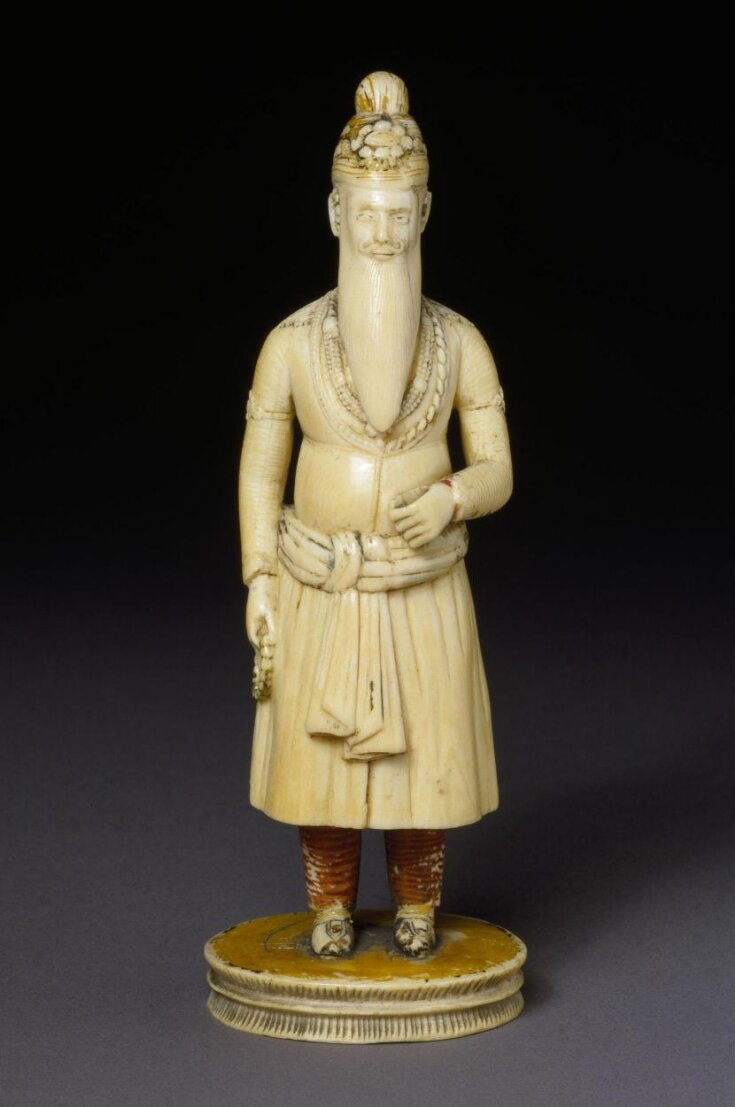
Although the name of the first Sikh maharaja of the Panjab, Ranjit Singh (1780–1839), was very well known in northern India during his reign, few outside the Panjab would have known what he looked like. Lacking any portrait miniature from which to copy a likeness, the carver of this ivory statuette (who was probably working in Delhi, a major centre of the craft), gave the maharaja the majestic appearance and jewellery of a Mughal emperor. In reality Ranjit Singh was renowned for his simple dress and plain features, bearing the ravages of childhood smallpox, which had permanently scarred his skin. It also left him blind in one eye, a detail that the carver has incorporated. The statuette is similar to a ‘portrait’ of the maharaja in an illustrated copy of the ‘Tazkirat ul-’umara’ (‘Historical notices of princely families [of Rajasthan and the Punjab’]) by Colonel James Skinner of about 1830, suggesting that the carver used this as his model.
Object details
| Categories | |
| Object type | |
| Materials and techniques | Carved ivory, with traces of gold and pigment |
| Brief description | Ivory model of Maharaja Ranjit Singh. Front View. Delhi, ca. 1830. |
| Physical description | Ivory model of Maharaja Ranjit Singh. Front View. Delhi, ca. 1830. |
| Dimensions |
|
| Gallery label | FIGURE OF MAHARAJA RANJIT SINGH
Carved ivory, with traces of gold and pigment
Delhi
c. 1830
IS.60-1998
In his own lifetime, the renown of Maharaja Ranjit Singh spread far beyond the boundaries of Punjab. However, relatively few portraits were in circulation outside the region, and artists in major cities like Delhi relied on written or verbal descriptions of him. The ivory carver knew only that the ruler was blind in one eye due to childhood smallpox, and gives him Delhi-style clothing, including turban. Similar depictions bearing no resemblance to the Maharaja were done by Delhi’s painters at the same time.
(august 2017) |
| Production | As Delhi was a known centre of ivory-carving, the close relationship between this figure and a 'portrait' of Maharaja Ranjit Singh in the Tazkhirat-ul-umana, a volume containing a collection of portraits of leading figures from the Panjab and Rajasthan, suggests a similar date and provenance for the figure: Delhi ca. 1830. |
| Subject depicted | |
| Summary | Although the name of the first Sikh maharaja of the Panjab, Ranjit Singh (1780–1839), was very well known in northern India during his reign, few outside the Panjab would have known what he looked like. Lacking any portrait miniature from which to copy a likeness, the carver of this ivory statuette (who was probably working in Delhi, a major centre of the craft), gave the maharaja the majestic appearance and jewellery of a Mughal emperor. In reality Ranjit Singh was renowned for his simple dress and plain features, bearing the ravages of childhood smallpox, which had permanently scarred his skin. It also left him blind in one eye, a detail that the carver has incorporated. The statuette is similar to a ‘portrait’ of the maharaja in an illustrated copy of the ‘Tazkirat ul-’umara’ (‘Historical notices of princely families [of Rajasthan and the Punjab’]) by Colonel James Skinner of about 1830, suggesting that the carver used this as his model. |
| Bibliographic reference | Stronge, S. (Ed.) "The Arts of the Sikh Kingdoms", V&A, 1999
cat. 101, p. 222. |
| Collection | |
| Accession number | IS.60-1998 |
About this object record
Explore the Collections contains over a million catalogue records, and over half a million images. It is a working database that includes information compiled over the life of the museum. Some of our records may contain offensive and discriminatory language, or reflect outdated ideas, practice and analysis. We are committed to addressing these issues, and to review and update our records accordingly.
You can write to us to suggest improvements to the record.
Suggest feedback
You can write to us to suggest improvements to the record.
Suggest feedback
| Record created | November 17, 1998 |
| Record URL |
Download as: JSONIIIF Manifest
