Theseus and the Minotaur
Statue
1782 (made)
1782 (made)
| Artist/Maker | |
| Place of origin |
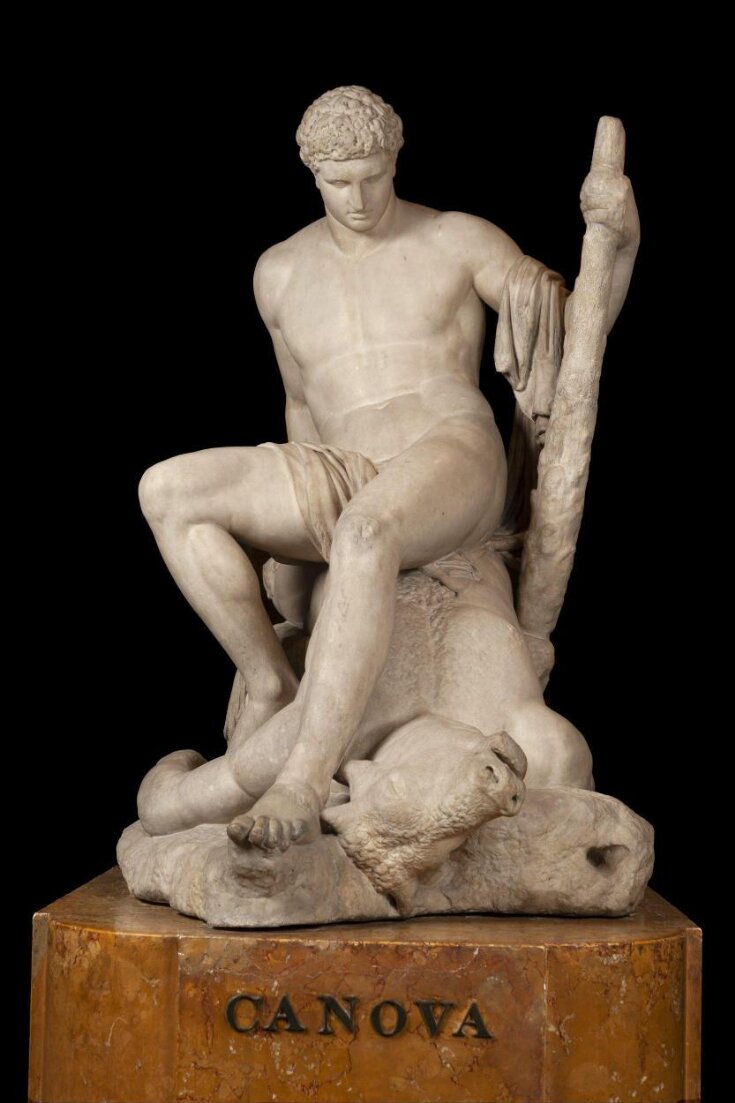
The legendary Greek hero Theseus sits astride the minotaur whom he has just killed. Coils of thread used by Theseus to retrace his steps from the minotaur's lair can be seen by the minotaur's left leg. This was one of Canova's earliest completed works after he left Venice to settle in Rome in 1780. The massive block of marble from which this group was carved was given to Canova by his patron Girolamo Zulian, who was Venetian ambassador in Rome in 1781. Zulian gave Canova the choice of subject for the work, and he decided on one of the stories from Ovid's Metamorphoses.
The Scottish painter, archaeologist and dealer, Gavin Hamilton (1723-1798), who was a friend of Canova, advised that he should portray Theseus and the Minotaur after their struggle. He considered that Canova would gain more favour and critical acclaim if he were to create a static group rather than a violent one. The sculpture did indeed receive widespread acclaim, and helped establish Canova's reputation as the leading European sculptor of his day. By the time Canova finished the work in 1782, his patron Zulian had moved to Constantinople, and he therefore allowed Canova to keep it. Canova sold it to an Austrian nobleman and collector, Count Moritz von Fries (1777-1826), and it was transported to Vienna. Later it was acquired by the 3rd Marquis of Londonderry and was installed in Londonderry House, probably during the 1820s. The contents of the house were sold in the 1960s prior to its demolition, when the Museum acquired the sculpture.
The Scottish painter, archaeologist and dealer, Gavin Hamilton (1723-1798), who was a friend of Canova, advised that he should portray Theseus and the Minotaur after their struggle. He considered that Canova would gain more favour and critical acclaim if he were to create a static group rather than a violent one. The sculpture did indeed receive widespread acclaim, and helped establish Canova's reputation as the leading European sculptor of his day. By the time Canova finished the work in 1782, his patron Zulian had moved to Constantinople, and he therefore allowed Canova to keep it. Canova sold it to an Austrian nobleman and collector, Count Moritz von Fries (1777-1826), and it was transported to Vienna. Later it was acquired by the 3rd Marquis of Londonderry and was installed in Londonderry House, probably during the 1820s. The contents of the house were sold in the 1960s prior to its demolition, when the Museum acquired the sculpture.
Delve deeper
Discover more about this object

Object details
| Categories | |
| Object type | |
| Parts | This object consists of 2 parts.
|
| Title | Theseus and the Minotaur (generic title) |
| Materials and techniques | Marble |
| Brief description | Statue, marble, of Theseus and the Minotaur, by Antonio Canova, made in Rome, 1782 |
| Physical description | Theseus seated on the prostrate Minotaur, holds a club in his left hand and rests his right on the left leg of his victim. |
| Dimensions |
|
| Gallery label | Antonio Canova (1757–1822)
Theseus and the Minotaur
1782
Based on the ancient Greek myth, this sculpture represents the moment after the Greek hero Theseus has killed the Minotaur (a half-man, half-bull monster). On the rock are coils of thread he needs to retrace his steps out of the labyrinth, the creature’s lair. This work, sculpted by Canova in his twenties, received widespread praise. It helped establish the young artist as the leading European sculptor of his day.
Rome
Marble
Formerly in the Londonderry collection(2021) |
| Credit line | Purchased with Art Fund support |
| Object history | Workshop of Antonio Canova, Rome; purchased by Johann Josef Graf von Fries and brought to Fries Palace in Vienna in 1788; purchased by Charles William Vane, 3rd Marquess of Londonderry in 1822 and brought to Londonderry House, London, in 1824; purchased by the V&A in 1962. Bought with the assistance of the National Art-Collections Fund (£1000) for £3000 from the Executor of the 7th Marquess of Londonderry (Lord Nathan). |
| Subjects depicted | |
| Summary | The legendary Greek hero Theseus sits astride the minotaur whom he has just killed. Coils of thread used by Theseus to retrace his steps from the minotaur's lair can be seen by the minotaur's left leg. This was one of Canova's earliest completed works after he left Venice to settle in Rome in 1780. The massive block of marble from which this group was carved was given to Canova by his patron Girolamo Zulian, who was Venetian ambassador in Rome in 1781. Zulian gave Canova the choice of subject for the work, and he decided on one of the stories from Ovid's Metamorphoses. The Scottish painter, archaeologist and dealer, Gavin Hamilton (1723-1798), who was a friend of Canova, advised that he should portray Theseus and the Minotaur after their struggle. He considered that Canova would gain more favour and critical acclaim if he were to create a static group rather than a violent one. The sculpture did indeed receive widespread acclaim, and helped establish Canova's reputation as the leading European sculptor of his day. By the time Canova finished the work in 1782, his patron Zulian had moved to Constantinople, and he therefore allowed Canova to keep it. Canova sold it to an Austrian nobleman and collector, Count Moritz von Fries (1777-1826), and it was transported to Vienna. Later it was acquired by the 3rd Marquis of Londonderry and was installed in Londonderry House, probably during the 1820s. The contents of the house were sold in the 1960s prior to its demolition, when the Museum acquired the sculpture. |
| Bibliographic references |
|
| Collection | |
| Accession number | A.5&A-1962 |
About this object record
Explore the Collections contains over a million catalogue records, and over half a million images. It is a working database that includes information compiled over the life of the museum. Some of our records may contain offensive and discriminatory language, or reflect outdated ideas, practice and analysis. We are committed to addressing these issues, and to review and update our records accordingly.
You can write to us to suggest improvements to the record.
Suggest feedback
You can write to us to suggest improvements to the record.
Suggest feedback
| Record created | March 8, 2004 |
| Record URL |
Download as: JSONIIIF Manifest
