
Rai Surjan Hada making Submission to Akbar
Painting
ca. 1590-95 (made)
ca. 1590-95 (made)
| Artist/Maker | |
| Place of origin |
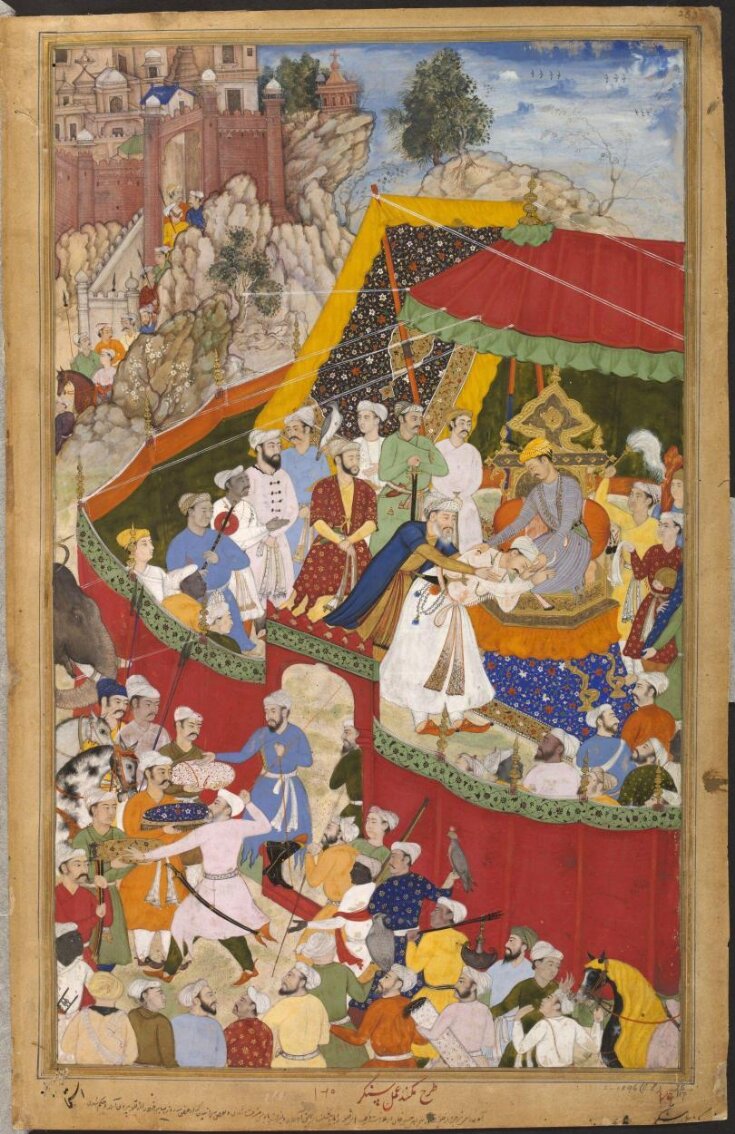
This illustration to the Akbarnama (Book of Akbar) was designed by the Mughal court artist Mukund and painted by Shankar. It depicts Rai Surjan Hada, the ruler of Ranthambhor in north-west India, submitting to the Mughal emperor Akbar (r.1556–1605) in 1569, after a fiercely fought campaign of immense strategic importance to the expanding Mughal empire. Akbar is shown seated on a throne under a canopy, with the raja bowing in submission before him.
The Akbarnama was commissioned by Akbar as the official chronicle of his reign. It was written in Persian by his court historian and biographer, Abu’l Fazl, between 1590 and 1596, and the V&A’s partial copy of the manuscript is thought to have been illustrated between about 1592 and 1595. This is thought to be the earliest illustrated version of the text, and drew upon the expertise of some of the best royal artists of the time. Many of these are listed by Abu’l Fazl in the third volume of the text, the A’in-i Akbari, and some of these names appear in the V&A illustrations, written in red ink beneath the pictures, showing that this was a royal copy made for Akbar himself. After his death, the manuscript remained in the library of his son Jahangir, from whom it was inherited by Shah Jahan.
The V&A purchased the manuscript in 1896 from Frances Clarke, the widow of Major General John Clarke, who bought it in India while serving as Commissioner of Oudh between 1858 and 1862.
The Akbarnama was commissioned by Akbar as the official chronicle of his reign. It was written in Persian by his court historian and biographer, Abu’l Fazl, between 1590 and 1596, and the V&A’s partial copy of the manuscript is thought to have been illustrated between about 1592 and 1595. This is thought to be the earliest illustrated version of the text, and drew upon the expertise of some of the best royal artists of the time. Many of these are listed by Abu’l Fazl in the third volume of the text, the A’in-i Akbari, and some of these names appear in the V&A illustrations, written in red ink beneath the pictures, showing that this was a royal copy made for Akbar himself. After his death, the manuscript remained in the library of his son Jahangir, from whom it was inherited by Shah Jahan.
The V&A purchased the manuscript in 1896 from Frances Clarke, the widow of Major General John Clarke, who bought it in India while serving as Commissioner of Oudh between 1858 and 1862.
Object details
| Categories | |
| Object type | |
| Title | Rai Surjan Hada making Submission to Akbar (generic title) |
| Materials and techniques | Painted in opaque watercolour and gold on paper |
| Brief description | Painting, Akbarnama, Rai Surjan Hada making submission to Akbar, outline by Mukund, painting by Shankar, opaque watercolour and gold on paper, Mughal, ca. 1590-95 |
| Physical description | Painting, in opaque watercolour and gold on paper, Rai Surjan Hada, the ruler of Ranthambhor, submitting to Akbar. Akbar is shown seated on a throne under a canopy. The Raja is shown bowing in submission before the emperor. |
| Dimensions |
|
| Content description | Rai Surjan Hada, the ruler of Ranthambhor, submitting to Akbar. Akbar is shown seated on a throne under a canopy. The Raja is shown bowing in submission before the emperor. |
| Styles | |
| Marks and inscriptions | (Contemporary librarian's attribution in Persian written beneath the image at the bottom of the page in red ink.)
|
| Gallery label | RAI SURJAN HARA SUBMITTING TO AKBAR
Illustration to the Akbarnama
Opaque watercolour and gold on paper
Mughal, composition by Mukund, painted by Shankar
c. 1590-95
IS.2:75-1896
After the Mughal victory, Raja Surjan Hara prostrated himself before the emperor. He handed over the keys of his fort, as well as
the treasury and stores. Behind Akbar, servants hold weapons wrapped in precious textiles
and a flywhisk. These and the red colour of
the canopy above the emperor’s head are all emblems of royalty.
(27/9/2013) |
| Credit line | Purchased from Mrs. Clarke, The Dingle, Sydenham Hill, S. E |
| Object history | The Akbarnama was commissioned by Akbar as an official chronicle of his reign. It was written by his court historian and biographer Abu'l Fazl around 1590, and illustrated during the same decade by at least forty-nine different artists from Akbar's studio. After Akbar's death, the manuscript remained in the library of his son, Jehangir. The Victoria and Albert Museum purchased it in 1896 from the widow of major General Clarke, an official who served as the Commissioner in Oudh province. Historical significance: It is thought to be the first illustrated copy of the Akbarnama. It drew upon the expertise of some of the best royal painters of the time, many of whom receive special mention by Abu'l Fazl in the A'in-i-Akbari. The inscriptions in red ink on the bottom of the paintings name the artists. |
| Subjects depicted | |
| Association | |
| Literary reference | Akbarnama |
| Summary | This illustration to the Akbarnama (Book of Akbar) was designed by the Mughal court artist Mukund and painted by Shankar. It depicts Rai Surjan Hada, the ruler of Ranthambhor in north-west India, submitting to the Mughal emperor Akbar (r.1556–1605) in 1569, after a fiercely fought campaign of immense strategic importance to the expanding Mughal empire. Akbar is shown seated on a throne under a canopy, with the raja bowing in submission before him. The Akbarnama was commissioned by Akbar as the official chronicle of his reign. It was written in Persian by his court historian and biographer, Abu’l Fazl, between 1590 and 1596, and the V&A’s partial copy of the manuscript is thought to have been illustrated between about 1592 and 1595. This is thought to be the earliest illustrated version of the text, and drew upon the expertise of some of the best royal artists of the time. Many of these are listed by Abu’l Fazl in the third volume of the text, the A’in-i Akbari, and some of these names appear in the V&A illustrations, written in red ink beneath the pictures, showing that this was a royal copy made for Akbar himself. After his death, the manuscript remained in the library of his son Jahangir, from whom it was inherited by Shah Jahan. The V&A purchased the manuscript in 1896 from Frances Clarke, the widow of Major General John Clarke, who bought it in India while serving as Commissioner of Oudh between 1858 and 1862. |
| Bibliographic reference | Geeti Sen, Paintings from the Akbar Nama, Lustre Press Pvt Ltd, page 126 |
| Other number | 160 - inscription/original number |
| Collection | |
| Accession number | IS.2:75-1896 |
About this object record
Explore the Collections contains over a million catalogue records, and over half a million images. It is a working database that includes information compiled over the life of the museum. Some of our records may contain offensive and discriminatory language, or reflect outdated ideas, practice and analysis. We are committed to addressing these issues, and to review and update our records accordingly.
You can write to us to suggest improvements to the record.
Suggest feedback
You can write to us to suggest improvements to the record.
Suggest feedback
| Record created | November 11, 1998 |
| Record URL |
Download as: JSONIIIF Manifest
