
Akbar
Painting
ca. 1590-95 (made)
ca. 1590-95 (made)
| Artist/Maker | |
| Place of origin |
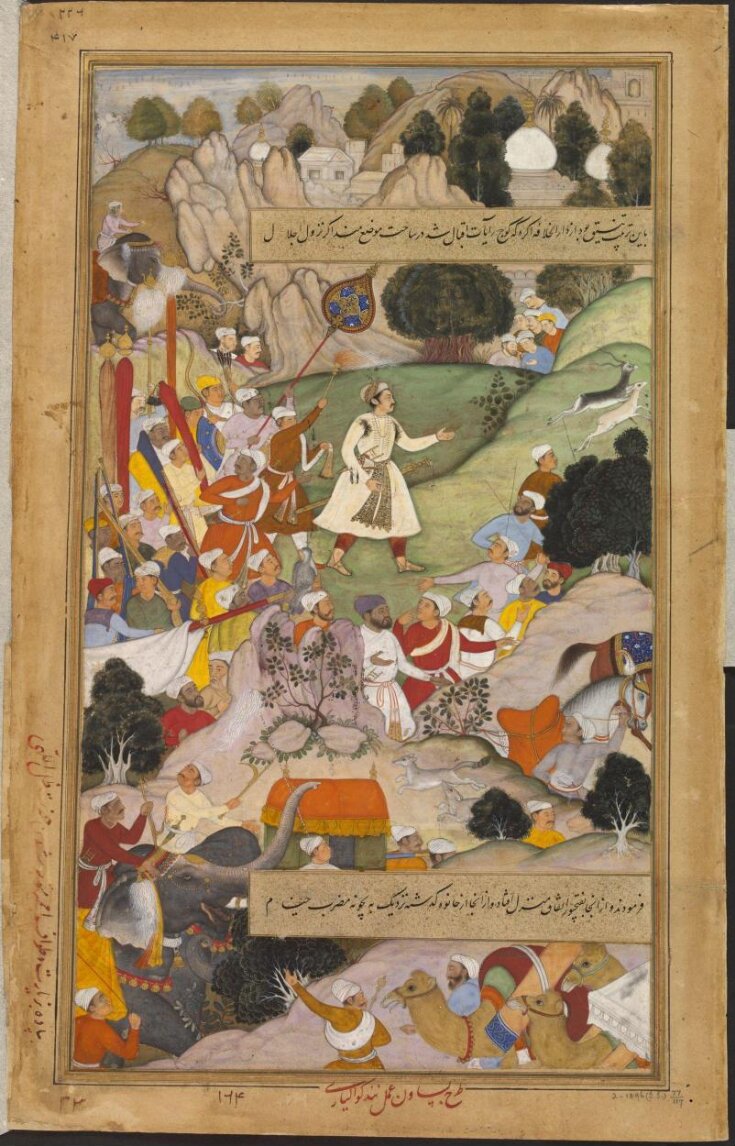
This painting from the Akbarnama (Book of Akbar) depicts an incident from the life of the Mughal emperor Akbar (r. 1556-1605). Akbar had vowed that if he should be blessed with a son, he would walk to the shrine of the founder of the Chishti order, Shaikh Mu'in ad-Din Chishti, at Ajmer to offer his prayers. He left Agra in January 1570, and swiftly covered the 370 or so kilometers. He is depicted here accompanied by servants carrying emblems of royalty. Abu’l Fazl, in the A’in-i Akbari, the third volume of his history of the reign entitled the Akbarnama, notes that whenever the emperor went out in a formal context, five standards would be carried next to him, as well as the qur, a collection of flags and other insignia. These were all wrapped in red cloth, the colour of royalty. The aftabgir, a shade held over the emperor’s head and seen here, was also on Abu’l Fazl’s list of royal emblems. While in Ajmer, Akbar distributed alms at the shrine, visited other local sacred places, and ordered the construction of new mosques. When a second son, Murad, was born at Sikri some months later to another wife, Akbar returned to Ajmer and had the fort enlarged, new mansions built and gardens laid out for the elite of the court. From then until 1579 he made annual pilgrimages to the city. The composition (tarh) of the painting was designed by Basawan, and the "work" ('amal), or painting, was done by Nand Gwaliari. [Akbarnama, English translation: Beveridge, vol. II, pp. 510-11]
The Akbarnama was commissioned in 1589 by the emperor Akbar as the official chronicle of his reign. It was written by his court historian and biographer Abu'l Fazl between 1590 and 1596 and is thought to have been illustrated between about 1592 and 1594. At least 49 different artists from Akbar's Ketabkhana, or "House of Books", where manuscripts were stored as well as created, worked on the illustrations. After Akbar's death in 1605, the incomplete manuscript remained in the library of his son, Jahangir (r. 1605-1627) who recorded his ownership on the flyleaf, and later Shah Jahan (r.1628-1658). The Victoria and Albert Museum purchased it in 1896 from Mrs Frances Clarke, the widow of Major-General John Clarke, who bought it in India while serving as Commissioner of Oudh between 1858 and 1862.
The Akbarnama was commissioned in 1589 by the emperor Akbar as the official chronicle of his reign. It was written by his court historian and biographer Abu'l Fazl between 1590 and 1596 and is thought to have been illustrated between about 1592 and 1594. At least 49 different artists from Akbar's Ketabkhana, or "House of Books", where manuscripts were stored as well as created, worked on the illustrations. After Akbar's death in 1605, the incomplete manuscript remained in the library of his son, Jahangir (r. 1605-1627) who recorded his ownership on the flyleaf, and later Shah Jahan (r.1628-1658). The Victoria and Albert Museum purchased it in 1896 from Mrs Frances Clarke, the widow of Major-General John Clarke, who bought it in India while serving as Commissioner of Oudh between 1858 and 1862.
Object details
| Categories | |
| Object type | |
| Title | Akbar (generic title) |
| Materials and techniques | Painted in opaque watercolour and gold on paper |
| Brief description | Painting, Akbarnama, Akbar's pilgrimage to Ajmer in thanksgiving for the birth of Prince Salim, outline by Basawan, painting by Nand Gwaliari, opaque watercolour and gold on paper, Mughal, ca. 1590-95 |
| Physical description | Painted in opaque watercolour and gold on paper, Akbar is at the centre of the composition, dressed in white, walking across a landscape during his pilgrimage on foot to Ajmer in thanksgiving for the birth of Prince Salim (later Emperor Jahangir). Servants follow him, bearing emblems of royalty including a sunshade. Panels of Persian text are pasted onto the painting in panels at top and bottom. |
| Dimensions |
|
| Content description | Akbar is at the centre of the composition, dressed in white, walking across a landscape during his pilgrimage on foot to Ajmer in thanksgiving for the birth of Prince Salim (later Emperor Jahangir). Servants follow him, bearing emblems of royalty including a sunshade. Panels of Persian text are pasted onto the painting in panels at top and bottom. |
| Styles | |
| Marks and inscriptions | (The contemporary attributions are written in Persian in red ink beneath the painting.)
|
| Credit line | Purchased from Mrs. Clarke, The Dingle, Sydenham Hill, S. E |
| Object history | The Akbarnama was commissioned by the emperor Akbar as the official chronicle of his reign in 1589 and was written by Abu'l Fazl between 1590 and 1596. The paintings were done while the author wrote and revised his text and were completed by 1595. After Akbar's death in 1605, the manuscript remained in the library of his son, Jahangir (r. 1605-1627) and later Shah Jahan (r. 1628-1658). The Victoria and Albert Museum purchased it in 1896 from Mrs Frances Clarke, the widow of Major-General John Clarke, who bought it while serving as Commissioner of Oudh province between 1858 and 1862. Historical significance: It is thought to be the first illustrated copy of the Akbarnama. It drew upon the expertise of some of the best royal painters of the time, many of whom receive special mention by Abu'l Fazl in the A'in-i-Akbari, the third book of the Akbarnama. The inscriptions in red ink on the bottom of the paintings refer to the artists and indicate that this was a royal copy. Calza, Gian Carlo (ed.) Akbar: the great emperor of India. Rome : Fondazione, Roma Museo, 2012. ISBN 978-88-572-1525-9 (hard cover edition); ISBN 978-88-572-1793-2 (soft cover edition). p.234 , cat. no.1.2. |
| Production | Outline painted by Basawan, colours and details by Nand Gwaliari. Attribution place is likely to be Lahore. |
| Subjects depicted | |
| Association | |
| Literary reference | Akbarnama |
| Summary | This painting from the Akbarnama (Book of Akbar) depicts an incident from the life of the Mughal emperor Akbar (r. 1556-1605). Akbar had vowed that if he should be blessed with a son, he would walk to the shrine of the founder of the Chishti order, Shaikh Mu'in ad-Din Chishti, at Ajmer to offer his prayers. He left Agra in January 1570, and swiftly covered the 370 or so kilometers. He is depicted here accompanied by servants carrying emblems of royalty. Abu’l Fazl, in the A’in-i Akbari, the third volume of his history of the reign entitled the Akbarnama, notes that whenever the emperor went out in a formal context, five standards would be carried next to him, as well as the qur, a collection of flags and other insignia. These were all wrapped in red cloth, the colour of royalty. The aftabgir, a shade held over the emperor’s head and seen here, was also on Abu’l Fazl’s list of royal emblems. While in Ajmer, Akbar distributed alms at the shrine, visited other local sacred places, and ordered the construction of new mosques. When a second son, Murad, was born at Sikri some months later to another wife, Akbar returned to Ajmer and had the fort enlarged, new mansions built and gardens laid out for the elite of the court. From then until 1579 he made annual pilgrimages to the city. The composition (tarh) of the painting was designed by Basawan, and the "work" ('amal), or painting, was done by Nand Gwaliari. [Akbarnama, English translation: Beveridge, vol. II, pp. 510-11] The Akbarnama was commissioned in 1589 by the emperor Akbar as the official chronicle of his reign. It was written by his court historian and biographer Abu'l Fazl between 1590 and 1596 and is thought to have been illustrated between about 1592 and 1594. At least 49 different artists from Akbar's Ketabkhana, or "House of Books", where manuscripts were stored as well as created, worked on the illustrations. After Akbar's death in 1605, the incomplete manuscript remained in the library of his son, Jahangir (r. 1605-1627) who recorded his ownership on the flyleaf, and later Shah Jahan (r.1628-1658). The Victoria and Albert Museum purchased it in 1896 from Mrs Frances Clarke, the widow of Major-General John Clarke, who bought it in India while serving as Commissioner of Oudh between 1858 and 1862. |
| Associated objects | |
| Bibliographic references |
|
| Other number | 164 - inscription/original number |
| Collection | |
| Accession number | IS.2:77-1896 |
About this object record
Explore the Collections contains over a million catalogue records, and over half a million images. It is a working database that includes information compiled over the life of the museum. Some of our records may contain offensive and discriminatory language, or reflect outdated ideas, practice and analysis. We are committed to addressing these issues, and to review and update our records accordingly.
You can write to us to suggest improvements to the record.
Suggest feedback
You can write to us to suggest improvements to the record.
Suggest feedback
| Record created | November 11, 1998 |
| Record URL |
Download as: JSONIIIF Manifest
