Fish Slice
1814-1815 (made)
| Artist/Maker | |
| Place of origin |
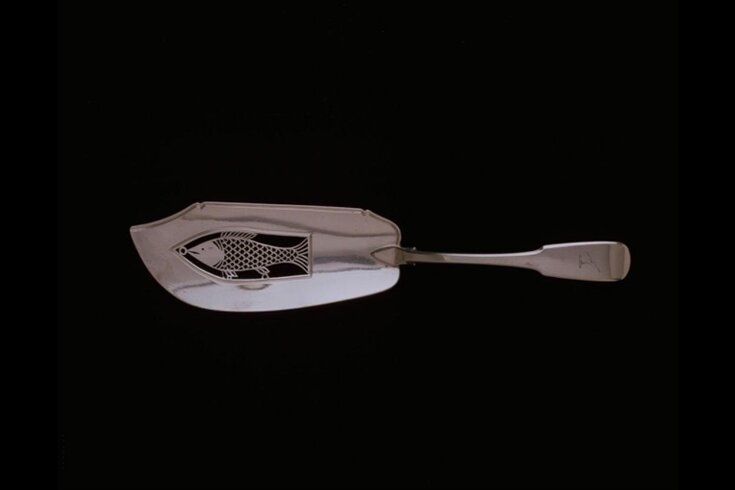
This fish slice would have been part of a silver table service. By the time it was made in 1814 to 1815 almost every flatware service included such a slice. The advantage of silver was that it did not taint the delicate flavour of the fish. The pierced decoration also allowed any liquid to drain away.
The fish slice evolved from the ‘Pudding Trowle’, such as the one supplied to the Earl of Kildare in 1745. The ‘trowle’ normally consisted of a triangular blade which was pierced and sawn to various designs. It was soon used for fish as well as pudding. By the 1770s, when it was suddenly fashionable to eat whitebait, silversmiths supplied a large number of trowels both with fish-shaped outlines and also pierced and chased to represent one. The earliest trowels usually had solid silver handles. Later examples had turned and stained ivory handles.
The fish slice evolved from the ‘Pudding Trowle’, such as the one supplied to the Earl of Kildare in 1745. The ‘trowle’ normally consisted of a triangular blade which was pierced and sawn to various designs. It was soon used for fish as well as pudding. By the 1770s, when it was suddenly fashionable to eat whitebait, silversmiths supplied a large number of trowels both with fish-shaped outlines and also pierced and chased to represent one. The earliest trowels usually had solid silver handles. Later examples had turned and stained ivory handles.
Delve deeper
Discover more about this object

Object details
| Categories | |
| Object type | |
| Materials and techniques | Silver |
| Brief description | Fish slice, silver, marks of William and Samuel Knight, London, England, 1814-1815 |
| Marks and inscriptions |
|
| Gallery label | 9. FISH SLICE
London, 1814-15
Mark of W & S. Knight
Slices or trowels for serving fish are recoded from about 1730. Shaped like the fin of a fish, the decorative openwork made by saw cutting enabled the juices to drain. Silver was a preferable material to copper or tinned iron as it did not affect the delicate flavour of the fish.
Miss Campbell of Jura Gift
M.31-1957(26/11/1996) |
| Credit line | Given by Miss M.R. Campbell |
| Object history | Acquisition RF: 57 / 982 Gift - Miss M R Campbell of Jura |
| Summary | This fish slice would have been part of a silver table service. By the time it was made in 1814 to 1815 almost every flatware service included such a slice. The advantage of silver was that it did not taint the delicate flavour of the fish. The pierced decoration also allowed any liquid to drain away. The fish slice evolved from the ‘Pudding Trowle’, such as the one supplied to the Earl of Kildare in 1745. The ‘trowle’ normally consisted of a triangular blade which was pierced and sawn to various designs. It was soon used for fish as well as pudding. By the 1770s, when it was suddenly fashionable to eat whitebait, silversmiths supplied a large number of trowels both with fish-shaped outlines and also pierced and chased to represent one. The earliest trowels usually had solid silver handles. Later examples had turned and stained ivory handles. |
| Collection | |
| Accession number | M.31-1957 |
About this object record
Explore the Collections contains over a million catalogue records, and over half a million images. It is a working database that includes information compiled over the life of the museum. Some of our records may contain offensive and discriminatory language, or reflect outdated ideas, practice and analysis. We are committed to addressing these issues, and to review and update our records accordingly.
You can write to us to suggest improvements to the record.
Suggest feedback
You can write to us to suggest improvements to the record.
Suggest feedback
| Record created | March 3, 2004 |
| Record URL |
Download as: JSONIIIF Manifest
