The Andrews Diptych
Diptych
early 9th century (made)
early 9th century (made)
| Artist/Maker | |
| Place of origin |
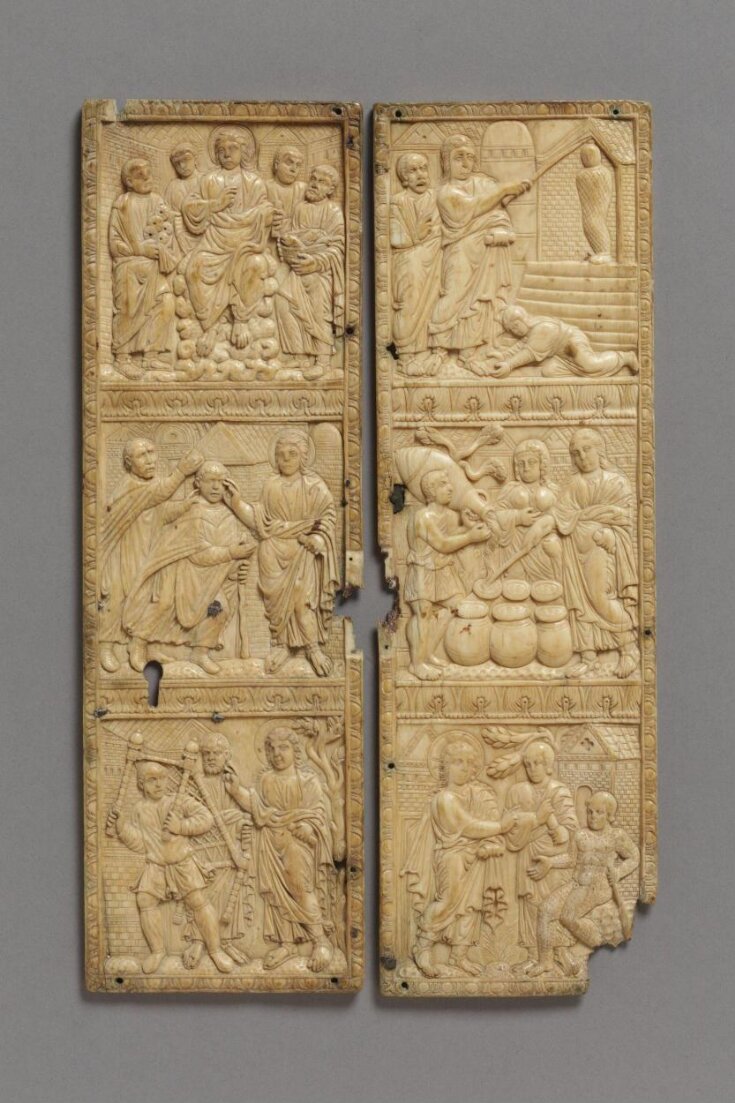
The dating and localisation of this ivory are highly controversial subjects. It has been viewed by many scholars as Late Antique work. Recently, however, most have favoured the attribution to the ninth-century Carolingian Renaissance. The shallowness of the picture space, the lack of depth in the ornament and the flatness of the architectural background (despite the detailed rendering of the brickwork) are put forward as reasons for a later date.
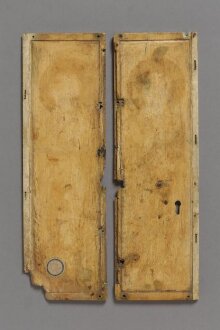
The leaves were probably re-carved from a late Antique diptych. They were later - perhaps in the 12th century - converted into doors, possibly for a tabernacle or shrine. The figures painted on the reverse of the plaques were probably also added at this time. There is little doubt that ealry Christian models were drawn upon for the iconographic types, and that the figure style is derived from fifth century prototypes.
The leaves were probably re-carved from a late Antique diptych. They were later - perhaps in the 12th century - converted into doors, possibly for a tabernacle or shrine. The figures painted on the reverse of the plaques were probably also added at this time. There is little doubt that ealry Christian models were drawn upon for the iconographic types, and that the figure style is derived from fifth century prototypes.
Object details
| Categories | |
| Object type | |
| Parts | This object consists of 2 parts.
|
| Titles |
|
| Materials and techniques | Elephant Ivory |
| Brief description | Diptych, ivory, 'The Andrews Diptych', depicting the Miracles of Christ, Carolingian, probably North Italian, early 9th century |
| Physical description | The diptych depicts the six miracles of Christ. From top right these are the Raising of Lazarus, the Marriage at Cana, the Healing of the Leper, the Miracles of the Loaf and Fishes, the Healing of the Blind Man, and the Healing of the Man sick of Palsy. The scenes are divided by acanthus borders (different on left and right leaves) and each leaf has a narrow border of egg and dart ornament. The backs of the leaves were originally hollowed out to take wax, appear to have been planed down or cut with a fine saw alongside the the outside edges. On the backs, in place of the wax are faint traces of painted figures of two nimbed saints; the saint on the left-hand leaf appears to be holding a book, with his right hand raised in belessing. These must be considerably later in date than the carving, probably sometimes between the ninth and twelfth century. A large key-hole has also been cut into the leaf, at an unkown period the diptych formed prbably the door of a tabernacle or a reliquary. |
| Dimensions |
|
| Style | |
| Credit line | Given by Mr F. E. Andrews through Art Fund |
| Object history | The diptych was formerly at Palermo and later in the Currie collection. Given by F.E. Andrews, Esq., through the National Art-Collections Fund. The leaves were probably re-carved from a late Antique diptych. They were later - perhaps in the 12th century - converted into doors, possibly for a tabernacle or shrine. The figures painted on the reverse of the plaques were probably also added at this time. There is little doubt that ealry Christian models were drawn upon for the iconographic types, and that the figure style is derived from fifth century prototypes. Historical significance: The present diptych shows that the artists at the Carolingian court copied Late Antique models, often so closely that they were indistiguishable from the orignal, as in this instance. Each scene has iconograhically its precedents in Early Christian works, but it is unusual for the Late Antique period in its restriction to representations of Christ's Miracles. This could be seen as the influence of theologians at the Carolingian Court. |
| Historical context | The dating and localisation of this ivory are highly controversial subjects. It has been viewed by many scholars as Late Antique work. Recently, however, most have favoured the attribution to the ninth-century Carolingian Renaissance. The shallowness of the picture space, the lack of depth in the ornament and the flatness of the architectural background (despite the detailed rendering of the brickwork) are put forward as reasons for a later date. The function of the two tablets depends on the dating. If one prefers a date in the fifth century, the diptych was probably used as writing purposes. A later date in the ninth century with the revival of the imperial tradition and the Late Antique heritage makes the function quite unclear and it needs to be explored; were these writing tablets in the Late Antique manner? |
| Subjects depicted | |
| Summary | The dating and localisation of this ivory are highly controversial subjects. It has been viewed by many scholars as Late Antique work. Recently, however, most have favoured the attribution to the ninth-century Carolingian Renaissance. The shallowness of the picture space, the lack of depth in the ornament and the flatness of the architectural background (despite the detailed rendering of the brickwork) are put forward as reasons for a later date. The leaves were probably re-carved from a late Antique diptych. They were later - perhaps in the 12th century - converted into doors, possibly for a tabernacle or shrine. The figures painted on the reverse of the plaques were probably also added at this time. There is little doubt that ealry Christian models were drawn upon for the iconographic types, and that the figure style is derived from fifth century prototypes. |
| Associated objects |
|
| Bibliographic references |
|
| Collection | |
| Accession number | A.47&A-1926 |
About this object record
Explore the Collections contains over a million catalogue records, and over half a million images. It is a working database that includes information compiled over the life of the museum. Some of our records may contain offensive and discriminatory language, or reflect outdated ideas, practice and analysis. We are committed to addressing these issues, and to review and update our records accordingly.
You can write to us to suggest improvements to the record.
Suggest feedback
You can write to us to suggest improvements to the record.
Suggest feedback
| Record created | March 1, 2004 |
| Record URL |
Download as: JSONIIIF Manifest
