The Devonshire Hunting Tapestries
Tapestry
1440-1450 (made)
1440-1450 (made)
| Artist/Maker | |
| Place of origin |
In the 15th century, tapestries provided colour, warmth and draught-proofing in bleak rooms with stone walls. Those with narratives also provided entertainment and interest for the household and guests at a time of low literacy, when images were extremely important.
The group of four Devonshire Hunting Tapestries of which this is one example belonged, until they came to the Museum in 1957, to the dukes of Devonshire. Large tapestries were not produced in England in the 15th century and had to be imported. A number of towns or cities in the southern Netherlands had workshops and it was in one of these that the Devonshire Hunting Tapestries were made. The earliest history of the tapestries is unknown but they were identified as being at Hardwick Hall in Derbyshire in the 16th century, from an inventory compiled in 1601 for the Countess of Shrewsbury. This celebrated and four-times married noblewoman had Hardwick Hall built and furnished to her taste, which evidently included the15th-century hunting tapestries.
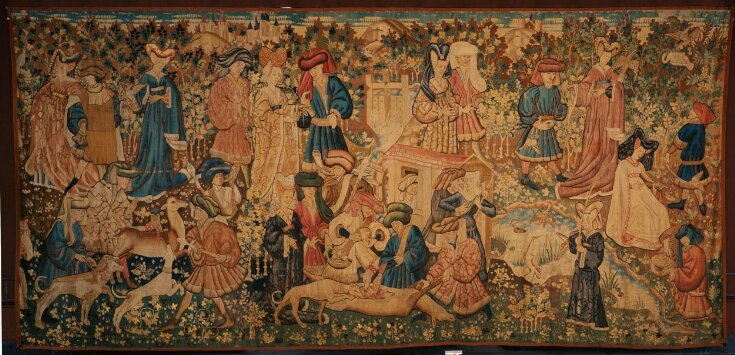
The hunt was a particularly powerful theme and would have been a familiar pastime to many of the high-born individuals and families who owned tapestries. Hunting was both a sport and an important source of food. All types of hunting had their own etiquette, and treatises had by this time been written on the principal forms of the sport. Deer hunting was known as the sport of kings and confined to the courts and other favoured inidviduals. In this tapestry the main scenes show various parts of the deer hunt, including, at the centre bottom, the gruesome scene of the dead deer being cut up and the meat distributed. This was carried out as a set ritual with specifi bits of the meat being given to particular huntsmen and favoured dogs.
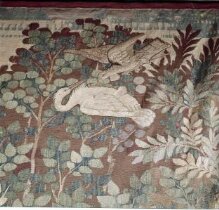
The tapestry has two horizontal ‘registers’, the upper part showing falconry on foot. This sport used falcons to catch ducks and other wild fowl and birds. It was also favoured by princes and the aristocracy and had its own rituals. Women participated using smaller falcons than the men and the activity is seen here as much as a backdrop for gossip and parading in fine clothes as a sport.
The dress of the participants is of the type worn at court, particularly that of Burgundy, which had control of the tapestry-weaving areas in the southern Netherlands. It is unlikely that any serious hunting took place in such restricting and exotic clothes.
The composition is made up of numerous scenes that each make sense separately. This device was often used in tapestry design so that if, as often happened, the tapestry were cut up or altered - for example, to go round a doorway or fit a smaller room - the narrative would still make sense.
The group of four Devonshire Hunting Tapestries of which this is one example belonged, until they came to the Museum in 1957, to the dukes of Devonshire. Large tapestries were not produced in England in the 15th century and had to be imported. A number of towns or cities in the southern Netherlands had workshops and it was in one of these that the Devonshire Hunting Tapestries were made. The earliest history of the tapestries is unknown but they were identified as being at Hardwick Hall in Derbyshire in the 16th century, from an inventory compiled in 1601 for the Countess of Shrewsbury. This celebrated and four-times married noblewoman had Hardwick Hall built and furnished to her taste, which evidently included the15th-century hunting tapestries.
The hunt was a particularly powerful theme and would have been a familiar pastime to many of the high-born individuals and families who owned tapestries. Hunting was both a sport and an important source of food. All types of hunting had their own etiquette, and treatises had by this time been written on the principal forms of the sport. Deer hunting was known as the sport of kings and confined to the courts and other favoured inidviduals. In this tapestry the main scenes show various parts of the deer hunt, including, at the centre bottom, the gruesome scene of the dead deer being cut up and the meat distributed. This was carried out as a set ritual with specifi bits of the meat being given to particular huntsmen and favoured dogs.
The tapestry has two horizontal ‘registers’, the upper part showing falconry on foot. This sport used falcons to catch ducks and other wild fowl and birds. It was also favoured by princes and the aristocracy and had its own rituals. Women participated using smaller falcons than the men and the activity is seen here as much as a backdrop for gossip and parading in fine clothes as a sport.
The dress of the participants is of the type worn at court, particularly that of Burgundy, which had control of the tapestry-weaving areas in the southern Netherlands. It is unlikely that any serious hunting took place in such restricting and exotic clothes.
The composition is made up of numerous scenes that each make sense separately. This device was often used in tapestry design so that if, as often happened, the tapestry were cut up or altered - for example, to go round a doorway or fit a smaller room - the narrative would still make sense.
Object details
| Categories | |
| Object type | |
| Titles |
|
| Materials and techniques | Tapestry-woven in wool |
| Brief description | Tapestry with scenes of a deer hunt and falconry |
| Physical description | Tapestry showing a deer hunt |
| Dimensions |
|
| Gallery label | THE DEER HUNT
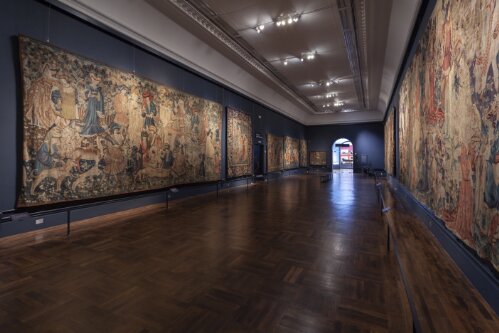
This is one of the four tapestries known as the Devonshire Hunts because they belonted to the Dukes of Devonshire (other three tapestries opposite). Restored in Paris in 1950-51, details of the patterened textiles have been lost by reweaving; but style of clothing and stylization of plants show this piece was made slightly later than the others from an updated cartoon. Hunting scenes were frequently rewoven, never losing their popularity. This tapestry was originally wider, with riders at the left.
ARRAS? Design of the 1420s redrawn and woven in the 1440s.
Museum number T. 205-1957(ca. 2003) |
| Credit line | Accepted by HM Government in lieu of tax payable on the estate of the 10th Duke of Devonshire and allocated to the Victoria and Albert Museum |
| Subjects depicted | |
| Summary | In the 15th century, tapestries provided colour, warmth and draught-proofing in bleak rooms with stone walls. Those with narratives also provided entertainment and interest for the household and guests at a time of low literacy, when images were extremely important. The group of four Devonshire Hunting Tapestries of which this is one example belonged, until they came to the Museum in 1957, to the dukes of Devonshire. Large tapestries were not produced in England in the 15th century and had to be imported. A number of towns or cities in the southern Netherlands had workshops and it was in one of these that the Devonshire Hunting Tapestries were made. The earliest history of the tapestries is unknown but they were identified as being at Hardwick Hall in Derbyshire in the 16th century, from an inventory compiled in 1601 for the Countess of Shrewsbury. This celebrated and four-times married noblewoman had Hardwick Hall built and furnished to her taste, which evidently included the15th-century hunting tapestries. The hunt was a particularly powerful theme and would have been a familiar pastime to many of the high-born individuals and families who owned tapestries. Hunting was both a sport and an important source of food. All types of hunting had their own etiquette, and treatises had by this time been written on the principal forms of the sport. Deer hunting was known as the sport of kings and confined to the courts and other favoured inidviduals. In this tapestry the main scenes show various parts of the deer hunt, including, at the centre bottom, the gruesome scene of the dead deer being cut up and the meat distributed. This was carried out as a set ritual with specifi bits of the meat being given to particular huntsmen and favoured dogs. The tapestry has two horizontal ‘registers’, the upper part showing falconry on foot. This sport used falcons to catch ducks and other wild fowl and birds. It was also favoured by princes and the aristocracy and had its own rituals. Women participated using smaller falcons than the men and the activity is seen here as much as a backdrop for gossip and parading in fine clothes as a sport. The dress of the participants is of the type worn at court, particularly that of Burgundy, which had control of the tapestry-weaving areas in the southern Netherlands. It is unlikely that any serious hunting took place in such restricting and exotic clothes. The composition is made up of numerous scenes that each make sense separately. This device was often used in tapestry design so that if, as often happened, the tapestry were cut up or altered - for example, to go round a doorway or fit a smaller room - the narrative would still make sense. |
| Associated objects | |
| Bibliographic references |
|
| Collection | |
| Accession number | T.205-1957 |
About this object record
Explore the Collections contains over a million catalogue records, and over half a million images. It is a working database that includes information compiled over the life of the museum. Some of our records may contain offensive and discriminatory language, or reflect outdated ideas, practice and analysis. We are committed to addressing these issues, and to review and update our records accordingly.
You can write to us to suggest improvements to the record.
Suggest feedback
You can write to us to suggest improvements to the record.
Suggest feedback
| Record created | February 27, 2004 |
| Record URL |
Download as: JSONIIIF Manifest
