
The Stein Collection
Fragment
200 BC-400 AD (made)
200 BC-400 AD (made)
| Artist/Maker | |
| Place of origin |
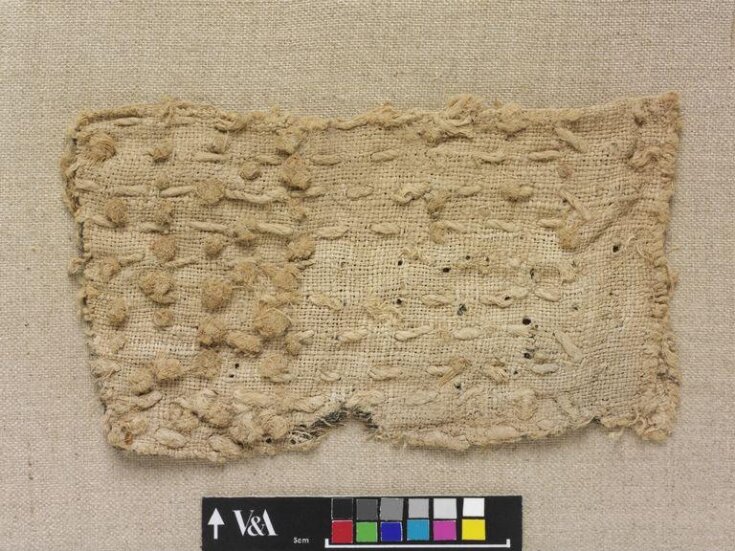
This fragment consists of three layers of plain woven buff plant fibre, quilted together by strings in rows. Some of these have been left as short tufts. The middle layer of fabric is coated with black pigment on each side. It is unclear what this textile would have been used for, although it is likely to have been part of a shoe. It was recovered from the sites called The Limes Watchtowers a line of fortified encampments designed to ensure the safe transit of goods across the area and dating from 200 BC to 400 AD.
The sites are part of an area of Central Asia we now call the Silk Road, a series of overland trade routes that crossed Asia, from China to Europe. The most notable item traded was silk. Camels and horses were used as pack animals and merchants passed the goods from oasis to oasis. The Silk Road was also important for the exchange of ideas. Whilst silk textiles travelled west from China, Buddhism entered China from India in this way.
This textile was brought back from Central Asia by the explorer and archaeologist Sir Marc Aurel Stein (1862-1943). The V&A has around 650 ancient and medieval textiles recovered by Stein at the beginning of the 20th century. Some are silk while others are made from the wool of a variety of different animals.
The sites are part of an area of Central Asia we now call the Silk Road, a series of overland trade routes that crossed Asia, from China to Europe. The most notable item traded was silk. Camels and horses were used as pack animals and merchants passed the goods from oasis to oasis. The Silk Road was also important for the exchange of ideas. Whilst silk textiles travelled west from China, Buddhism entered China from India in this way.
This textile was brought back from Central Asia by the explorer and archaeologist Sir Marc Aurel Stein (1862-1943). The V&A has around 650 ancient and medieval textiles recovered by Stein at the beginning of the 20th century. Some are silk while others are made from the wool of a variety of different animals.
Object details
| Categories | |
| Object type | |
| Title | The Stein Collection (named collection) |
| Materials and techniques | Quilted plain woven plant fibre |
| Brief description | Quilted plain woven buff plant fibre. |
| Physical description | Rectangular fragment of three layers of plain woven buff-coloured unidentified plant fibre quilted together. Quilting made by rows of string, some of which have been left as short tufts. The middle layer of fabric is coated with black pigment on each side. |
| Dimensions |
|
| Style | |
| Credit line | Stein Textile Loan Collection. On loan from the Government of India and the Archaeological Survey of India. Copyright: Government of India. |
| Object history | According to Stein this fragment may originally been part of quilted sole of fabric shoe. |
| Historical context | The Limes are a line of defensive walls and beacon towers north of Dunhuang. They extend the wall completed by Emperor Qin Shi Huangdi (259-210 BC) in 214 BC as a barrier against the Xiongnu. Under the Han Dynasty (206 BC-220 AD) the walls were carried 1,000 miles to the west, to the easternmost edge of the Tarim Basin. The Limes protected China's trade and military colonies and served as a base for expansion into Central Asia. They were made of stamped clay and gravel, alternating with layers with wood, to protect against corrosion by wind-blown sand. They were completed in less than a century with water carried over huge distances. Behind the walls lay a series of watchtowers. These housed small numbers of soldiers who watched the desert and signalled to armies stationed at nearby Dunhuang through a system of couriers and fire signals. Within the towers Stein found an astounding range of artefacts, which provide a glimpse of garrison life and military operations under the Han empire, including bronze mirrors, coarse pottery, tools, leather armour, weapons, shoes, and clothing. Ancient documents included personal letters on silk and wood; military directives and supply lists; and treatises on a range of subjects, including medicine and astrology. The V&A holds, on loan, several utilitarian textile fragments, parts of shoes and several pottery shards from the sites, dating from the Han Dynasty (206 BC-220 AD) to the Ming Dynasty (1368-1644 AD). |
| Association | |
| Summary | This fragment consists of three layers of plain woven buff plant fibre, quilted together by strings in rows. Some of these have been left as short tufts. The middle layer of fabric is coated with black pigment on each side. It is unclear what this textile would have been used for, although it is likely to have been part of a shoe. It was recovered from the sites called The Limes Watchtowers a line of fortified encampments designed to ensure the safe transit of goods across the area and dating from 200 BC to 400 AD. The sites are part of an area of Central Asia we now call the Silk Road, a series of overland trade routes that crossed Asia, from China to Europe. The most notable item traded was silk. Camels and horses were used as pack animals and merchants passed the goods from oasis to oasis. The Silk Road was also important for the exchange of ideas. Whilst silk textiles travelled west from China, Buddhism entered China from India in this way. This textile was brought back from Central Asia by the explorer and archaeologist Sir Marc Aurel Stein (1862-1943). The V&A has around 650 ancient and medieval textiles recovered by Stein at the beginning of the 20th century. Some are silk while others are made from the wool of a variety of different animals. |
| Bibliographic reference | Stein, Aurel, Serindia: Detailed Report of Exploration in Central Asia and Westernmost China Carried Out and Described Under the Orders of H.M Indian Government , 5 vols (Oxford: The Clarendon Press, 1921), vol. II, p. 776. |
| Other number | T.XII.a.0033 - Stein number |
| Collection | |
| Accession number | LOAN:STEIN.583 |
About this object record
Explore the Collections contains over a million catalogue records, and over half a million images. It is a working database that includes information compiled over the life of the museum. Some of our records may contain offensive and discriminatory language, or reflect outdated ideas, practice and analysis. We are committed to addressing these issues, and to review and update our records accordingly.
You can write to us to suggest improvements to the record.
Suggest feedback
You can write to us to suggest improvements to the record.
Suggest feedback
| Record created | February 25, 2004 |
| Record URL |
Download as: JSON
