Dish
1400-1450 (made)
| Artist/Maker | |
| Place of origin |
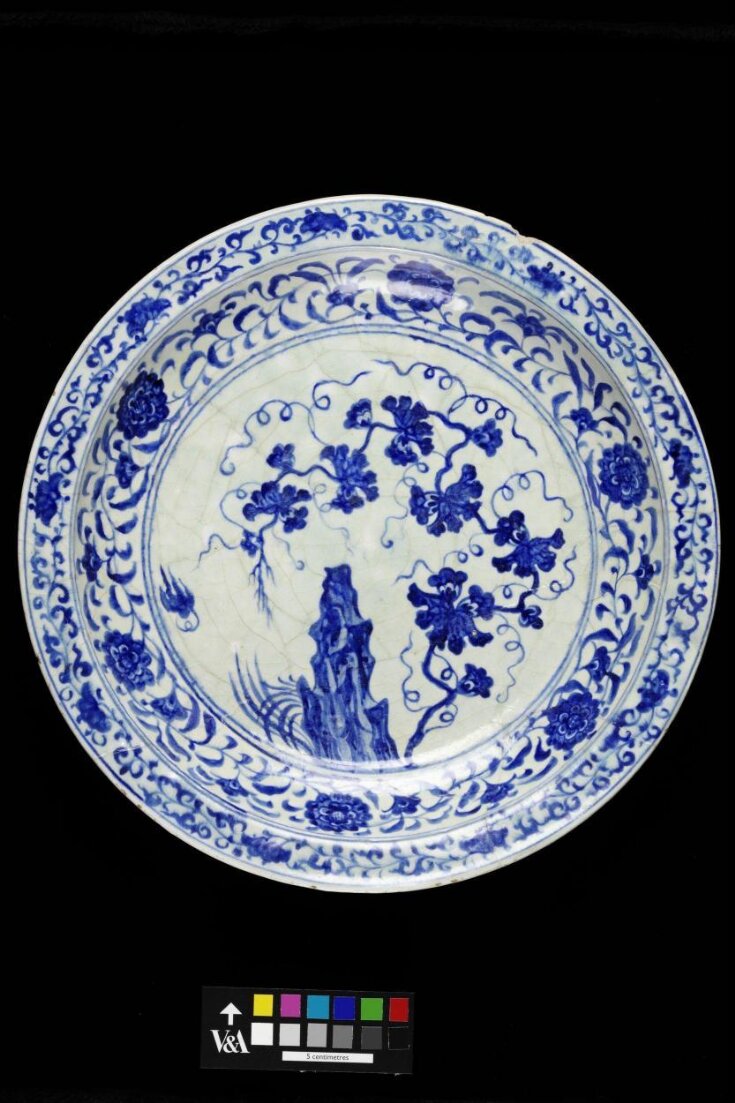
A pottery workshop was established at the court at Samarqand around 1401 under the patronage of Timur, the Uzbek ruler. Timur had invaded Syria, and forced potters from Damascus to move to Samarqand. Timur was a great patron of art and culture, and having established his court, he needed craftsmen to supply luxury wares. At the time, Chinese porcelain was available in sufficient quantities to be used as tablewares for dining, but supplies had ceased with the fall of the Yuan dynasty. This dish is a close copy of Chinese Yuan dynasty originals, possibly imitating examples included in the spoils from his campaigns in Syria.
Fritware shards painted in blue imitating Chinese prototypes have been found in Samarqand (cf. C.189-1911). The petrofabric of this dish reveals that the quartz, a crucial component, was derived from sand rather than the usual river pebbles used in Iranian technology to make the body. This confirms that the potters from Damascus working in Samarqand, had brought their technology with them.
Fritware shards painted in blue imitating Chinese prototypes have been found in Samarqand (cf. C.189-1911). The petrofabric of this dish reveals that the quartz, a crucial component, was derived from sand rather than the usual river pebbles used in Iranian technology to make the body. This confirms that the potters from Damascus working in Samarqand, had brought their technology with them.
Object details
| Categories | |
| Object type | |
| Materials and techniques | Fritware with underglaze painted decoration |
| Brief description | Dish, fritware, underglaze painted in cobalt blue with vine scroll in Chinese style, Uzbekistan (probably Samarqand), 1400-1450. |
| Physical description | Dish, fritware, with flat rim, underglaze painted in cobalt blue under a thick, uneven green-tinged glaze. The decorative scheme after Chinese Yuan and early Ming dynasty originals: the central motif depicting a scholar's rock enclosed by a scrolling vine, possibly convolvulus, with borders of continuous flowering scrolls. |
| Dimensions |
|
| Style | |
| Gallery label |
|
| Object history | In Oliver Watson, 'Islamic Pots in Chinese Style', Burlington Magazine, 1987 (May), pp.304-6, suggested a Syrian origin for this piece. |
| Production | Made by Syrian potters transplanted from Damascus to Samarqand by Timur in 1402. |
| Subject depicted | |
| Summary | A pottery workshop was established at the court at Samarqand around 1401 under the patronage of Timur, the Uzbek ruler. Timur had invaded Syria, and forced potters from Damascus to move to Samarqand. Timur was a great patron of art and culture, and having established his court, he needed craftsmen to supply luxury wares. At the time, Chinese porcelain was available in sufficient quantities to be used as tablewares for dining, but supplies had ceased with the fall of the Yuan dynasty. This dish is a close copy of Chinese Yuan dynasty originals, possibly imitating examples included in the spoils from his campaigns in Syria. Fritware shards painted in blue imitating Chinese prototypes have been found in Samarqand (cf. C.189-1911). The petrofabric of this dish reveals that the quartz, a crucial component, was derived from sand rather than the usual river pebbles used in Iranian technology to make the body. This confirms that the potters from Damascus working in Samarqand, had brought their technology with them. |
| Bibliographic references |
|
| Collection | |
| Accession number | C.206-1984 |
About this object record
Explore the Collections contains over a million catalogue records, and over half a million images. It is a working database that includes information compiled over the life of the museum. Some of our records may contain offensive and discriminatory language, or reflect outdated ideas, practice and analysis. We are committed to addressing these issues, and to review and update our records accordingly.
You can write to us to suggest improvements to the record.
Suggest feedback
You can write to us to suggest improvements to the record.
Suggest feedback
| Record created | October 20, 1998 |
| Record URL |
Download as: JSONIIIF Manifest
