Tomb stone of Antonio and Caterina Maggi da Bassano
Tomb Stone
1520 (made)
1520 (made)
| Artist/Maker | |
| Place of origin |
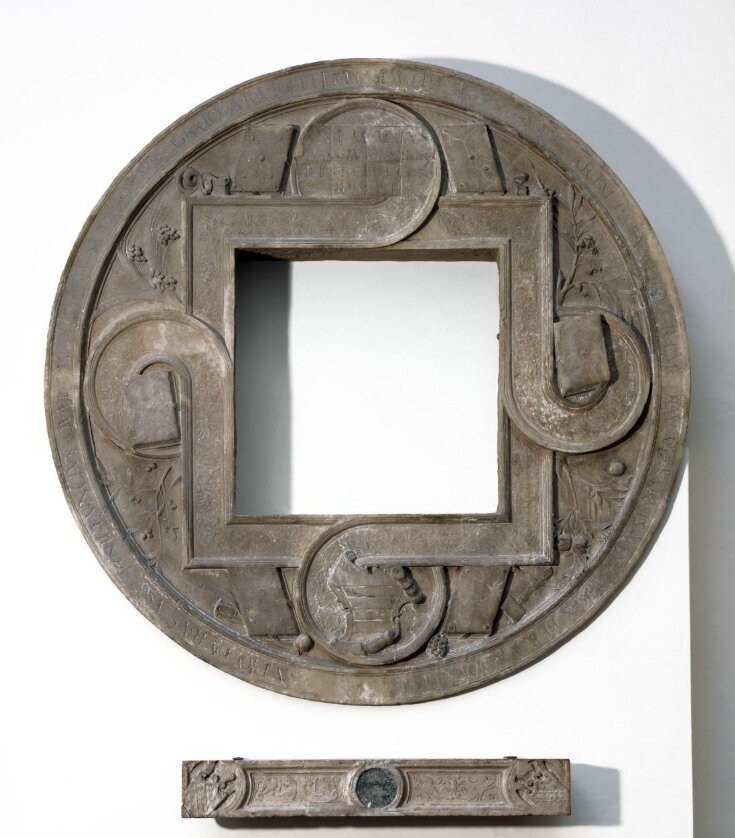
This round frame formed part of a tomb set in the floor of San Pietro delle Monache Benedettine in Padua. The names of the deceased, Antonio and Catharina Maggi da Bassano, a celebrated jurist and his wife are inscribed on the imitation pavement in the upper loop of the frame. It is difficult to determine the original location of the tomb, but it appears from Salamonio’s description that it was near the high altar. The tomb’s original placement near the high altar, its size and the elaborate inscription demonstrate the prestige of Antonio Maggi as the alderman of various towns in the Veneto, all listed on the inscription.
In commissioning this unusual round marker, the lawyer Antonio Maggi da Bassano departed from the typical rectangular tomb slab. The books, serpent, parchment rolls and inkwell are symbols of the scholar, while the hourglass and candlesnuffer remind us of fleeting time and are symbols of mortality. The peach with one leaf was an attribute of Truth and the pine cone symbolised Virtue. The blank space in the middle may once have held an engraved brass panel that gave access to the tomb.
In commissioning this unusual round marker, the lawyer Antonio Maggi da Bassano departed from the typical rectangular tomb slab. The books, serpent, parchment rolls and inkwell are symbols of the scholar, while the hourglass and candlesnuffer remind us of fleeting time and are symbols of mortality. The peach with one leaf was an attribute of Truth and the pine cone symbolised Virtue. The blank space in the middle may once have held an engraved brass panel that gave access to the tomb.
Object details
| Categories | |
| Object type | |
| Parts | This object consists of 4 parts. (Some alternative part names are also shown below)
|
| Title | Tomb stone of Antonio and Caterina Maggi da Bassano (generic title) |
| Materials and techniques | Istrian stone |
| Brief description | Tomb stone, Istrian stone, of Antonio and Catharina Maggi da Bassano, Italy (Padua), 1520 |
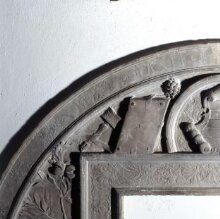
| Physical description | Large circular tomb entrance with a central, square aperture, which is surrounded by a broad frame consisting of four scrolls with raised borders, each scroll carved with foliated ornament in low relief. Across the upper scroll-head the stone has been carved to represent a sheet of paper or parchment nailed to the surface behind. On it is an inscription. To the left of the upper scroll-head appear (1) a book inscribed DECRET on the front cover, (2) two rolls of parchment; (3) an inkwell with a pen standing in it and a cork hanging beside it. Books also appear in the scroll-heads to the right and left of the central aperture. On the lower scroll-head is a shield, charged with the arms of Bassano of Padua (barry of six). To the left of the lower scroll-head is a book inscribed DIGEST on its front cover.; An hour-glass protrudes to the left from beneath the book. Above the hour glass is a scroll inscribed FVGIT. FVGIT. Beneath is a peach. To the right of the lower scroll-head are (1) a book; (2) a candle-snuffer, round whose handle is wrapped a scroll inscribed SIC EXTINGVIMVR OMNES. Beneath is a pine-cone. The whole tomb-stone is enclosed in a broad circular frame which has inlaid in letters of lead the inscription (see second below). The background between the inner and the outer frames is filled with branches of palm, laurel, pomegranate, olive. |
| Dimensions |
|
| Marks and inscriptions |
|
| Object history | Purchased by Robinson in Venice in 1882. In his description for the museum officials, he called it a “…circular frame or architrave surrounding a square tablet of Istrian stone,” with “…a long inscription round the marginal band, a shorter one on a square tablet...” This could suggest that the center, now empty, was once filled. However, he may have been referring to the faux parchment at the top of the tomb slab. The description also included the note that the memorial was originally located in a building of the University of Padua. It is not clear why Robinson later changed this statement in his letter to the Times of 24 October, 1883, in which he claimed that it came from Brescia, and was meant to honour Antonio Maggi Bassiano. In the letter, he also stated that “…the square center of the medallion is missing; it was doubtless an inscribed marble or bronze tablet.” Pope-Hennessy noted that the tomb, with its inscriptions, was described in a 1560 guide to Padua as in the church of San Pietro in Padua. Pope-Hennessy also noted that Giacomo Salamonio recorded “further verses, which seem to have been carved on a tablet set in the square aperture.” (Pope-Hennessy, 514) Though Pope-Hennessy did not mention Robinson’s original description of a square tablet set in the middle, this may have been his source. However, there is no record of such a tablet associated with the tomb slab upon its arrival at the museum. Pope-Hennessy’s theory also may have been inspired by his translation of the verses recorded by Salamonio. In Salamonio’s text, they were printed in italics; perhaps due to having been written in Italian and not Latin. Pope-Hennessy believed that the verses indicated that the tomb was damaged, however they could also refer to the tomb being opened in order to bury further family members. It is difficult to determine the original location of the tomb, but it appears from Salamonio’s description that it was near the high altar. Historical significance: The round format of this tomb slab is highly unusual for an Italian Renaissance tomb. Its innovative shape was noted by Salamonio, who described it as “like a shell.” (Salamonio, 116). The tomb’s original placement near the high altar, its size and the elaborate inscription demonstrate the prestige of Antonio Maggi as the alderman of various towns in the Veneto, all listed on the inscription. The tomb slab is elaborately carved with both decorative and symbolic motifs. The square frame in the center, out of which scroll heads curve at the top, bottom and sides, is covered in a delicate vegetal pattern. The area between the circular border and the square frame is filled with symbolic objects. The iconography relates to Maggi’s life and more general symbols for death. The books inscribed DECRET and DIGEST refer to Maggi’s work as a lawyer and symbolize his knowledge of canon and civil law. The serpent found at the top left might have a variety of meanings. Though generally negative, serpents could also be seen to symbolize wisdom, prudence, logic – all useful qualities for a jurist. It might also be seen as symbolizing Time and death. The box with the open lid might also refer to scholarly work. The peach below the hourglass symbolizes truth. The rolls of parchment and inkwell to the upper right likely refer to Maggi’s work as an alderman or jurist. The hourglass with the scroll inscribed FVGIT, FVGIT (it flees, it flees) refers to the fleeting qualities of time, while the candle snuffer’s scroll is inscribed SIC EXTINGVIMVR OMNES (so all men are extinguished.) Both are therefore memento mori; intended for the viewer to be aware of his or her own temporary existence. The pinecone was a symbol of immortality, but also fertility. The branches of palm in the upper left symbolize victory over death. Laurel, as found in the upper right, was a common symbol for victory. The pomegranate in the lower right symbolizes resurrection, and the olive is the lower left is likely a sign of peace. The coat of arms at the bottom are those of the Maggi family, and balance the faux parchment inscribed with the names of Antonio and Caterina found in the top scroll head. |
| Historical context | Round tomb slabs such as this one are unusual. Pavement tombs were more commonly rectangular. A possible precedent for the form of Maggi’s tomb is found in the tomb marker of Cosimo il Vecchio de’ Medici by Andrea del Verrocchio in the church of San Lorenzo in Florence (c.1464-1467). Cosimo’s tomb marker was series of porphyry and serpentine discs joined by white marble bands and framed in a square. One white marble band creates a circular border, while two others in the form of elongated ovals intersect and frame a porphyry square in the center. Faux parchment inlays at the top and bottom have are inscribed with Cosimo’s name and his status as Pater patriae (a name meaning father of the nation, awarded to him after his death). The Medici arms appear in the four corners of the square. Bronze grates in three squares at the bottom, left and right of the square visually connect the crypt with the upper church. Though Cosimo’s tomb is flat and is made of inlaid stone, the Maggi tomb, though sculptural, evokes its general form. Donatello brought the influence of Florentine sculpture to Padua during his sojourn there from 1443-53. Exchange of ideas also took place during artists’ travels and through pattern books and sketch books.. It is possible that the unknown artist who sculpted Maggi’s tomb had seen Cosimo il Vecchio’s tomb, either in person or in a drawing, and changed the flat forms of the inlay into an updated 16th century sculptural form. On the Maggi tomb, the inside border which appears to curve out of and around the square frame is also reminiscent of patterns found in Cosmati pavements (mosaic inlaid floors popular in churches during the 12th and 13th centuries, though the style was based on earlier Byzantine models). Such pavements often had funereal connotations. Similar patterning appears in the church of San Vitale in Ravenna, where Maggi served as alderman. |
| Subjects depicted | |
| Summary | This round frame formed part of a tomb set in the floor of San Pietro delle Monache Benedettine in Padua. The names of the deceased, Antonio and Catharina Maggi da Bassano, a celebrated jurist and his wife are inscribed on the imitation pavement in the upper loop of the frame. It is difficult to determine the original location of the tomb, but it appears from Salamonio’s description that it was near the high altar. The tomb’s original placement near the high altar, its size and the elaborate inscription demonstrate the prestige of Antonio Maggi as the alderman of various towns in the Veneto, all listed on the inscription. In commissioning this unusual round marker, the lawyer Antonio Maggi da Bassano departed from the typical rectangular tomb slab. The books, serpent, parchment rolls and inkwell are symbols of the scholar, while the hourglass and candlesnuffer remind us of fleeting time and are symbols of mortality. The peach with one leaf was an attribute of Truth and the pine cone symbolised Virtue. The blank space in the middle may once have held an engraved brass panel that gave access to the tomb. |
| Bibliographic references |
|
| Collection | |
| Accession number | 71-1882 |
About this object record
Explore the Collections contains over a million catalogue records, and over half a million images. It is a working database that includes information compiled over the life of the museum. Some of our records may contain offensive and discriminatory language, or reflect outdated ideas, practice and analysis. We are committed to addressing these issues, and to review and update our records accordingly.
You can write to us to suggest improvements to the record.
Suggest feedback
You can write to us to suggest improvements to the record.
Suggest feedback
| Record created | February 17, 2004 |
| Record URL |
Download as: JSONIIIF Manifest
