Tile Panel
17th century (made)
| Place of origin |
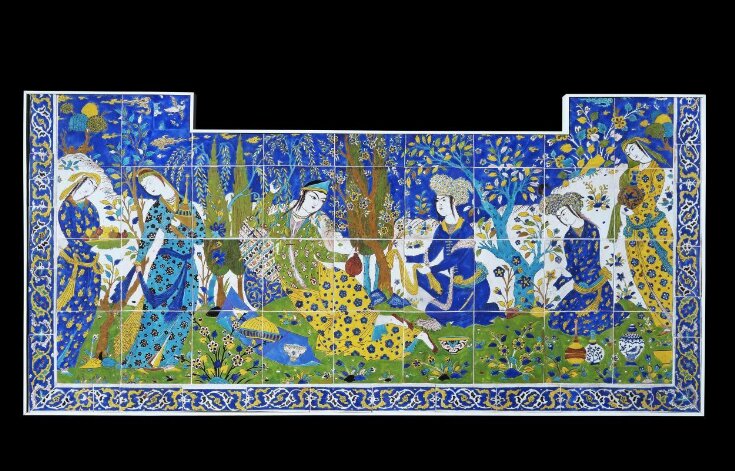
This tile panel covered the lower part of a wall, probably in a palace in Isfahan. It is shaped to fit under a window or niche. It shows a springtime scene of an outdoor entertainment. A young woman is the focus of the composition, surrounded by her attendants.
Object details
| Categories | |
| Object type | |
| Parts | This object consists of 4 parts.
|
| Materials and techniques | Fritware |
| Brief description | A panel of tiles, fritware decorated with coloured glazes, showing a picnic scene, Isfahan, Iran, 1600-1700. |
| Physical description | Tile panel depicting a woman being served with wine and food by her attendants in an outdoor setting in springtime. The tiles have a fritware body covered in a white slip opacified with tin oxide. After the initial firing, the design was set out in the coloured-glaze technique (haftrangi in Persian; a parallel to European cuerda seca), in which each block within the composition was filled with one of a range of coloured glazes, which include cobalt blue, green, black, yellow and turquoise. The details of the faces were painted in in black. As currently reconstructed, a border runs along the bottom and sides of the panel. It has a blue ground and a repeating pattern in which cloud bands (mostly yellow, some white) alternate with vine scroll motifs in black edged with white, all executed as coloured glazes. |
| Dimensions |
|
| Style | |
| Gallery label | Jameel Gallery
Tile Panel with Picnic Scene
Iran, probably Isfahan
1600-1700
Springtime scenes of outdoor meals or entertainments were popular in Safavid art and poetry. Here a young woman is the centre of attention, surrounded by her attendants. The blue-and-white vessels on the ground may be Chinese, or Iranian copies. This tile panel covered the lower part of a wall, probably in a palace in Isfahan. It is shaped to fit under a window or niche.
Earthenware under coloured glazes
Museum no. 139-1891(Jameel Gallery) |
| Object history | According to the register entry, this panel was Bought from L.S. Myers, 6 Savile Row, for £275. H 3'7". The piece is described as a Panel. 36 tiles plus border. Lady in rich garments and diadem reclines in a garden with attendants. Part of dado in Chehel Sotun. Persian, late 16th - early 17th century. The association with the Chihil Sutun is refuted by the observations of 19th-century travellers. For example, Jane Dieulafoy published a reproduction of the panel (p. 239, Panneau de faïence persane, with a cross-reference to p. 254). This depiction of the panel suggests that the blue border originally ran around the whole composition. On p.254, Dieulafoy describes a visit to the Chahar Bagh in Isfahan: En rentrant à Djoulfa, nous avons suivi la grande voie de Tchaar-Bag. Généralement triste et abandonnée, elle reprend quelque animation vers le soir, au moment ou les caravanes se mettent en marche. ... She then imagines how the street would have looked in the 17th century, and how the scene would have been observed by: les yeux de belles khanoums assises dans le balakhané construit en tête de la promenade. She visited this building, the Jahannuma, or Panorama, Pavilion (see Farshid Emami, "All the City's Courtesans"), which was decorated with tile panels of this type: Je suis entrée, en escaladant les terrasses de maisons voisins, dans ce célèbre pavillon et j’ai regardé. ... Malgré la sauvagerie du tableau je n’ai pas eu à regretter mon ascension jusqu’aux étages supérieurs du balakhané. Autour des pièces règnent de magnifiques lambris de faïence. Ces peintures, divisées en tableaux distincts, représentent des scènes d’andéroun traitées avec un incontestable mérite. Vêtus de robes de brocart, coiffées de turbans ou de diadèmes de pierreries, de jeunes femmes sont assises dans des jardins et mangent des chirini (bonbons) et des fruits. Leurs vêtements sont peints en couleurs vives et franches, tandis que les figures ne sont guère plus colorées que les fonds blancs laiteux sur lesquels elles se dessinent. ... Emami claims that other panels of this type in the Metropolitan Museum, New York, and the Musee du Louvre, Paris, are from the same pavilion, but there are notable differences between them. |
| Subjects depicted | |
| Summary | This tile panel covered the lower part of a wall, probably in a palace in Isfahan. It is shaped to fit under a window or niche. It shows a springtime scene of an outdoor entertainment. A young woman is the focus of the composition, surrounded by her attendants. |
| Bibliographic references |
|
| Collection | |
| Accession number | 139:1 to 4-1891 |
About this object record
Explore the Collections contains over a million catalogue records, and over half a million images. It is a working database that includes information compiled over the life of the museum. Some of our records may contain offensive and discriminatory language, or reflect outdated ideas, practice and analysis. We are committed to addressing these issues, and to review and update our records accordingly.
You can write to us to suggest improvements to the record.
Suggest feedback
You can write to us to suggest improvements to the record.
Suggest feedback
| Record created | February 17, 2004 |
| Record URL |
Download as: JSONIIIF Manifest
