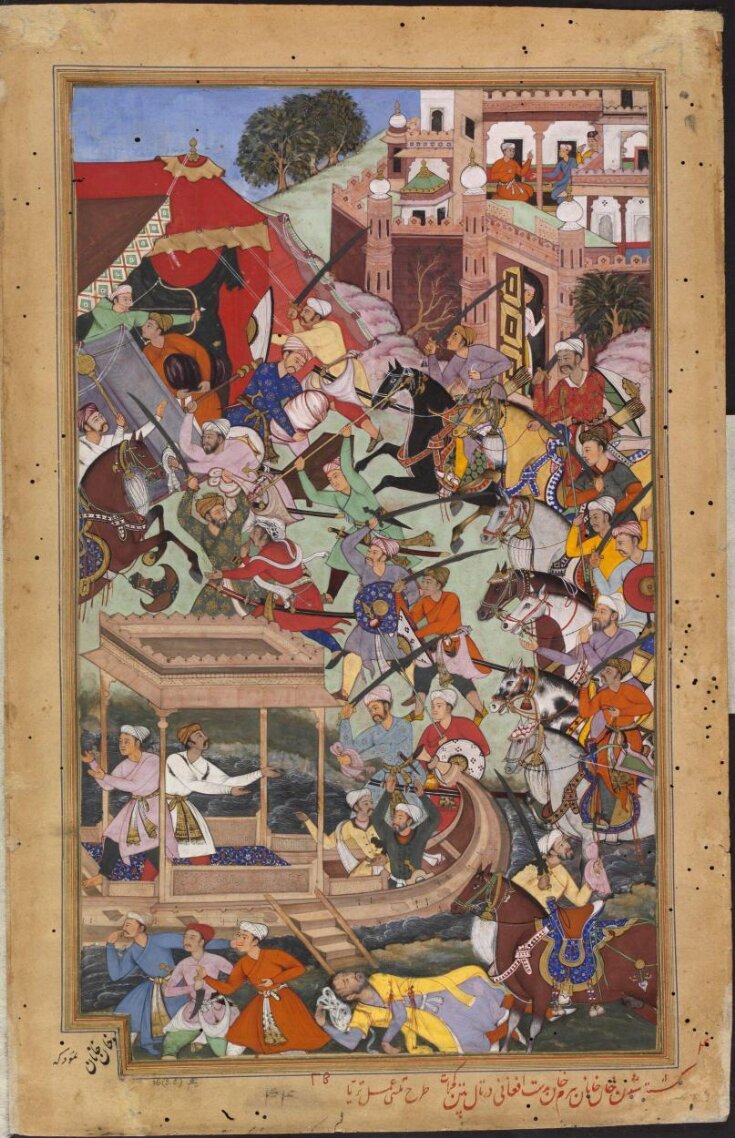

Bairam Khan is Assassinated by an Afghan at Patan
Painting
ca. 1590-95 (made)
ca. 1590-95 (made)
| Artist/Maker | |
| Place of origin |
This illustration to the Akbarnama (Book of Akbar) depicts the assassination of Bairam Khan by Afghans beside the lake at Patan, north-west India, in 1561. Bairam Khan was a general and friend of the emperor Humayun, father of the Mughal emperor Akbar (r.1556–1605). After Akbar inherited the throne at the age of 13 following his father’s sudden death, Bairam Khan guided the young emperor in the early years of his reign. By now, the youth and his former mentor had fallen out and Bairam Khan had been given leave to make the pilgrimage to Mecca. On the way, he was murdered by Afghans. His four-year old son, Abd'ur-Rahim, was later taken into the protection of Akbar and as an adult rose to become the highest-ranking noble of the Mughal hierarchy.
The designer of the composition of this painting was the court artist Tulsi, and Tiriyya painted the details.
The Akbarnama was commissioned by Akbar as the official chronicle of his reign. It was written in Persian by his court historian and biographer, Abu’l Fazl, between 1590 and 1596, and the V&A’s partial copy of the manuscript is thought to have been illustrated between about 1592 and 1595. This is thought to be the earliest illustrated version of the text, and drew upon the expertise of some of the best royal artists of the time. Many of these are listed by Abu’l Fazl in the third volume of the text, the A’in-i Akbari, and some of these names appear in the V&A illustrations, written in red ink beneath the pictures, showing that this was a royal copy made for Akbar himself. After his death, the manuscript remained in the library of his son Jahangir, from whom it was inherited by Shah Jahan.
The V&A purchased the manuscript in 1896 from Frances Clarke, the widow of Major General John Clarke, who bought it in India while serving as Commissioner of Oudh between 1858 and 1862.
The designer of the composition of this painting was the court artist Tulsi, and Tiriyya painted the details.
The Akbarnama was commissioned by Akbar as the official chronicle of his reign. It was written in Persian by his court historian and biographer, Abu’l Fazl, between 1590 and 1596, and the V&A’s partial copy of the manuscript is thought to have been illustrated between about 1592 and 1595. This is thought to be the earliest illustrated version of the text, and drew upon the expertise of some of the best royal artists of the time. Many of these are listed by Abu’l Fazl in the third volume of the text, the A’in-i Akbari, and some of these names appear in the V&A illustrations, written in red ink beneath the pictures, showing that this was a royal copy made for Akbar himself. After his death, the manuscript remained in the library of his son Jahangir, from whom it was inherited by Shah Jahan.
The V&A purchased the manuscript in 1896 from Frances Clarke, the widow of Major General John Clarke, who bought it in India while serving as Commissioner of Oudh between 1858 and 1862.
Object details
| Categories | |
| Object type | |
| Title | Bairam Khan is Assassinated by an Afghan at Patan |
| Materials and techniques | Painted in opaque watercolour and gold on paper |
| Brief description | Painting, Akbarnama, The assassination of Bairam Khan by Afghans, outline by Tulsi, painting by Tiriyya, opaque watercolour and gold on paper, Mughal, ca. 1590-95 |
| Physical description | Depicts the assassination of Bairam Khan (regent to the boy emperor Akbar) by Afghans beside the lake at Patan, in 1561. |
| Dimensions |
|
| Styles | |
| Marks and inscriptions | (Contemporary librarian's attribution in Persian written beneath the image at the bottom of the page in red ink)
|
| Credit line | Purchased from Mrs. Clarke, The Dingle, Sydenham Hill, S. E |
| Object history | The Akbarnama, or "Book of Akbar", was commissioned by the emperor Akbar as the official chronicle of his reign. It was written by 1590 and 1596 and is thought to have been illustrated between ca. 1592 and 1594 by at least forty-nine different artists from Akbar's studio. After Akbar's death in 1605, the manuscript remained in the library of his son, Jahangir (r.1605-1627) and later Shah Jahan (r.1628-1658). The Victoria and Albert Museum purchased it in 1896 from Mrs. Frances Clarke, the widow of Major General John Clarke, an official who had been the Commissioner in Oudh province between 1858 and 1862. Historical significance: It is thought to be the first illustrated copy of the Akbarnama. It drew upon the expertise of some of the best royal painters of the time, many of whom receive special mention by Abu'l Fazl in the A'in-i-Akbari, the third volume of the Akbarnama. The inscriptions in red ink on the bottom of the paintings refer to the artists and indicate that this was a royal copy. Purchased from Mrs. Clarke, The Dingle, Sydenham Hill, S. E. This acquisition information reflects that found in the Museum records (Asia Department registers and/or Central Inventory) as part of a 2023 provenance research project. Registered Papers: 85488/95 |
| Production | Composition by Tulsi; painting by Tiriyya |
| Subjects depicted | |
| Place depicted | |
| Association | |
| Literary reference | Akbarnama |
| Summary | This illustration to the Akbarnama (Book of Akbar) depicts the assassination of Bairam Khan by Afghans beside the lake at Patan, north-west India, in 1561. Bairam Khan was a general and friend of the emperor Humayun, father of the Mughal emperor Akbar (r.1556–1605). After Akbar inherited the throne at the age of 13 following his father’s sudden death, Bairam Khan guided the young emperor in the early years of his reign. By now, the youth and his former mentor had fallen out and Bairam Khan had been given leave to make the pilgrimage to Mecca. On the way, he was murdered by Afghans. His four-year old son, Abd'ur-Rahim, was later taken into the protection of Akbar and as an adult rose to become the highest-ranking noble of the Mughal hierarchy. The designer of the composition of this painting was the court artist Tulsi, and Tiriyya painted the details. The Akbarnama was commissioned by Akbar as the official chronicle of his reign. It was written in Persian by his court historian and biographer, Abu’l Fazl, between 1590 and 1596, and the V&A’s partial copy of the manuscript is thought to have been illustrated between about 1592 and 1595. This is thought to be the earliest illustrated version of the text, and drew upon the expertise of some of the best royal artists of the time. Many of these are listed by Abu’l Fazl in the third volume of the text, the A’in-i Akbari, and some of these names appear in the V&A illustrations, written in red ink beneath the pictures, showing that this was a royal copy made for Akbar himself. After his death, the manuscript remained in the library of his son Jahangir, from whom it was inherited by Shah Jahan. The V&A purchased the manuscript in 1896 from Frances Clarke, the widow of Major General John Clarke, who bought it in India while serving as Commissioner of Oudh between 1858 and 1862. |
| Bibliographic reference | Shakeel Hossain and Deeti Ray, Celebrating Abdur Rahim Khan-i-khanan, Interglobe Foundation/Aga Khan Trust for Culture in association with Mapin Publishing, Ahmedabad, 2017, illustrated p. 57. |
| Other number | 85 - Inscription/original number |
| Collection | |
| Accession number | IS.2:5-1896 |
About this object record
Explore the Collections contains over a million catalogue records, and over half a million images. It is a working database that includes information compiled over the life of the museum. Some of our records may contain offensive and discriminatory language, or reflect outdated ideas, practice and analysis. We are committed to addressing these issues, and to review and update our records accordingly.
You can write to us to suggest improvements to the record.
Suggest feedback
You can write to us to suggest improvements to the record.
Suggest feedback
| Record created | October 6, 1998 |
| Record URL |
Download as: JSONIIIF Manifest
