The Dormition of the Virgin and Saints
Panel
late 10th century to early 11th century (carving)
late 10th century to early 11th century (carving)
| Artist/Maker | |
| Place of origin |
This is a Byzantine ivory panel made in Constantinople in the late 10th or early 11th century. The plaque formed once the centre of a triptych.
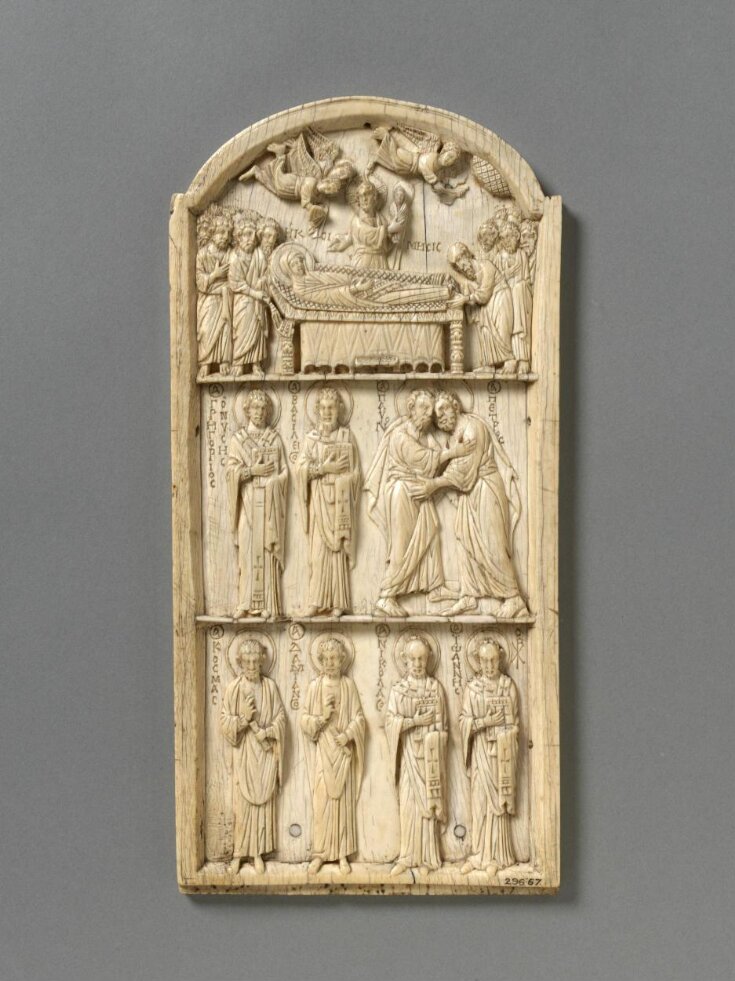
This panel depicts the Dormition of the Virgin. At the top of the Dormition, Christ stands behind the Virgin's bed, taking her soul up to Heaven. In the middle row are Sts. Gregory of Nyssa, Basil, Paul and Peter; at the bottom Sts. Cosmas, Damian, Nicholas and John Chrysostom.
The Death of the Virgin is depicted at the top, a scene which does not show the moment of the Virgin's death but the moment at which Christ comes to take away her soul after death. The story of the Death of the Virgin comes from the Apocryphal New Testament and appears very often in Byzantine art; its importance is reflected in the dominant place it often occupies in church decoration, on the west wall of the building. The basic format of the scene varies little over centuries. Standing saints appear very frequently in all forms of Byzantine art; here they are arranged not according to the calendar but according to their hierarchical order as found in the liturgy. Sts Paul and Peter embracing is very unusual in Byzantine Art and was probably taken over from western examples. In the present context it is likely to represent the saints' final meeting before martyrdom, juxtaposed with the Virgin's death on the level above.
This panel depicts the Dormition of the Virgin. At the top of the Dormition, Christ stands behind the Virgin's bed, taking her soul up to Heaven. In the middle row are Sts. Gregory of Nyssa, Basil, Paul and Peter; at the bottom Sts. Cosmas, Damian, Nicholas and John Chrysostom.
The Death of the Virgin is depicted at the top, a scene which does not show the moment of the Virgin's death but the moment at which Christ comes to take away her soul after death. The story of the Death of the Virgin comes from the Apocryphal New Testament and appears very often in Byzantine art; its importance is reflected in the dominant place it often occupies in church decoration, on the west wall of the building. The basic format of the scene varies little over centuries. Standing saints appear very frequently in all forms of Byzantine art; here they are arranged not according to the calendar but according to their hierarchical order as found in the liturgy. Sts Paul and Peter embracing is very unusual in Byzantine Art and was probably taken over from western examples. In the present context it is likely to represent the saints' final meeting before martyrdom, juxtaposed with the Virgin's death on the level above.
Object details
| Categories | |
| Object type | |
| Title | The Dormition of the Virgin and Saints (generic title) |
| Materials and techniques | Elephant ivory |
| Brief description | Panel, ivory, depicting the Dormition of the Virgin and Saints, Byzantine (Constantinople), late 10th or early 11th century |
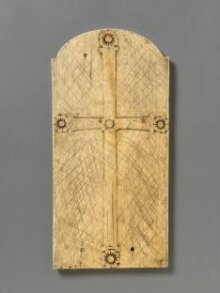
| Physical description | An ivory panel with three registers / sections: At the top, the "Koimesis" or Death (Dormition) of the Virgin, when Christ comes to take away the soul of the Virgin after her death. She lies on her death bed, surrounded by the apostles (there are actually thirteen heads depicted), with St Paul at the foot of the bed and St. Peter swinging a censer. Christ stands behind the bed, holding up the personification of the Virgin's soul (restored). Two angels fly down on the left and a third flies up to heaven. Inscriptions above the bed. In teh middle section are St. Gregory of Nyssa and St Basil, and St Paul and St Peter embracing. On the bottom row are Sts Cosmas and Damian, St Nicholas and St John Chrysostom identified by inscriptions. On the back is a large cross with rosettes at the ends of the arms (a cross is frequently carved on the back of Byzantine ivories). |
| Dimensions |
|
| Style | |
| Marks and inscriptions | 'H KOIMHCIC' (Incised above of the bed of the Virgin)
|
| Object history | Formerly in the Webb collection. Acquired in 1867. This plaque formed once the centre of a triptych. Historical significance: The Death of the Virgin is depicted at the top, a scene which does not show the moment of the Virgin's death but the moment at which Christ comes to take away her soul after death. The story of the Death of the Virgin comes from the Apocryphal New Testament and appears very often in Byzantine art; its importance is reflected in the dominant place it often occupies in church decoration, on the west wall of the building. The basic format of the scene varies little over centuries. Standing saints appear very frequently in all forms of Byzantine art; here they are arranged not according to the calendar but according to their hierarchical order as found in the liturgy. Sts Paul and Peter embracing is very unusual in Byzantine Art and was probably taken over from western examples. In the present context it is likely to represent the saints' final meeting before martyrdom, juxtaposed with the Virgin's death on the level above. |
| Historical context | The plaque exemplifies the style of the so-called 'Nikephoros Group', named by Goldschmidt and Weitzmann after the ivory panel on the Cortona Reliquary of the True Cross, which is associated by inscription with the Emperor Nikephoros II Phocas. It displays a distinctive stylistic homogeneity, with a rough but monumental style of carving and with broad and blunt facial features. |
| Subjects depicted | |
| Literary reference | Apocryphs |
| Summary | This is a Byzantine ivory panel made in Constantinople in the late 10th or early 11th century. The plaque formed once the centre of a triptych. This panel depicts the Dormition of the Virgin. At the top of the Dormition, Christ stands behind the Virgin's bed, taking her soul up to Heaven. In the middle row are Sts. Gregory of Nyssa, Basil, Paul and Peter; at the bottom Sts. Cosmas, Damian, Nicholas and John Chrysostom. The Death of the Virgin is depicted at the top, a scene which does not show the moment of the Virgin's death but the moment at which Christ comes to take away her soul after death. The story of the Death of the Virgin comes from the Apocryphal New Testament and appears very often in Byzantine art; its importance is reflected in the dominant place it often occupies in church decoration, on the west wall of the building. The basic format of the scene varies little over centuries. Standing saints appear very frequently in all forms of Byzantine art; here they are arranged not according to the calendar but according to their hierarchical order as found in the liturgy. Sts Paul and Peter embracing is very unusual in Byzantine Art and was probably taken over from western examples. In the present context it is likely to represent the saints' final meeting before martyrdom, juxtaposed with the Virgin's death on the level above. |
| Bibliographic references |
|
| Collection | |
| Accession number | 296-1867 |
About this object record
Explore the Collections contains over a million catalogue records, and over half a million images. It is a working database that includes information compiled over the life of the museum. Some of our records may contain offensive and discriminatory language, or reflect outdated ideas, practice and analysis. We are committed to addressing these issues, and to review and update our records accordingly.
You can write to us to suggest improvements to the record.
Suggest feedback
You can write to us to suggest improvements to the record.
Suggest feedback
| Record created | February 11, 2004 |
| Record URL |
Download as: JSONIIIF Manifest
