Memento Mori pendents
Rosary Bead
ca. 1520-1530 (made)
ca. 1520-1530 (made)
| Place of origin |
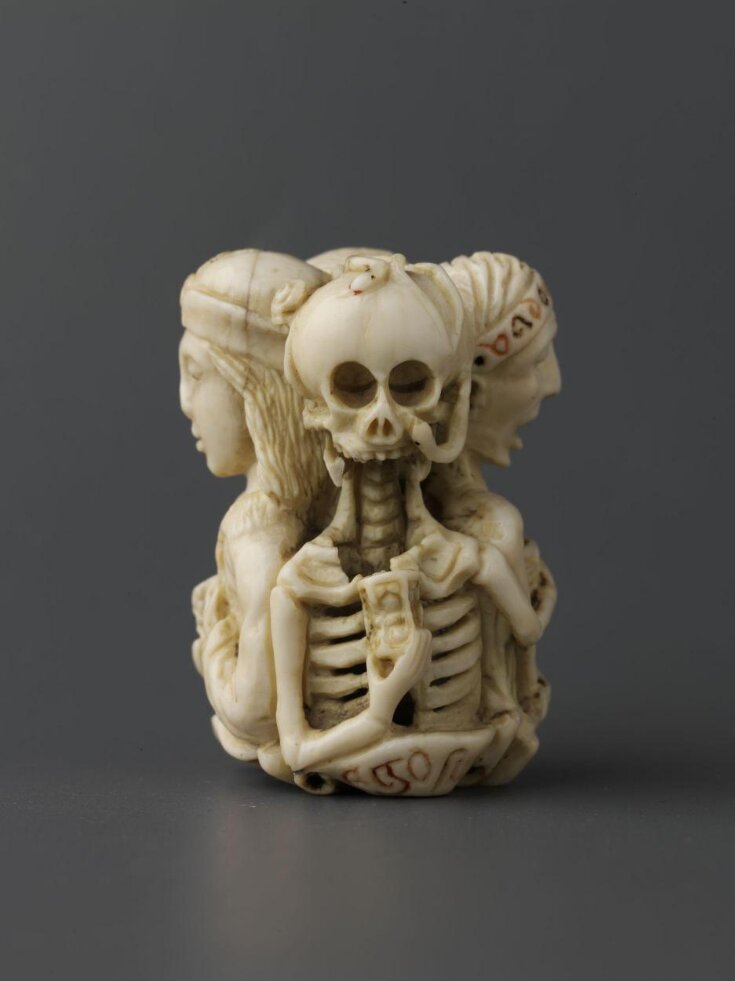
This small ivory carving conveys one of the most profound themes of the late Middle Ages, serving as a memento mori, a reminder of the transitory nature of life and the inevitability of death.
The repetition of prayers and liturgical texts was an important part of late medieval devotion. The rosary, which became popular by the fourteenth century, is a collection of these texts devoted particularly to the Virgin Mary. Strings of beads to assist those saying the long sequences of recitations also came to be known as rosaries. Such carvings as this one are pierced vertically for suspension, consistent with their original function as pendants to rosaries or chaplets (shorter strings of devotional beads).
Dating from the late Middle Ages through the seventeenth century, there are many surviving memento mori pendants from rosaries. Frequently double-sided, the pendants are often decorated with a skull on one side and a youthful face on the other. This is a rare example of a pendant showing four figures and no close analogue is known.
The words inscribed on the fillet encircling the dying man's brow, VADO MORI, may be an allusion to the tradition of 'Vado Mori' poems which had their origin in the thirteenth century. In such poems, or 'carmina de morte', a distich is put into the mouth of each type of individual, young and old, poor and rich, learned and unlearned, layman and cleric, of low and high social grade. Each distich begins and ends with the words 'Vado Mori'.
It is likely to have been hung asa pendant to a chaplet.
The repetition of prayers and liturgical texts was an important part of late medieval devotion. The rosary, which became popular by the fourteenth century, is a collection of these texts devoted particularly to the Virgin Mary. Strings of beads to assist those saying the long sequences of recitations also came to be known as rosaries. Such carvings as this one are pierced vertically for suspension, consistent with their original function as pendants to rosaries or chaplets (shorter strings of devotional beads).
Dating from the late Middle Ages through the seventeenth century, there are many surviving memento mori pendants from rosaries. Frequently double-sided, the pendants are often decorated with a skull on one side and a youthful face on the other. This is a rare example of a pendant showing four figures and no close analogue is known.
The words inscribed on the fillet encircling the dying man's brow, VADO MORI, may be an allusion to the tradition of 'Vado Mori' poems which had their origin in the thirteenth century. In such poems, or 'carmina de morte', a distich is put into the mouth of each type of individual, young and old, poor and rich, learned and unlearned, layman and cleric, of low and high social grade. Each distich begins and ends with the words 'Vado Mori'.
It is likely to have been hung asa pendant to a chaplet.
Object details
| Categories | |
| Object type | |
| Title | Memento Mori pendents (generic title) |
| Materials and techniques | Carved elephant ivory with traces of red and black paint |
| Brief description | Pendant, memento mori from a chaplet or rosary, ivory with traces of red and black paint, formed of four half-length figures placed back to back, northern France or South Netherlands, ca. 1520-1530 |
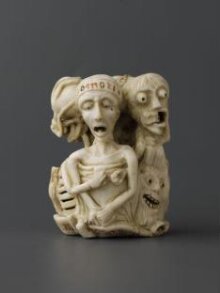
| Physical description | Bead from a chaplet or rosary; carved ivory with traces of red and black paint. Formed of four half-length figures placed back to back. One represents a young man in the costume of the time with cap turned up and jewelled and a fur-collared jacket over a pleated shirt; underneath a scroll is incised with the words 'AMOR M(un)DI' (Love of the World), the letters colored alternately black and red. At his back is the same person dying, his figure emaciated, with ribcage visible beneath the skin and an open mouth as if gasping for breath; on a fillet the words 'VADO MORI' (I am going to die). The third figure appears to be a devil, or imp with bulging eyes and lolling tongue, the stomach filled with a hideous head. This figure has locked arms with the dying figure as if to pull him away; underneath on a scroll is 'SEQUERE ME' (Follow me). The fourth is a skeleton (Death) holding an hourglass in his right and reaching across to grab the chest of the figure with his left hand; underneath is 'EGO SUM' (I am). A snail and snakes crawl over the skull. The pendant is pierced vertically for suspension. |
| Dimensions |
|
| Marks and inscriptions |
|
| Object history | In the collection of Ralph Bernal, MP (1783-1854), London; Acquired from the Bernal Collection (Sale, Christie & Manson, London, 21 March, 1855, lot No. 1635), for £8 10s. Historical significance: The words inscribed on the fillet encircling the dying man's brow, VADO MORI, may be an allusion to the tradition of 'Vado Mori' poems which had their origin in the thirteenth century. In such poems, or 'carmina de morte', a distich is put into the mouth of each type of individual, young and old, poor and rich, learned and unlearned, layman and cleric, of low and high social grade. Each distich begins and ends with the words 'Vado Mori'. For example, in one such poem, the physician and logician say respectively - "Vado mori medicus, medicamine non redimendus, Quid quid agat medici pocio.Vado mori" "Vado mori logicus; aliis concludere novi. Conclusit breviter mors michi: vado mori" Approximate translation: "I the doctor hurry to die, no medicine will help me, Whatever potion I take, I hurry to die." "I the logician hurry to die; I have learned to 'conclude' in a different way. Death ends me quickly: I hurry to die" Like the 'Dance of Death' motif, these poems stress death as the great leveller , which will come to us all. |
| Historical context | This small ivory carving conveys one of the most profound themes of the late Middle Ages, serving as a memento mori, a reminder of the transitory nature of life and the inevitability of death. The repetition of prayers and liturgical texts was an important part of late medieval devotion. The rosary, which became popular by the fourteenth century, is a collection of these texts devoted particularly to the Virgin Mary. Strings of beads to assist those saying the long sequences of recitations also came to be known as rosaries. Such carvings as this one are pierced vertically for suspension, consistent with their original function as pendants to rosaries or chaplets (shorter strings of devotional beads). Dating from the late Middle Ages through the seventeenth century, there are many surviving memento mori pendants from rosaries. Frequently double-sided, the pendants are often decorated with a skull on one side and a youthful face on the other. This is a rare example of a pendant showing four figures and no close analogue is known, although it has been compared to pendants showing three figures: an embracing couple on one side and a figure of death on the reverse (e.g. Metropolitan Museum of Art, New York, 17.190.305, see Images in Ivory: Precious Objects of the Gothic Age, Princeton, 1997, pp 277-78, No. 79). |
| Subjects depicted | |
| Summary | This small ivory carving conveys one of the most profound themes of the late Middle Ages, serving as a memento mori, a reminder of the transitory nature of life and the inevitability of death. The repetition of prayers and liturgical texts was an important part of late medieval devotion. The rosary, which became popular by the fourteenth century, is a collection of these texts devoted particularly to the Virgin Mary. Strings of beads to assist those saying the long sequences of recitations also came to be known as rosaries. Such carvings as this one are pierced vertically for suspension, consistent with their original function as pendants to rosaries or chaplets (shorter strings of devotional beads). Dating from the late Middle Ages through the seventeenth century, there are many surviving memento mori pendants from rosaries. Frequently double-sided, the pendants are often decorated with a skull on one side and a youthful face on the other. This is a rare example of a pendant showing four figures and no close analogue is known. The words inscribed on the fillet encircling the dying man's brow, VADO MORI, may be an allusion to the tradition of 'Vado Mori' poems which had their origin in the thirteenth century. In such poems, or 'carmina de morte', a distich is put into the mouth of each type of individual, young and old, poor and rich, learned and unlearned, layman and cleric, of low and high social grade. Each distich begins and ends with the words 'Vado Mori'. It is likely to have been hung asa pendant to a chaplet. |
| Bibliographic references |
|
| Collection | |
| Accession number | 2149-1855 |
About this object record
Explore the Collections contains over a million catalogue records, and over half a million images. It is a working database that includes information compiled over the life of the museum. Some of our records may contain offensive and discriminatory language, or reflect outdated ideas, practice and analysis. We are committed to addressing these issues, and to review and update our records accordingly.
You can write to us to suggest improvements to the record.
Suggest feedback
You can write to us to suggest improvements to the record.
Suggest feedback
| Record created | February 11, 2004 |
| Record URL |
Download as: JSONIIIF Manifest
