Dish
ca. 1700 (made)
| Artist/Maker | |
| Place of origin |
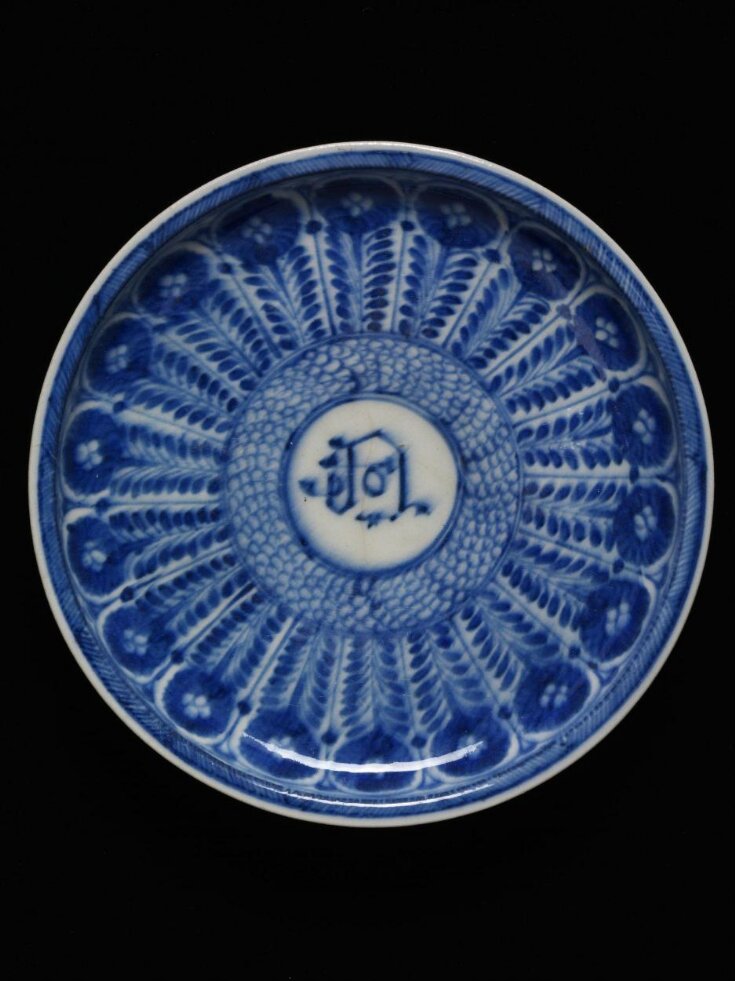
There are a number of dishes painted with Nazaret, a name attributed to khawaje Nazar (d.1636 [Kurdian]), who was the head of the Armenian community in New Julfa, or a descendent. The pattern was based on a Chinese prototype, which is often associated with the Islamic market, but examples have been found in the Americas and elsewhere.
Object details
| Category | |
| Object type | |
| Materials and techniques | Fritware, painted and glazed |
| Brief description | Dish, fritware, painted in underglaze blue with the 'Aster pattern' after a Chinese pattern, the centre incorporating an Armenian merchant's monogram, Iran, ca. 1700 |
| Physical description | Dish, fritware. The dish has a small flange with a bands of hatchings grouped in alternating directions. Eighteen panels with asters at the end of stems with parallel leaves, surround a band of sketchy scales. An Armenian monogram, painted within the band, can be read as Nazaret. A very loose scroll of nodescript flowers and tadpole leaves surround the outside with a plain white band above the base ring There is no mark. |
| Dimensions |
|
| Style | |
| Marks and inscriptions | (There are a number of dishes painted with Nazaret, a name attributed to khawaje Nazar, the head of the Armenian community in New Julfa, who died in 1636 [Kurdian], or a descendent.)
|
| Gallery label |
|
| Object history | Historical significance: Thus dish is part of a small group of wares commisioned by or for members of the Armenian community living in New Julfa, outside Isfahan. |
| Summary | There are a number of dishes painted with Nazaret, a name attributed to khawaje Nazar (d.1636 [Kurdian]), who was the head of the Armenian community in New Julfa, or a descendent. The pattern was based on a Chinese prototype, which is often associated with the Islamic market, but examples have been found in the Americas and elsewhere. |
| Bibliographic reference | Y. Crowe, Persia and China. Safavid Blue and White Ceramics in the Victoria and Albert Museum 1501-1738, London, Thames & Hudson, 2002, p.240; no. 423. |
| Collection | |
| Accession number | 2715-1876 |
About this object record
Explore the Collections contains over a million catalogue records, and over half a million images. It is a working database that includes information compiled over the life of the museum. Some of our records may contain offensive and discriminatory language, or reflect outdated ideas, practice and analysis. We are committed to addressing these issues, and to review and update our records accordingly.
You can write to us to suggest improvements to the record.
Suggest feedback
You can write to us to suggest improvements to the record.
Suggest feedback
| Record created | September 29, 1998 |
| Record URL |
Download as: JSONIIIF Manifest
