Ewer
1540-1550 (made)
| Artist/Maker | |
| Place of origin |
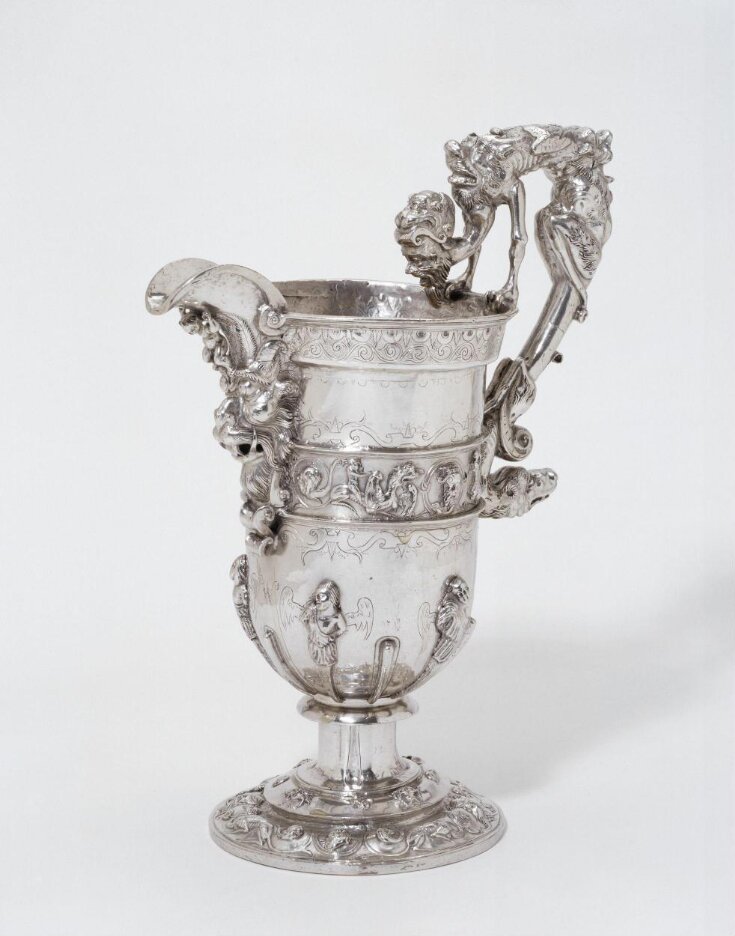
The cylindrical body, prominent, curved, spout and curving handle of this ewer are characteristic of sixteenth and seventeenth-century Spanish jugs, particularly those produced in Seville. However, the winged women, bearded heads enclosed in roundels, and monstrous figures that decorate the body and handle of this example are more characteristic of goldsmiths' work from Cuenca (central Spain). The combination of styles means the ewer has been attributed to Juan Ruiz el Vandalino, asixteenth-century goldsmith who worked in both Cuenca and Seville.
Contemporaries referred to this type of ewer as a 'jarro de pico' (literally 'pointed/spouted jug'). They were commonly used in a domestic setting, either as water jugs at table or, when paired with a basin, as ewers for handwashing.
Contemporaries referred to this type of ewer as a 'jarro de pico' (literally 'pointed/spouted jug'). They were commonly used in a domestic setting, either as water jugs at table or, when paired with a basin, as ewers for handwashing.
Object details
| Categories | |
| Object type | |
| Materials and techniques | Silver, raised, embossed and chased. |
| Brief description | Ewer, silver, cylindrical body on a low, circular foot, embossed with monsters and roundels enclosing heads, the curved handle in the form of a vomiting monster. Unmarked. |
| Physical description | Cylindrical body with flanged lip engraved with foliage, the body with embossed band with monsters and roundels enclosing heads, curved spout and a handle of human and animal grotesque, stepped base chased with masks. |
| Dimensions |
|
| Style | |
| Marks and inscriptions |
|
| Gallery label |
|
| Credit line | Dr W.L. Hildburgh Bequest |
| Production | Toledo or Cuenca, Castilla La Mancha |
| Summary | The cylindrical body, prominent, curved, spout and curving handle of this ewer are characteristic of sixteenth and seventeenth-century Spanish jugs, particularly those produced in Seville. However, the winged women, bearded heads enclosed in roundels, and monstrous figures that decorate the body and handle of this example are more characteristic of goldsmiths' work from Cuenca (central Spain). The combination of styles means the ewer has been attributed to Juan Ruiz el Vandalino, asixteenth-century goldsmith who worked in both Cuenca and Seville. Contemporaries referred to this type of ewer as a 'jarro de pico' (literally 'pointed/spouted jug'). They were commonly used in a domestic setting, either as water jugs at table or, when paired with a basin, as ewers for handwashing. |
| Bibliographic references |
|
| Collection | |
| Accession number | M.471-1956 |
About this object record
Explore the Collections contains over a million catalogue records, and over half a million images. It is a working database that includes information compiled over the life of the museum. Some of our records may contain offensive and discriminatory language, or reflect outdated ideas, practice and analysis. We are committed to addressing these issues, and to review and update our records accordingly.
You can write to us to suggest improvements to the record.
Suggest feedback
You can write to us to suggest improvements to the record.
Suggest feedback
| Record created | February 9, 2004 |
| Record URL |
Download as: JSONIIIF Manifest
