Balance Standard
1550-1600 (made)
| Artist/Maker | |
| Place of origin |
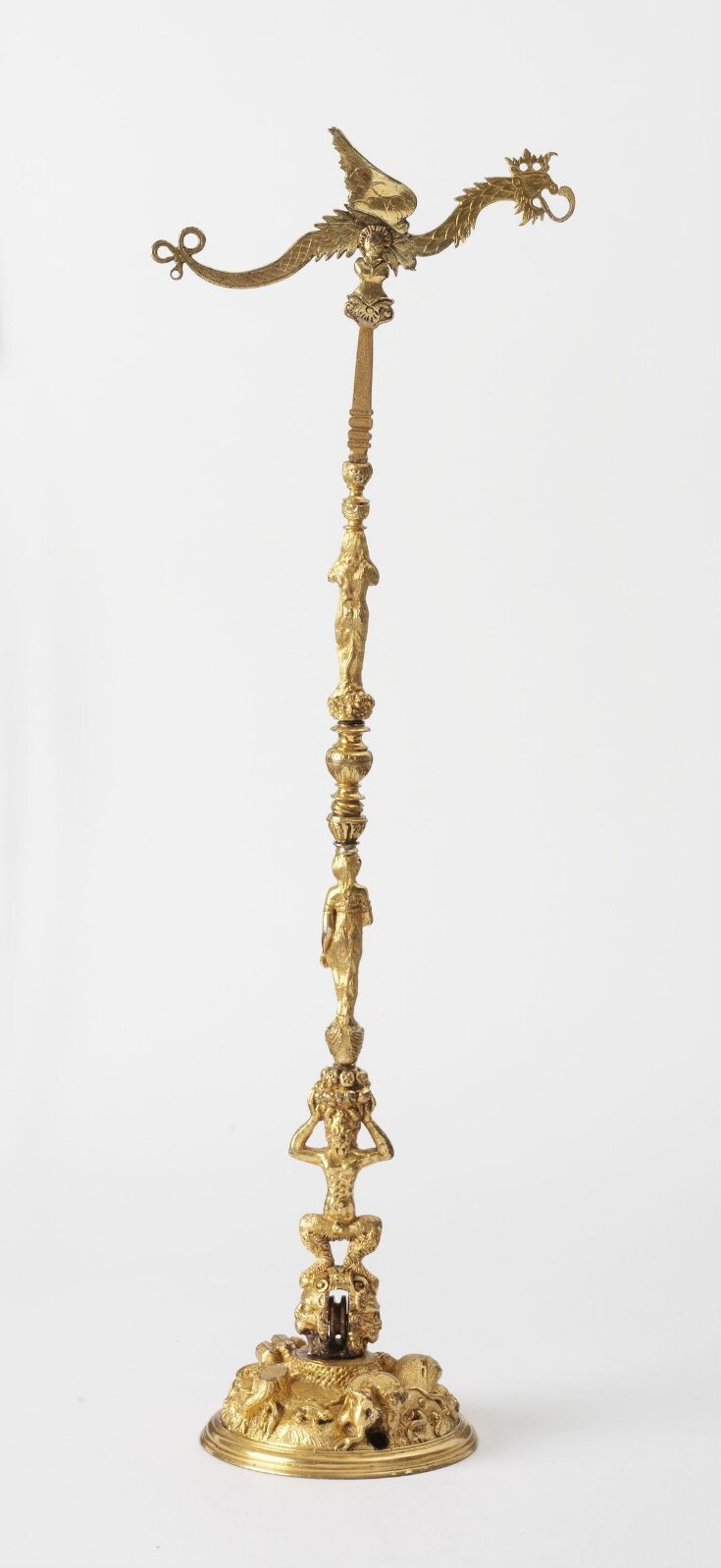
Goldsmiths used a balance standard to weigh out amounts of silver and gold in the workshop. This one has a stem supporting an arm in the shape of a dragon poised on a central pivot, with holes for supporting weights at one end and a hook for hanging the weighing pan at the other.
The base crawls with snakes, a frog, snail and twisted tree roots, possibly inspired by the innovative techniques of the Nuremberg goldsmith, Wenzel Jamnitzer, who made silver casts of real insects, shells and plants. The baby clutching a skull is perhaps a symbol of the vanity of human life, a much-depicted theme of the period.
The base crawls with snakes, a frog, snail and twisted tree roots, possibly inspired by the innovative techniques of the Nuremberg goldsmith, Wenzel Jamnitzer, who made silver casts of real insects, shells and plants. The baby clutching a skull is perhaps a symbol of the vanity of human life, a much-depicted theme of the period.
Object details
| Categories | |
| Object type | |
| Materials and techniques | Gilt bronze, cast and chiselled |
| Brief description | Scientific instrument |
| Physical description | Gilt bronze with circular base, cast and chiselled with a putto, its hand resting on a skull, the standard composed of three figures with vases between, the figure of a crowned dragon on top with a hook |
| Dimensions |
|
| Marks and inscriptions | Unmarked |
| Gallery label | Silver Gallery:
Goldsmiths used a balance standard to weigh out amounts of silver and gold in the workshop. This one has a stem supporting an arm in the shape of a dragon poised on a central pivot, with holes for supporting weights at one end and a hook for hanging the weighing pan at the other. The base crawls with snakes, a frog, snail and twisted tree roots, possibly inspired by the innovative techniques of the Nuremberg goldsmith, Wenzel Jamnitzer, who made casts of insects, shells and plants. The baby clutching a skull is perhaps a symbol of the vanity of human life, a much-depicted theme of the period.(26/11/2002) |
| Credit line | Given by Mrs M. Russell |
| Object history | Acquisition RF: 53/3486 Russell Gift (Bought from the Rosenheim Collection) Exhibitions: Burlington Arts Club, 1906 Sold Sotheby's May 9 - 11/1923, Lot 400; a similar example in the Cleveland Museum is complete with scales. See Helen S. Foote 'Goldsmiths' scales in gilt bronze' Bulletin of the Cleveland Museum of Art, Vol. XLI (1954) pp. 26-28 |
| Production | Possibly inspired by the work of the Jamnitzer workshop in Nuremberg |
| Subjects depicted | |
| Summary | Goldsmiths used a balance standard to weigh out amounts of silver and gold in the workshop. This one has a stem supporting an arm in the shape of a dragon poised on a central pivot, with holes for supporting weights at one end and a hook for hanging the weighing pan at the other. The base crawls with snakes, a frog, snail and twisted tree roots, possibly inspired by the innovative techniques of the Nuremberg goldsmith, Wenzel Jamnitzer, who made silver casts of real insects, shells and plants. The baby clutching a skull is perhaps a symbol of the vanity of human life, a much-depicted theme of the period. |
| Collection | |
| Accession number | M.121-1953 |
About this object record
Explore the Collections contains over a million catalogue records, and over half a million images. It is a working database that includes information compiled over the life of the museum. Some of our records may contain offensive and discriminatory language, or reflect outdated ideas, practice and analysis. We are committed to addressing these issues, and to review and update our records accordingly.
You can write to us to suggest improvements to the record.
Suggest feedback
You can write to us to suggest improvements to the record.
Suggest feedback
| Record created | February 9, 2004 |
| Record URL |
Download as: JSONIIIF Manifest
