| Categories | |
| Object type | |
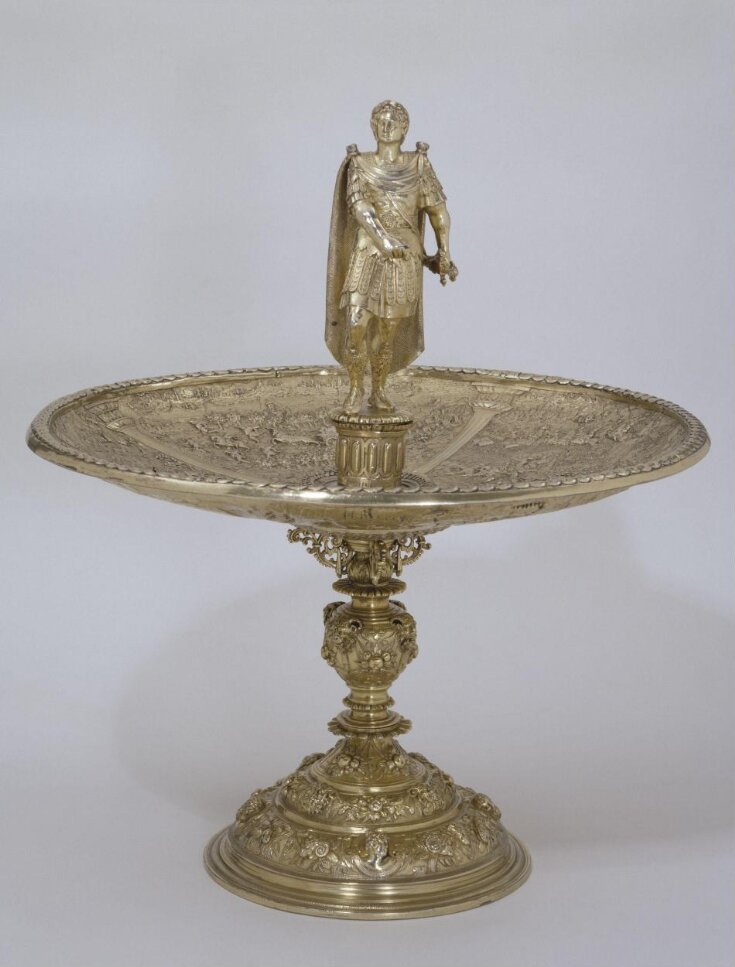
| Title | The Aldobrandini Tazza
(popular title) |
| Materials and techniques | Silver-gilt, embossed and chased with applied cast elements. |
| Brief description | gilded silver, probably Netherlands (Antwerp, modern Belgium), 1587-1599, unmarked except for a French import mark of 1864 onwards; the foot probably late 19th century. |
| Physical description | The central figure modelled and cast (the cloak cast separately), the base of this figure engraved '*DOMITIANVS*'; the bowl embossed and chased with four scenes from the life of the Emperor Tiberius; the foot a nineteenth-century replacement, possibly Spanish, 1550-1600 or made 1850-1890. |
| Dimensions | - Foot to top of figure in centre of bowl height: 42cm
- Across centre of bowl diameter: 37.5cm
(Note: Measurement taken when tazza dismantled in Metalwork conservation studio.)
- Across underside of foot diameter: 18cm
(Note: Measurement taken in Metalwork conservation studio when tazza dismantled.)
- Weight: 2910.2g
(Combined weight of dismantled sections, taken by Pippa Shirley.)
|
| Marks and inscriptions | - There are inscriptions or marks on all the original sections of the tazza.
Inscriptions:
*DOMITIANVS* (the 'N' reversed) on the plinth upon which the figure stands. The relatively crude execution suggests was added at a slightly later date.
Engraved on the inner rim of the bowl: the Arabic numerals '1' to '4' above the four scenes embossed round the inside of the bowl.
'VESPASIANVS' (the 'N' reversed) and the number '10' engraved on the inside (ungilded) side of the circular plate screwed to the underside of the bowl.
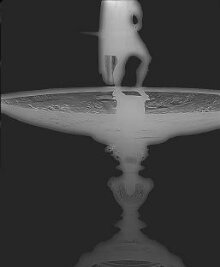
Various assembly marks
On the underside of the plate on which the emperor stands: seven vertical scratched marks and two curved ones.
Incised on the inner cylinder beneath the figure which encloses the hollow for the screw: l ... (a vertical mark and three dots)
Engraved on the side of the cylinder that conceals the fixings for the figure: l l l . . . . (three vertical marks and ?four dots)
Engraved on the inside of the cylinder that conceals the fixings for the figure, at the base: \ /// (four lines)
Engraved on the rim of the cylinder that conceals the fixings for the figure: . . . . (four dots)
Engraved on the applied ornament ring round the underside of the cylinder that conceals the fixings, and next to the four dots on the cylinder rim: l l l l l l l l l (nine vertical lines)
On the underside of the bowl: an 'x' scratched on the embossed section between narrative scenes 2 and 3
On the underside of the bowl, at the centre:
a zig-zag assay mark
a vertical line and three dots on the circular fixing plate around the screw, opposite the assay mark: l . . .
Engraved on the inside (ungilded) side of the circular plate screwed to the underside of the bowl:
three vertical marks on the rim: lll
two vertical marks towards the centre: ll
On the outer (gilded) side of the circular plate screwed to the underside of the bowl:
l l l l
. . .
(four vertical lines and, below, three dots)
- On the replacement foot: two vertical marks on the underside of the base and a single vertical scratched mark at the top of the base section beside the screw hole.
- On the underside of the circular plate fixed to the underside of the bowl: a 'weevil' in an oval frame, French import mark for gold and silver imported from countries with Customs Conventions, and in force from June 1 1864.
|
| Gallery label | - (2018)
- 9. THE ‘ALDOBRANDINI’ TAZZA
Silver-gilt, the gilding possibly later
The figure and bowl probably the southern Netherlands (modern Belgium), about 1587–1599, French import mark for 1864 onwards.
The foot unmarked, possibly Spain, 1550–1600, or made and added by Frédéric Spitzer (1850–1890)
The figure standing triumphantly atop this footed cup (tazza) is the Roman emperor Domitian. However, the bowl is decorated with scenes from the life of another emperor, Tiberius, taken from an account by the Roman historian Suetonius. This cup was originally part of a set of twelve tazze, all of which survive today in different collections. Over time, the interchangeable parts of the tazze – the bowls and figures – have been mixed up, resulting in mis-matched emperors and bowls.
The set is known as the ‘Aldobrandini Tazze’, but it was not commissioned for this family. Instead, the design celebrating emperors as victorious leaders and wise rulers was calculated to appeal to the Habsburg dynasty, who controlled much of Europe in the late 16th century and traced their ancestors to the earliest Roman emperors. The tazze were probably originally presented by town authorities to a Habsburg governor-general of the southern Netherlands, possibly Archduke Ernest of Austria (d. 1595), or his brother and successor Albert (d. 1621). By 1604, however, a letter describes them among the sumptuous display of silver at a banquet organized by Cardinal Pietro Aldobrandini at his palace in Rome.
M. 247-1956
Hildburgh Bequest - (2000-2018)
- 9. THE ALDOBRANDINI TAZZA
Silver-gilt, the gilding possibly later
Probably Italy, 1560-70
No maker's mark
The Roman Emperor Domitian in military dress stands on a fluted column in the centre of the salver, which shows scenes from his life: on a chariot, in battle, a triumph scene and his elevation to a divine status. This was one of a set of twelve spectacular tazze (salver with stemmed foot) bearing figures of the first Caesars of Imperial Rome. In the late 16th century they were owned by a member of the Aldobrandini family, possibly Cardinal Ippolito Aldobrandini the Elder, later Pope Clement VIII (1592-1605). In the 1860s the Austrian collector and art dealer Frédéric Spitzer (1815-1890) bought six of the tazze, including this one. He replaced the original fluted stemmed foot with a more elaborate Renaissance style one of the 16th century with swags of fruit and drapery, cherubs and satyrs and male Roman heads.
Hildburgh Bequest
M.247-1956 - (1980-2000)
- THE ALDOBRANDINI TAZZA
Silver-gilt; unmarked
The dish and figure about 1570-92; the stem and foot about 1530-70, and from a SPANISH monstrance.
The figure and dish probably by a GERMAN or NETHERLANDISH craftsman
Hildburgh Bequest
M.247-1956
One of twelve tazze (cups) belonging to Cardinal Ippolito Aldobrandini, elected Pope Clement VIII in 1592. Each of these tazze bears the figure of a Roman Emperor, this one being Domitian. The dish of the tazza is chased with scenes from Suetonius' life of the Emperor: 1. Domita, wife of Domitian, travelling in Germany; 2. Domitian fighting against the Dacian and Quadi in Pannonia; 3. Triumph of Domitian; 4. Domitian receiving the submission of the Germans. The marriage between the foot and the dish was made by the Paris dealer and antiquary Frédéric Spitzer, in whose collection the piece was in the nineteenth century. - (2002)
- This is one of a set of 12 tazze (standing dishes) bearing figures of the first 12 Caesars of Imperial Rome. Made about 1560-70, they are one of the most spectacular groups of 16th-century silver to survive. They were owned in the late 16th century by a member of the Aldobrandini family, possibly Ippolito Aldobrandini the Elder, later Pope Clement VIII, no doubt to make an impressive display in his palace. The Emperor Domitian stands on a fluted column in the centre of this bowl, which is decorated with scenes from his life.
The set has had an eventful history. They were still a set of 12 in 1861 but 6 of them, including this one, were later bought by the 19th-century Austrian art dealer and collector Frédéric Spitzer (1815-90). He 'improved' them by apparently replacing the original stems with versions modelled on a different 16th-century stem. All 12 survive but in different collections across the world.
|
| Credit line | Dr W.L. Hildburgh Bequest |
| Object history | One of a set of twelve standing dishes ('tazze' in Italian) bearing figures of the first twelve Caesars of Imperial Rome. Made no earlier than 1587 and completed by 1599, they are one of the most spectacular groups of 16th century silver to survive. They were owned in the late 16th century by a member of the Aldobrandini family, possibly Ippolito Aldobrandini the Elder, later Pope Clement VIII, no doubt to make an impressive display in his palace. The set had an eventful history. They were still a set of twelve in 1861 but six of them, including this one, were later bought by the 19th century Austrian art dealer and collector Frédéric Spitzer (1815-90), who 'improved' them by apparently replacing the original stems with versions modelled on a different 16th century stem. Despite these vicissitudes, all twelve survive today in different collections across the world.
The V&A tazza shows the Emperor Domitian standing on a fluted column in the centre of this bowl. The four scenes embossed around him have traditionally been identified as scenes from his life, and the V&A tazza considered to be one of the few in which emperor and bowl correspond. Recent research has shown that the scenes in fact refer to the life of the emperor Tiberius. The scene labelled '1' shows a woman and baby in a chariot fleeing a forest fire, an event that occurred to the infant emperor Tiberius according to the Roman historian Suetonius (Lives, chapter 6). The shields and banners held by soldiers in the other scenes rarely allude to specific forms of heraldry, but in the scene labelled '2' a banner on the left bears the distinctive pine-cone motif of the town of Augsburg. This would again link the narrative to the emperor Tiberius, as many of his campaigns were fought against the peoples of Southern Germany. Ironically, the original emperor on the V&A bowl (Vitellius) was removed in the 1950s (when it was still owned by Walter Leo Hildburgh) and replaced by the figure of Domitian from a tazza in Toronto, in an attempt to correct a mismatch. (The figure of the emperor Vitellius was transferred to a tazza in the Metropolitan Museum, New York; the figure of Tiberius is in a private collection and its present whereabouts are unknown.) |
| Subjects depicted | |
| Bibliographic references | - Hayward, J. F. The Aldobrandini Tazzas, Burlington Magazine, October 1970, pp. 669-74.
- Works of art from the Wernher Collection, Christie's London, Sale 6293, 7 July 2000, lot 19.
- Suetonius, The Lives of the Twelve Caesars. London, Penguin.
- Siemon, Julia, ed. The Silver Caesars. A Renaissance Mystery. The Metropolitan Museum of Art Symposia. Catalogue of the exhibition held at the Metropolitan Museum, New York, 12 December 2017 to 11 March 2018, and at Waddesdon Manor, Buckinghamshire, 18 April to 21 July 2018. New York: Metropolitan Museum, 2017. ISBN 9781588396396.
- Carré, Louis. A Guide to Old French Plate. London: Eyre & Spottiswoode, 1931, repr. 1971.
|
| Collection | |
| Accession number | |