
Inkwell
ca. 1600-1625 (made)
| Artist/Maker | |
| Place of origin |
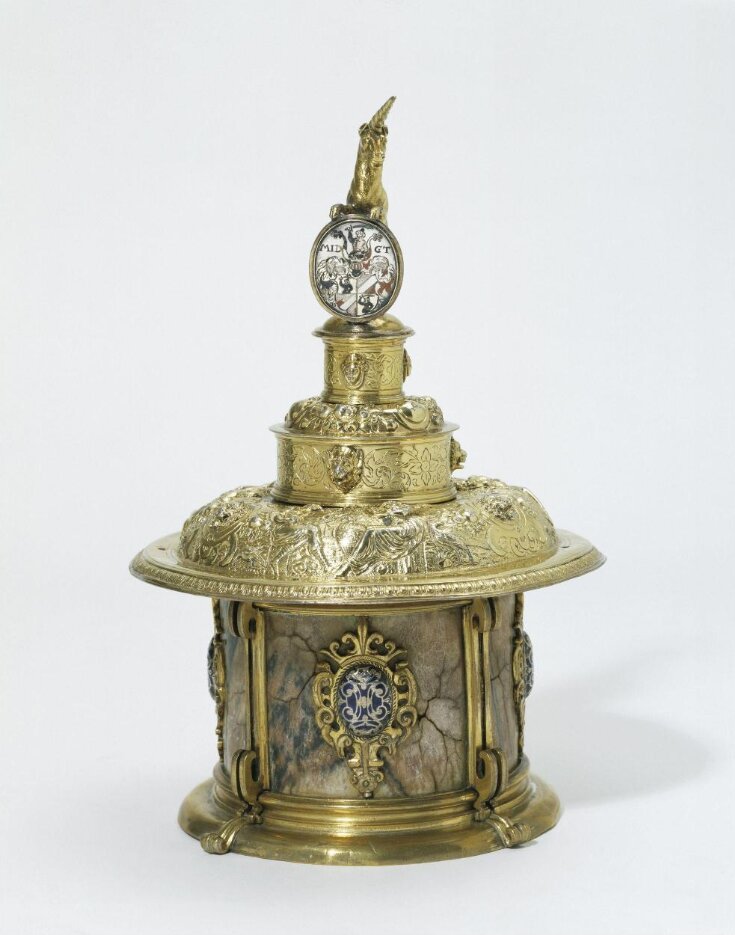
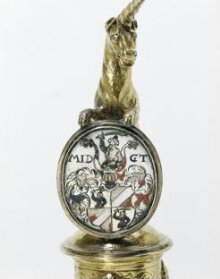
Although probably an inkwell, the top of this object has been lost and its original function is uncertain. The silver-gilt mounts are in the Spanish 'Herrera' style, named after Juan de Herrera, architect of the Escorial palace built for Philip II of Spain about 1575. On goldsmiths' work, the style is characterised by austere design combining plain surfaces with decorative enamelled bosses.
The inkwell was given to the Museum by Walter Leo Hildburgh, one of the most dedicated and generous patrons in the history of the V&A. His name is not well-known outside the museum world, but his influence on the shaping of the collections was immense. Born in New York in 1876, he trained as a scientist. Initially his collecting interest was ethnography, but after 1914 he turned to the decorative arts. His tastes were eclectic, but he developed his closest links with the Departments of Metalwork and Sculpture. Encouraged by successive Keepers of Metalwork, he began to accumulate European silver, with the gaps in the existing collections in mind. He travelled widely on collecting expeditions, usually recording when and where he bought something, but not (frustratingly for posterity) from whom.
Hildburgh's abiding passion was the art of Spain and Portugal, and it is no coincidence that the Museum holds one of the finest collections of Hispanic silver in the world. He also fell into the charming habit of giving the Museum presents at Christmas and on his own birthday. In some ways he was a shadowy figure, living frugally in a flat surrounded by what he called `the Museum mistakes', and devoting all his resources to collecting, but he is known to have been a keen skater. From 1924 when he offered the first objects to the Museum on loan, to 1956 when the huge collection was bequeathed, Hildburgh was part of the Museum landscape. We continue to benefit from his generosity. His will set up a fund for future purchases, administered in the spirit of his earlier acquisitions.
The inkwell was given to the Museum by Walter Leo Hildburgh, one of the most dedicated and generous patrons in the history of the V&A. His name is not well-known outside the museum world, but his influence on the shaping of the collections was immense. Born in New York in 1876, he trained as a scientist. Initially his collecting interest was ethnography, but after 1914 he turned to the decorative arts. His tastes were eclectic, but he developed his closest links with the Departments of Metalwork and Sculpture. Encouraged by successive Keepers of Metalwork, he began to accumulate European silver, with the gaps in the existing collections in mind. He travelled widely on collecting expeditions, usually recording when and where he bought something, but not (frustratingly for posterity) from whom.
Hildburgh's abiding passion was the art of Spain and Portugal, and it is no coincidence that the Museum holds one of the finest collections of Hispanic silver in the world. He also fell into the charming habit of giving the Museum presents at Christmas and on his own birthday. In some ways he was a shadowy figure, living frugally in a flat surrounded by what he called `the Museum mistakes', and devoting all his resources to collecting, but he is known to have been a keen skater. From 1924 when he offered the first objects to the Museum on loan, to 1956 when the huge collection was bequeathed, Hildburgh was part of the Museum landscape. We continue to benefit from his generosity. His will set up a fund for future purchases, administered in the spirit of his earlier acquisitions.
Object details
| Categories | |
| Object type | |
| Materials and techniques | Silver and enamel mounts, marble and gilt brass |
| Brief description | Marble mounted in gilt brass with enamelled silver mounts, Spain, 1600-25. |
| Physical description | Round body of yellow marble with black streaks, gilt brass lip band joined to moulded base by 4 double buttresses, intervening panel with a silver cartouche with oval centre decorated with strapwork on a ground of dark blue. |
| Dimensions |
|
| Gallery label | Silver Gallery:
Although probably an inkwell, the top of this object has been lost and its original function is uncertain. The enamelled mounts are in the Spanish 'Herrera' style, named after Juan de Herrera, architect of the Escorial.(26/11/2002) |
| Credit line | Given by Dr W. L. Hildburgh FSA |
| Object history | Dr WL Hildburgh FSA Gift, from the E.T Cook Collection. Walter Leo Hildburgh was one of the most dedicated and generous patrons in the history of the V&A. His name is not well-known outside the museum world, but his influence on the shaping of the collections was immense. Born in New York in 1876, he trained as a scientist. Initially his collecting interest was ethnography, but after 1914 he turned to the decorative arts. His tastes were eclectic, but he developed his closest links with the Departments of Metalwork and Sculpture. Encouraged by successive Keepers of Metalwork, he began to accumulate European silver, with the gaps in the existing collections in mind. He travelled widely on collecting expeditions, usually recording when and where he bought something, but not (frustratingly for posterity) from whom. Hildburgh's abiding passion was the art of Spain and Portugal, and it is no coincidence that the Museum holds one of the finest collections of Hispanic silver in the world. He also fell into the charming habit of giving the Museum presents at Christmas and on his own birthday. In some ways he was a shadowy figure, living frugally in a flat surrounded by what he called `the Museum mistakes', and devoting all his resources to collecting, but he is known to have been a keen skater. From 1924 when he offered the first objects to the Museum on loan, to 1956 when the huge collection was bequeathed, Hildburgh was part of the Museum landscape. We continue to benefit from his generosity; his will set up a fund for future purchases, administered in the spirit of his earlier acquisitions. |
| Summary | Although probably an inkwell, the top of this object has been lost and its original function is uncertain. The silver-gilt mounts are in the Spanish 'Herrera' style, named after Juan de Herrera, architect of the Escorial palace built for Philip II of Spain about 1575. On goldsmiths' work, the style is characterised by austere design combining plain surfaces with decorative enamelled bosses. The inkwell was given to the Museum by Walter Leo Hildburgh, one of the most dedicated and generous patrons in the history of the V&A. His name is not well-known outside the museum world, but his influence on the shaping of the collections was immense. Born in New York in 1876, he trained as a scientist. Initially his collecting interest was ethnography, but after 1914 he turned to the decorative arts. His tastes were eclectic, but he developed his closest links with the Departments of Metalwork and Sculpture. Encouraged by successive Keepers of Metalwork, he began to accumulate European silver, with the gaps in the existing collections in mind. He travelled widely on collecting expeditions, usually recording when and where he bought something, but not (frustratingly for posterity) from whom. Hildburgh's abiding passion was the art of Spain and Portugal, and it is no coincidence that the Museum holds one of the finest collections of Hispanic silver in the world. He also fell into the charming habit of giving the Museum presents at Christmas and on his own birthday. In some ways he was a shadowy figure, living frugally in a flat surrounded by what he called `the Museum mistakes', and devoting all his resources to collecting, but he is known to have been a keen skater. From 1924 when he offered the first objects to the Museum on loan, to 1956 when the huge collection was bequeathed, Hildburgh was part of the Museum landscape. We continue to benefit from his generosity. His will set up a fund for future purchases, administered in the spirit of his earlier acquisitions. |
| Bibliographic reference | Oman, Charles. The Golden Age of Hispanic Silver, 1400-1665. London: Her Majesty's Stationery Office, 1968. |
| Collection | |
| Accession number | M.162-1951 |
About this object record
Explore the Collections contains over a million catalogue records, and over half a million images. It is a working database that includes information compiled over the life of the museum. Some of our records may contain offensive and discriminatory language, or reflect outdated ideas, practice and analysis. We are committed to addressing these issues, and to review and update our records accordingly.
You can write to us to suggest improvements to the record.
Suggest feedback
You can write to us to suggest improvements to the record.
Suggest feedback
| Record created | February 9, 2004 |
| Record URL |
Download as: JSONIIIF Manifest
