Flagon
1605 (made)
| Artist/Maker | |
| Place of origin |
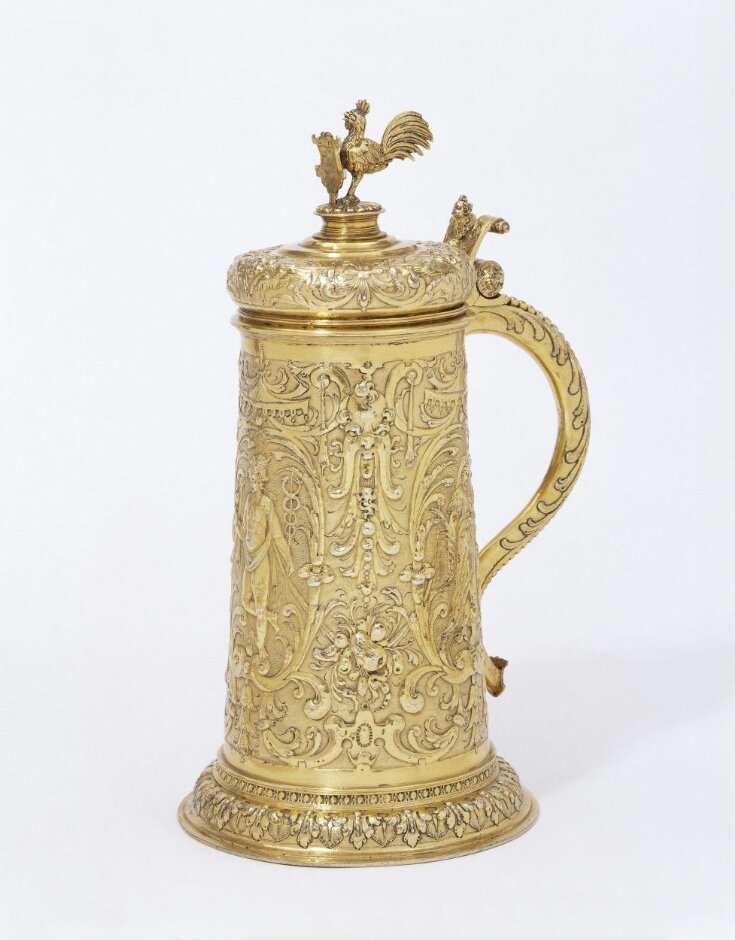
This large flagon is decorated with embossing (ornament hammered into relief), depicting figures of the Roman gods Diana (with dog and spear) and Mercury (with winged feet and caduceus) and the Christian allegorical figure of Charity (with two children). It is possible that the flagon was originally one of a pair, the other of which might have helped to unify the apparently unconnected decoration. During the early 17th century many goldsmiths from Augsburg and elsewhere settled in the prosperous, ethnically German, area of modern Hungary known as Siebenburgen (the 'seven towns').
Object details
| Categories | |
| Object type | |
| Materials and techniques | Silver-gilt, raised, embossed and chased |
| Brief description | Flagon, gilded silver, raised, embossed and chased, Hungary, maker's mark NH, 1605 |
| Physical description | Cylindrical tankard, raised, embossed, chased, handle and thumb-piece cast, scrollwork under hinged lid with rooster finial holding a shield, the body with medallions depicting Madonna and child, Mercury and one other figure. |
| Dimensions |
|
| Marks and inscriptions |
|
| Gallery label |
|
| Object history | Repairs to lid recorded in register from 1864-65 |
| Production | Maker NH, unidentified |
| Summary | This large flagon is decorated with embossing (ornament hammered into relief), depicting figures of the Roman gods Diana (with dog and spear) and Mercury (with winged feet and caduceus) and the Christian allegorical figure of Charity (with two children). It is possible that the flagon was originally one of a pair, the other of which might have helped to unify the apparently unconnected decoration. During the early 17th century many goldsmiths from Augsburg and elsewhere settled in the prosperous, ethnically German, area of modern Hungary known as Siebenburgen (the 'seven towns'). |
| Collection | |
| Accession number | 4860-1858 |
About this object record
Explore the Collections contains over a million catalogue records, and over half a million images. It is a working database that includes information compiled over the life of the museum. Some of our records may contain offensive and discriminatory language, or reflect outdated ideas, practice and analysis. We are committed to addressing these issues, and to review and update our records accordingly.
You can write to us to suggest improvements to the record.
Suggest feedback
You can write to us to suggest improvements to the record.
Suggest feedback
| Record created | February 9, 2004 |
| Record URL |
Download as: JSONIIIF Manifest
