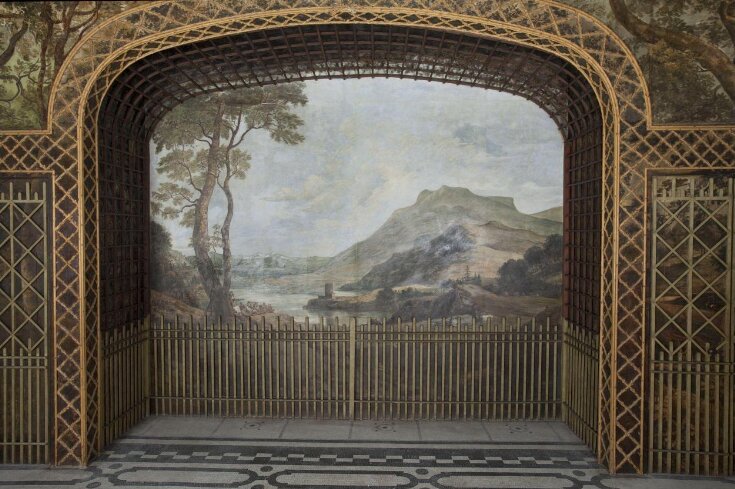
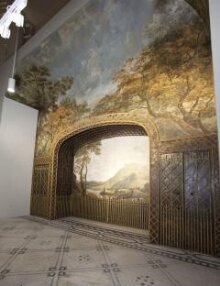
Landscape with Castle (fresco from the Painted Dining Room, Drakelow Hall)
Fresco
1793 (painted)
1793 (painted)
| Artist/Maker | |
| Place of origin |
Paul Sandby was a founder member of the Royal Academy, particularly famous for his landscapes, although he was equally skilled in many other subjects and in techniques besides oil painting. In 1793 he was commissioned by Sir Nigel Gresley to paint a huge panoramic imaginary landscape extending across all four walls of the the dining room at Drakelow Hall in Derbyshire, near Burton upon Trent (now in Staffordshire). Sandby appears to have painted the landscape in a very short time. The building was sold and demolished in 1934 and a power station was built upon the site. Of the series of paintings on the four walls, only this one was saved, and was purchased by the V&A. It represents a view of Dolbadarn Castle on the lake Llyn Peris in north Wales, with Snowdon beyond.
Object details
| Categories | |
| Object type | |
| Parts | This object consists of 3 parts.
|
| Title | Landscape with Castle (fresco from the Painted Dining Room, Drakelow Hall) (popular title) |
| Materials and techniques | fresco on plaster |
| Brief description | Fresco from The Painted Dining Room at Drakelow Hall by Paul Sandby. Great Britain, 1793. |
| Physical description | Scenic landscape painting of a lake and hills with a castle or tower in the middle distance. |
| Dimensions |
|
| Style | |
| Object history | Painted by Paul Sandby in 1793 as part of the decoration of the dining room at Drakelow Hall Derbyshire, for Sir Nigel Gresley. Sandby had stayed with Sir Watkin Williams Wynn at Wynnstay near Wrexham in north Wales in 1771, and published a series of aquatints of North Wales in 1776. While at Wynnstay he painted all the scenes for Sir Watkin's private theatre. When he decorated the dining hall at Drakelow, he included as a central motif in the architectural niche at one end of the room a view of Dolbadarn Castlle with the lake Llyn Padarn in Snowdonia. Vitruvius and Pliny both mention the decoration of classical villas with illusionistic landscapes, and similar wall decorations were painted by Italian painters of the 16th-18th centuries, such as Battista and Dosso Dossi at the Villa Imperiale in Pesaro in 1530-40, Pieter Mulier called Tempesta at the Palazzo Colonna in Rone in 1668 and Monsù Francesco Borgognone in the cloister of S. Andrea delle Fratte at Rome in 1720-30. Around 1781 George Barret decorated a room in Norbury Park for William Locke with a comparable contiunuous illusionistic landscape. This may have provided the model for thesimilar painted room at Drakelow. On visiting Drakelow in 1794 the poet Anna Steward found the dining room of 'singular happiness' and described it thus: 'It is large, one side painted with forest scenery whose majestic trees arch over the coved ceiling. Through them we see glades, tufted banks, and ascending walks in perspective. The opposite side exhibits a Peak valley, the front shows a prospect of a more distant country, vieing with the beauties of the real one, admitted through a crystal wall of window. Its chimney piece, formed of spars and ores and shells, represents a grotto. Real pales, painted green, and breast high, are placed a few inches from the wall and increase the deception. In these are little wicket gates that, half open, invite us to ascend the seeming forest banks. The perspective is so well preserved as to produce a landscape deception little inferior to the watery delusion of the celebrated panorama.' [*presumably a reference to the Panorama of London by Robert Baker exhibited in Leicester Square in 1792]. Following the demolition of Drakelow Hall the fragment of the painted decoration with the architectural niche with a view of Dolbadarn Castlle and Llyn Padarn was purchased for £50 from Perry and Phillips Ltd., of High Street, Bridgenorth, 1934 |
| Production | Painted at Drakelow Hall which was demolished in 1934. The site, previously in Derbyshire, is now a power station near Burton-on-Trent in Staffordshire. |
| Subjects depicted | |
| Summary | Paul Sandby was a founder member of the Royal Academy, particularly famous for his landscapes, although he was equally skilled in many other subjects and in techniques besides oil painting. In 1793 he was commissioned by Sir Nigel Gresley to paint a huge panoramic imaginary landscape extending across all four walls of the the dining room at Drakelow Hall in Derbyshire, near Burton upon Trent (now in Staffordshire). Sandby appears to have painted the landscape in a very short time. The building was sold and demolished in 1934 and a power station was built upon the site. Of the series of paintings on the four walls, only this one was saved, and was purchased by the V&A. It represents a view of Dolbadarn Castle on the lake Llyn Peris in north Wales, with Snowdon beyond. |
| Bibliographic references |
|
| Collection | |
| Accession number | P.12-1934 |
About this object record
Explore the Collections contains over a million catalogue records, and over half a million images. It is a working database that includes information compiled over the life of the museum. Some of our records may contain offensive and discriminatory language, or reflect outdated ideas, practice and analysis. We are committed to addressing these issues, and to review and update our records accordingly.
You can write to us to suggest improvements to the record.
Suggest feedback
You can write to us to suggest improvements to the record.
Suggest feedback
| Record created | February 6, 2004 |
| Record URL |
Download as: JSONIIIF Manifest
