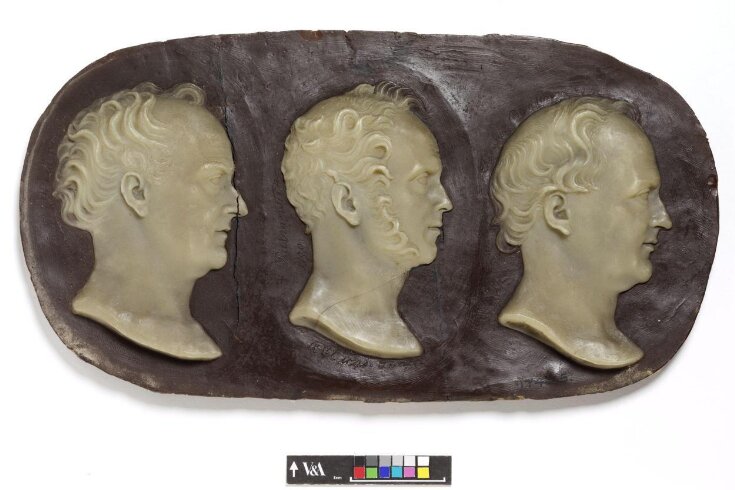

Chevalier Bunsen, Lord Palmerstone and Abbott Lawrence
Relief
19th century (made)
19th century (made)
| Artist/Maker | |
| Place of origin |
This is a wax model made by R. C. Lucas in the 19th century England. This model shows three heads in low relief on dark ground representing Chevalier Bunsen, Lord Palmerstone and Abbott Lawrence.
Richard Cockle Lucas (1800-1883) is mainly known as a sculptor in wax and ivory, but he also worked in glass, marble and bronze, as well as being a painter. Lucas began his career as a sculptor as an apprentice to his uncle, who worked as a cutler in Winchester, carving knife handles. He joined the Royal Academy Schools in 1828 and studied under Richard Westmacott. Lucas made two models of the Parthenon, in its original state and after the explosion of 1687, which were aquired by the British Museum. He is best known for his small scale works including wax sculptures and ivory carvings. Lucas was at the centre of a controversy about the bust of Flora in the Kaiser Friedrich Museum in Berlin. The bust was thought to be an authentic work by Leonardo da Vinci but the sculptor's son Albert Dürer Lucas claimed in the Burlington Magazine that the bust was modelled by his father. It is now generally thought that the bust is probably by Leonardo or his circle but was repaired by Lucas. He exhibited at the Royal Academy between 1829 and 1859 and showed ivory carvings and imitation bronzes at the Great Exhibition in 1851.
Richard Cockle Lucas (1800-1883) is mainly known as a sculptor in wax and ivory, but he also worked in glass, marble and bronze, as well as being a painter. Lucas began his career as a sculptor as an apprentice to his uncle, who worked as a cutler in Winchester, carving knife handles. He joined the Royal Academy Schools in 1828 and studied under Richard Westmacott. Lucas made two models of the Parthenon, in its original state and after the explosion of 1687, which were aquired by the British Museum. He is best known for his small scale works including wax sculptures and ivory carvings. Lucas was at the centre of a controversy about the bust of Flora in the Kaiser Friedrich Museum in Berlin. The bust was thought to be an authentic work by Leonardo da Vinci but the sculptor's son Albert Dürer Lucas claimed in the Burlington Magazine that the bust was modelled by his father. It is now generally thought that the bust is probably by Leonardo or his circle but was repaired by Lucas. He exhibited at the Royal Academy between 1829 and 1859 and showed ivory carvings and imitation bronzes at the Great Exhibition in 1851.
Object details
| Categories | |
| Object type | |
| Title | Chevalier Bunsen, Lord Palmerstone and Abbott Lawrence (generic title) |
| Materials and techniques | Wax |
| Brief description | Relief, wax, model, three heads, by R.C. Lucas (1800-1883), English, 19th century |
| Physical description | Three heads in low relief on dark ground representing Chevalier Bunsen, Lord Palmerstone and Abbott Lawrence. |
| Dimensions |
|
| Credit line | Given by R. C. Lucas |
| Object history | Riven by the artist R.C. Lucas in 1865. |
| Summary | This is a wax model made by R. C. Lucas in the 19th century England. This model shows three heads in low relief on dark ground representing Chevalier Bunsen, Lord Palmerstone and Abbott Lawrence. Richard Cockle Lucas (1800-1883) is mainly known as a sculptor in wax and ivory, but he also worked in glass, marble and bronze, as well as being a painter. Lucas began his career as a sculptor as an apprentice to his uncle, who worked as a cutler in Winchester, carving knife handles. He joined the Royal Academy Schools in 1828 and studied under Richard Westmacott. Lucas made two models of the Parthenon, in its original state and after the explosion of 1687, which were aquired by the British Museum. He is best known for his small scale works including wax sculptures and ivory carvings. Lucas was at the centre of a controversy about the bust of Flora in the Kaiser Friedrich Museum in Berlin. The bust was thought to be an authentic work by Leonardo da Vinci but the sculptor's son Albert Dürer Lucas claimed in the Burlington Magazine that the bust was modelled by his father. It is now generally thought that the bust is probably by Leonardo or his circle but was repaired by Lucas. He exhibited at the Royal Academy between 1829 and 1859 and showed ivory carvings and imitation bronzes at the Great Exhibition in 1851. |
| Bibliographic reference | Inventory of Art Objects acquired in the Year 1865. Inventory of the Objects in the Art Division of the Museum at South Kensington, arranged According to the Dates of their Acquisition. Vol. 1. London : Printed by George E. Eyre and William Spottiswoode for H.M.S.O., 1868, p. 44 |
| Collection | |
| Accession number | 174-1865 |
About this object record
Explore the Collections contains over a million catalogue records, and over half a million images. It is a working database that includes information compiled over the life of the museum. Some of our records may contain offensive and discriminatory language, or reflect outdated ideas, practice and analysis. We are committed to addressing these issues, and to review and update our records accordingly.
You can write to us to suggest improvements to the record.
Suggest feedback
You can write to us to suggest improvements to the record.
Suggest feedback
| Record created | February 5, 2004 |
| Record URL |
Download as: JSONIIIF Manifest
