Scene from the life of St Benedict
Panel
1140-1144 (made)
1140-1144 (made)
| Place of origin |
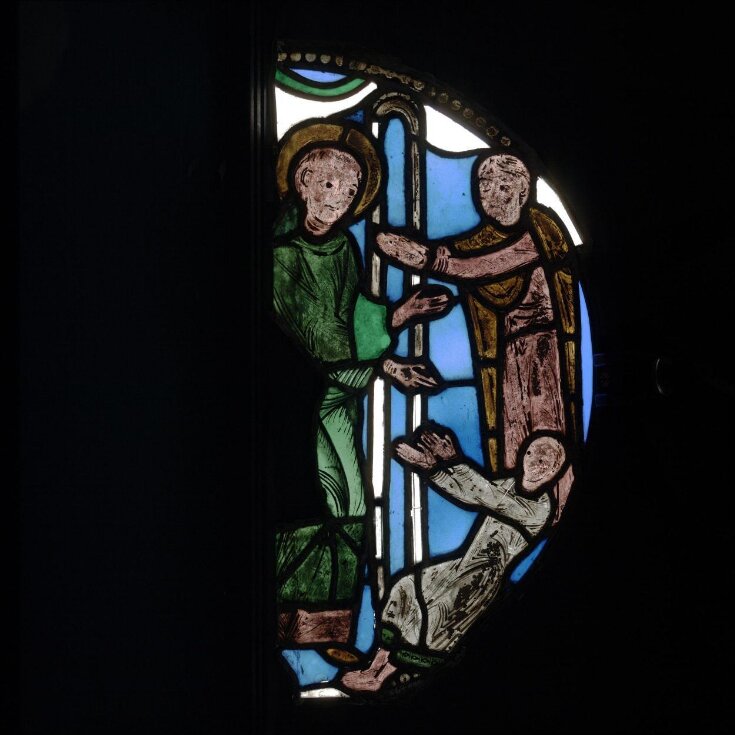
This fragmentary demi-roundel shows St Benedict, on the left, healing a sick child. A third, standing, figure hails the saint's healing powers. The panel comes from a window dedicated to St Benedict at the abbey church of Saint-Denis, near Paris. The window was perhaps in the crypt, and dismantled in the 1790s.
Lord Stuart de Rothesay acquired the panel and installed it with other panels from Saint-Denis in his newly built house at Highcliffe in Hampshire about 1820. (The house itself was constructed with some older architectural features.) After a fire in 1967 the glass was removed to the workshops of Dennis King in Norwich. The Museum acquired it in 1989.
Lord Stuart de Rothesay acquired the panel and installed it with other panels from Saint-Denis in his newly built house at Highcliffe in Hampshire about 1820. (The house itself was constructed with some older architectural features.) After a fire in 1967 the glass was removed to the workshops of Dennis King in Norwich. The Museum acquired it in 1989.
Object details
| Categories | |
| Object type | |
| Titles |
|
| Materials and techniques | Clear and coloured glass with painted details |
| Brief description | Clear and coloured glass with painted details. Depicting St Benedict Healing a Child. French (Ile-de-France), 1140-4 |
| Physical description | Semi-circular panel, the straight edge to the left. Depicts a man in green robes with a halo facing a boy in a white tunic who arises from the lower right. Behind the boy a man in pink robes gestures towards the other man. Blue background. |
| Dimensions |
|
| Production type | Unique |
| Object history | Made for the abbey of Saint Denis. Comes from a window dedicated to the life of St Benedict which made have been located in the crypt of the abbey. The abbey was dismantled in the 1790s. Acquired by Lord Stuart de Rothesay in France, where he had been George IV’s ambassador to Charles X. This is one of several panels from Saint Denis that he acquired. The panel was incorporated into the fabric of Highcliffe Castle, Hampshire, which Rothesay built around 1820. After a fire in 1967, the glass was removed to the workshops of Dennis King in Norwich and acquired by the Museum in 1989. There are other surviving panels from this window in Twycross (Leics), Raby Castle (Co.Durham), church of Saint-Léonard in Fougeres (Brittany) amd the Musée National du Moyan Age in Paris. |
| Historical context | The choir of Saint Denis was consecrated in 1144. The Saint Denis panels at Highcliffe consisted of two figurative panels and two ornamental panels. Story from the Life of St Benedict at Twycross: 1) St Benedict sending, from his cell, Saint Maur to rescue his brother Placide who was drowning. According to the legend, St Maur walked on the waves as if he was walking on land. There is a demon in this scene which is not found in the Life of Benedict by Saint Gregory. |
| Subjects depicted | |
| Summary | This fragmentary demi-roundel shows St Benedict, on the left, healing a sick child. A third, standing, figure hails the saint's healing powers. The panel comes from a window dedicated to St Benedict at the abbey church of Saint-Denis, near Paris. The window was perhaps in the crypt, and dismantled in the 1790s. Lord Stuart de Rothesay acquired the panel and installed it with other panels from Saint-Denis in his newly built house at Highcliffe in Hampshire about 1820. (The house itself was constructed with some older architectural features.) After a fire in 1967 the glass was removed to the workshops of Dennis King in Norwich. The Museum acquired it in 1989. |
| Bibliographic references |
|
| Collection | |
| Accession number | C.64-1989 |
About this object record
Explore the Collections contains over a million catalogue records, and over half a million images. It is a working database that includes information compiled over the life of the museum. Some of our records may contain offensive and discriminatory language, or reflect outdated ideas, practice and analysis. We are committed to addressing these issues, and to review and update our records accordingly.
You can write to us to suggest improvements to the record.
Suggest feedback
You can write to us to suggest improvements to the record.
Suggest feedback
| Record created | September 25, 1998 |
| Record URL |
Download as: JSONIIIF Manifest
