Casket
1320-1330 (made)
| Artist/Maker | |
| Place of origin |
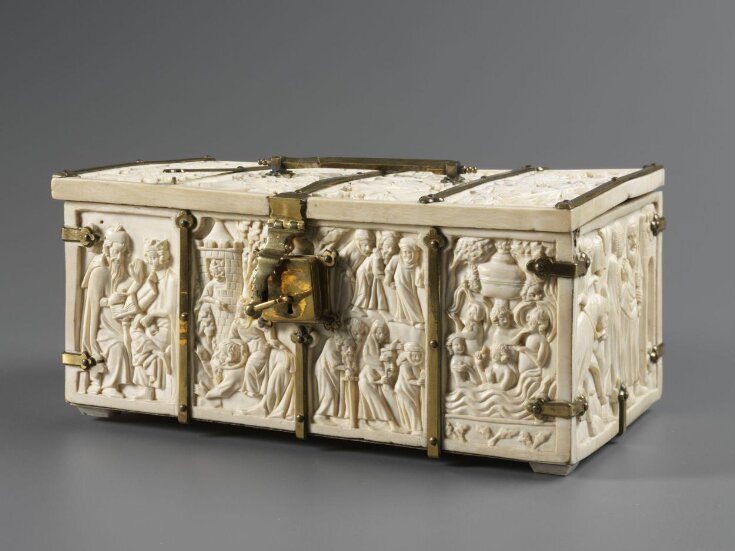
This splendid ivory casket is carved with scenes from romances and allegorical literature representing the courtly ideals of love and heroism. In the center of the lid, knights joust as ladies watch from the balcony; to the left, knights lay siege to the Castle of Love, the subject of an allegorical battle. The remaining scenes on the casket are drawn from well-known stories about Aristotle and Phyllis, Tristan and Iseult, and tales of the gallant, heroic deeds of Gawain, Galahad, and Lancelot. The box may originally have been a courtship gift.
This casket belongs to a group (comprised of six complete examples and numerous fragments) of early fourteenth-century French work which depict a variety of scenes drawn from romance, allegory and satire. The group are among the chief examples of the style attributed to Paris, which also includes a casket in the Metropolitan Museum (17.190.173) and another in the Walters Art Museum (71.265).
From about 1320 onwards, ivory caskets featuring secular subject matter began to be produced in substantial numbers, often sharing the imagery to be found on mirror backs. Some of the earlier examples are also some of the grandest, and must have been aimed at a wealthy clientele. The nature of the subject matter, which almost always concentrates on courtly love, chivalry and romance, indicates that the caskets were used for the exchange of courtship and wedding gifts. The most important type among the early caskets was what has become known as the ‘composite’ casket, illustrating more than one secular tale. This group of large and impressive caskets, of which at least eight examples survive, illustrate a variety of secular tales and themes. The primary function was not to stimulate memories of the viewers, but to delight and entertain.
This casket belongs to a group (comprised of six complete examples and numerous fragments) of early fourteenth-century French work which depict a variety of scenes drawn from romance, allegory and satire. The group are among the chief examples of the style attributed to Paris, which also includes a casket in the Metropolitan Museum (17.190.173) and another in the Walters Art Museum (71.265).
From about 1320 onwards, ivory caskets featuring secular subject matter began to be produced in substantial numbers, often sharing the imagery to be found on mirror backs. Some of the earlier examples are also some of the grandest, and must have been aimed at a wealthy clientele. The nature of the subject matter, which almost always concentrates on courtly love, chivalry and romance, indicates that the caskets were used for the exchange of courtship and wedding gifts. The most important type among the early caskets was what has become known as the ‘composite’ casket, illustrating more than one secular tale. This group of large and impressive caskets, of which at least eight examples survive, illustrate a variety of secular tales and themes. The primary function was not to stimulate memories of the viewers, but to delight and entertain.
Object details
| Categories | |
| Object type | |
| Materials and techniques | carved elephant ivory |
| Brief description | Casket, carved elephant ivory and brass, Paris, ca. 1320-1330 (with later mounts) |
| Physical description | The casket is composed of six panels of ivory held together with later brass mounts. The lid is divided into four sections. At the centre are two knights jousting in a tilt yard, the knight on the right carrying a blazon of three roses on his shield, while to either side heralds seated in trees blow their horns. Above on a trellised balcony can be seen several pairs of courting couples, and the crowned and winged God of Love shoots his bow at a knight climbing a ladder in the adjoining scene. The two side compartments depict the Storming of the Castle of Love; at the left, three knights attach a castle with two towers which is defended by three female figures, pelting the knights with roses. The compartment on the right is similarly composed, but here the three knights load a trebuchet with flowers while three women rain down flowers from above. The scenes around the sides of the casket show excerpts from a number of romance stories. The front panel is divided into four compartments. The two on the left tell the story of Aristotle and Alexander: in the first scene, the bearded Aristotle schools the young Alexander, pointing to a book with his right hand, and raising his left, to emphasise his point; Alexander sits cross-legged, and holds a glove in his left hand. In the next scene, Aristotle permits Campaspe (Phyllis) to ride him, holding a bridle in his mouth and being whipped by her from behind, as Alexander watches from a tower. The pair of scenes on the right illustrates the theme of the Fountain of Youth: on the left, a number of old and infirm characters shuffle towards the Fountain; on the right, freed from their clothes and transformed into younger figures, they frolic in the water. The right short end of the casket depicts Galahad receiving the key to the Castle of Maidens. The back of the casket is divided into four compartments; from left to right, these depict Gawain fighting the Lion, Lancelot crossing the Sword Bridge, Gawain on the Perilous Bed, and three female figures, presumably those who dwell in the Castle of Maidens, reacting to Gawain's plight. The left short end depicts two scenes within a wood. The first shows a unicorn kneeling to a seated woman, who holds a chaplet in her left hand, and strokes the unicorn's horn with her right; a male hunter wearing a large tricorn hat plunges a spear into the animal. The second scene depicts Tristan and Isolde's tryst at the tree, as they are spied on from above by King Mark. The base plate is plain, apart from now-illegible traces of an ink inscription, and some 'pearl' imperfections in the ivory. Four modern ivory feet have been added at the corners, to raise the base of the casket above the metal mounts. The sides of the casket fit together using the standard lap-jointed system common to many caskets of this type. The brass mounts and handle are of nineteenth-century manufacture, but reuse many of the original fixing holes. The interior of the casket is lined with modern red velvet. |
| Dimensions |
|
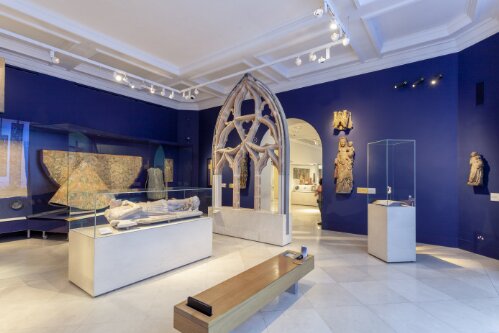
| Gallery label | Casket with scenes from Romance Literature
About 1330-1340
France
Elephant ivory with modern metal mounts(2006) |
| Object history | In the collection of Prince Petr Soltykoff, Paris, until 1861; Soltykoff sale (Soltykoff 1861, lot 341, bought Croyet); in the possession of John Webb, London, by 1862 (London 1862, cat. no. 128); purchased from Webb in 1866 for £296. A number of similar so-called 'composite' caskets, illustrating more than one secular tale, survive. Of these, those in Baltimore and the British Museum, like the present example, show the Fountain of Youth on the front. A second group, in Cracow, Birmingham, New York and Florence, places Pyramus and Thisbe on the front. A casket in Paris places a story similar to that of the Wisdom of Solomon in the same position. Fragments of further caskets can be found in several further collections, and one panel is set into a nineteenth-century binding of a manuscript of the Chevalier au Cygne in the British Library, London. Finally, a separate, more poorly-made group introduces new variations into narratives. The close similarities between the key examples of this group of caskets have often engendered speculation as to whether some, or all, emanate from the same workshop. The examples closest in style to the present casket are the two other caskets that place the Fountain of Youth scene on the front face, and which are otherwise the closest in terms of their iconography; the British Museum casket is especially comparable. Among the wider group of composite caskets, the examples at the Barber Institute of Fine Arts in Birmingham and the Metropolitan Museum of Art in New York are similar in style. Others, such as the caskets in Florence and Cracow, are so different as to make it unlikely that they were produced in the same atelier (Williamson and Davies 2014, p. 657). The cruder examples such as those of Boulogne, Winnipeg and Cleveland have been seen as later provincial variations on the theme. Considerable efforts have been made to identify the literary sources for each of the stories illustrated on these caskets (see, for example, Ross 1948). REcently, the work of Paula Mae Carns has not only extensively reviewed the surviving texts, but has also argued for the creative interpretation (or reinterpretation) of the stories on the part of the ivory carvers (Carns 2005; Carns 2011). The caskets' primary function seems to have been to delight and entertain, and the approach of the carvers to the representation of popular chivalric narratives was notably relaxed and creative. On the V&A casket, for example, there seems to be a deliberate conflation of the stories of Lancelot and Gawain. Both knights fought lions; it is Lancelot whom we find in surviving texts crossing the Sword Bridge; and it is Gawain who lies in the Perilous Bed. But in the images on the casket, a knight fights a lion; the lion's paw is added to his shield; the shield is carried by the knight crossing the Sword Bridge; and it is also held by the knight on the Perilous Bed: in other words, the viewer is encouraged to see the entire back face of the casket as a single story. The caskets so seem to have used stock motifs from well-known stories to create new harratives, or at least to encourage their viewers to construct them. This line argument may also serve to explain the use made on the caskets of motifs that can be found in rather different contexts within poems such as the Roman de la Rose, like the Castle of Love, the Fountain of Youth and the God of Love (see Carns 2011, pp. 253-54). The very ambiguity of the new images arranged on the caskets in this way has proved notably resistant to attempts to demonstrate their programmatic nature or meanings. (Williamson and Davies 2014, pp. 658-59). |
| Historical context | This casket belongs to a group (comprised of six complete examples and numerous fragments) of early fourteenth-century French work which depict a variety of scenes drawn from romance, allegory and satire. The group are among the chief examples of the style attributed to Paris, which also includes a casket in the Metropolitan Museum (17.190.173) and another in the Walters Art Museum (71.265). Loomis notes that the costume and armour on these caskets all indicate the period 1300-1340. Koechlin dates all except two of the group to the first half of the fourteenth century and Ross describes the present casket as appearing to represent the oldest surviving type of these caskets on the grounds that the carving of the lid is the most primitive. Dalton notes that these caskets represent the height of the didactic tendency of fourteenth century carving, with beauty used as a means to convey a story and a moral. the stories represented on the present casket (explored thoroughly by Dalton and Ross) are as follows: The lid follows a convention of division into four sections and depicts a tournament and the Attack on the Castle of Love. The idea of the defence of feminine chastity resembling that of a tower or castle was a popular medieval similie, with the subject also appearing on mirror cases. No literary source has been established for this scene although the Roman de la Rose has been suggested. Ross points out that in the Roman de la Rose, it is not the not the Castle of Love which is under siege and that there is no resemblance between the iconography of the Roman de la Rose in manuscripts and that of ivory carving. On the front of the casket are Aristotle, Alexander and Phyllis who participate in a favourite cautionary tale of the the middle ages. Aristotle warns Alexander that he is neglecting his royal duties in favour of the company of Phyllis, who in revenge seduces Aristotle and rides him, like a horse around an orhard so that Alexander will see. These scenes have sources in the literature of the period, the thirteenth century French "Lai d'Aristote" and the contemporary middle high German version "Aristoteles und Phyllis". The fountain of Youth was another popular subject for medieval iconographers and occurs in manuscripts, tapestries and goldsmith's work as well as on ivory carvings. It has clear literary sources, being mentioned in several works of medieval vernacular literature. Old people enter the fountain from the left and emerge rejuvenated. Lancelot on the bridge of the sword: The scene represents Lancelot going to the rescue of Guinevere who has been carried off by Meleagant to the mysterious knigdom of Gorre, whose entrance is by way of a bridge consisting of a sword blade. Ross suggests that this is based on an old Celtic legend of the other world. The inclusion of this scene, which interrupts the sequential development of another Gawain story - that of the Perilous Bed depicted in the three other sections - gives an indication that the sculptors were following a covention rather than working from knowledge of the story. Gawain and the perilous bed, as told bt Chretien deTroyes in his Perceval runs as follows. The knight arrives at a deserted castle and finds a wonderful bed, all of gold. he lies down, fortunately without removing his armour, for no sooner has he done so than bells attached to the bed ring, shutters fly open and a hail of bolts and arrows descend on Gawain.A lion is then set upon him and Gawain severes its paw. Finally Gawain is congratulated by the lady of the castle, who sends her maidens to honour him. Apart from on caskets, this story occurs on a mirror case in the Museo Civico, Bologna and a writing tablet now in the Museum Niort. One end of the casket features Tristram and Iseult watched by King Mark and the Unicorn killed while taking refuge with a maiden. The other end shows Galahad receiving the keys to the Castle of the Captive Maidens. |
| Subjects depicted | |
| Literary references |
|
| Summary | This splendid ivory casket is carved with scenes from romances and allegorical literature representing the courtly ideals of love and heroism. In the center of the lid, knights joust as ladies watch from the balcony; to the left, knights lay siege to the Castle of Love, the subject of an allegorical battle. The remaining scenes on the casket are drawn from well-known stories about Aristotle and Phyllis, Tristan and Iseult, and tales of the gallant, heroic deeds of Gawain, Galahad, and Lancelot. The box may originally have been a courtship gift. This casket belongs to a group (comprised of six complete examples and numerous fragments) of early fourteenth-century French work which depict a variety of scenes drawn from romance, allegory and satire. The group are among the chief examples of the style attributed to Paris, which also includes a casket in the Metropolitan Museum (17.190.173) and another in the Walters Art Museum (71.265). From about 1320 onwards, ivory caskets featuring secular subject matter began to be produced in substantial numbers, often sharing the imagery to be found on mirror backs. Some of the earlier examples are also some of the grandest, and must have been aimed at a wealthy clientele. The nature of the subject matter, which almost always concentrates on courtly love, chivalry and romance, indicates that the caskets were used for the exchange of courtship and wedding gifts. The most important type among the early caskets was what has become known as the ‘composite’ casket, illustrating more than one secular tale. This group of large and impressive caskets, of which at least eight examples survive, illustrate a variety of secular tales and themes. The primary function was not to stimulate memories of the viewers, but to delight and entertain. |
| Associated objects |
|
| Bibliographic references |
|
| Collection | |
| Accession number | 146-1866 |
About this object record
Explore the Collections contains over a million catalogue records, and over half a million images. It is a working database that includes information compiled over the life of the museum. Some of our records may contain offensive and discriminatory language, or reflect outdated ideas, practice and analysis. We are committed to addressing these issues, and to review and update our records accordingly.
You can write to us to suggest improvements to the record.
Suggest feedback
You can write to us to suggest improvements to the record.
Suggest feedback
| Record created | February 5, 2004 |
| Record URL |
Download as: JSONIIIF Manifest
