
The Sun at its Zenith - Ocean
Photograph
1856 (made)
1856 (made)
| Artist/Maker |
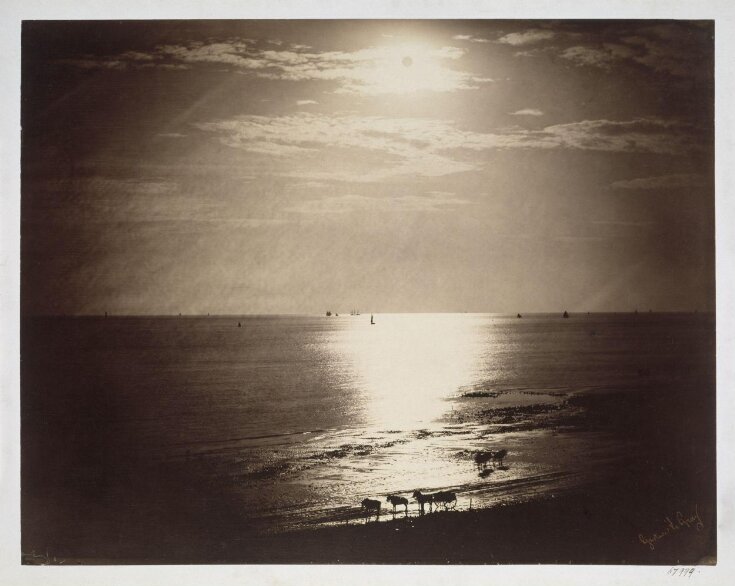
Le Gray shot directly into the sun for this photograph in an attempt to balance on one glass negative the exposure for a bright sky and a relatively dark sea. The sun has become a dark disc owing to a photochemical phenomenon in which extreme overexposure at an intense point of light reverses the tones on the negative.
Collodion-on-glass negatives were introduced in 1851. Le Gray adopted them in preference to paper negatives to achieve maximum sharpness coupled with even faster exposure times. The glass plate was covered with a solution of ether and guncotton (cotton steeped in nitric and sulphuric acids). It was then sensitised. The negative had to be exposed in the camera while still wet and developed immediately afterwards.
Collodion-on-glass negatives were introduced in 1851. Le Gray adopted them in preference to paper negatives to achieve maximum sharpness coupled with even faster exposure times. The glass plate was covered with a solution of ether and guncotton (cotton steeped in nitric and sulphuric acids). It was then sensitised. The negative had to be exposed in the camera while still wet and developed immediately afterwards.
Object details
| Categories | |
| Object type | |
| Title | The Sun at its Zenith - Ocean (assigned by artist) |
| Materials and techniques | Albumen print from a collodion-on-glass negative |
| Brief description | "The Sun at Zenith, Normandy" 1856-9.; 19thC, Townshend Bequest; Le Gray, Seascape, Normandy |
| Physical description | Photograph of sea and clouds |
| Dimensions |
|
| Gallery label | Le Gray shot directly into the sun for this photograph, in an attempt to balance on one glass negative the exposure for a bright sky and a relatively dark sea. The sun has become a dark disc, due to a photochemical phenomenon in which extreme over-exposure at an intense point of light reverses the tones on the negative.
Collodion-on-glass negatives were introduced in 1851. Le Gray adopted them in preference to paper negatives to achieve maximum sharpness coupled with even faster exposure times. The glass plate was covered with a solution of ether and guncotton (cotton steeped in nitric and sulphuric acids). It was then sensitised. The negative had to be exposed in the camera while still wet and developed immediately afterwards. |
| Historical context | Townshend bequest 1868 |
| Subjects depicted | |
| Summary | Le Gray shot directly into the sun for this photograph in an attempt to balance on one glass negative the exposure for a bright sky and a relatively dark sea. The sun has become a dark disc owing to a photochemical phenomenon in which extreme overexposure at an intense point of light reverses the tones on the negative. Collodion-on-glass negatives were introduced in 1851. Le Gray adopted them in preference to paper negatives to achieve maximum sharpness coupled with even faster exposure times. The glass plate was covered with a solution of ether and guncotton (cotton steeped in nitric and sulphuric acids). It was then sensitised. The negative had to be exposed in the camera while still wet and developed immediately afterwards. |
| Bibliographic references |
|
| Collection | |
| Accession number | 67999 |
About this object record
Explore the Collections contains over a million catalogue records, and over half a million images. It is a working database that includes information compiled over the life of the museum. Some of our records may contain offensive and discriminatory language, or reflect outdated ideas, practice and analysis. We are committed to addressing these issues, and to review and update our records accordingly.
You can write to us to suggest improvements to the record.
Suggest feedback
You can write to us to suggest improvements to the record.
Suggest feedback
| Record created | January 28, 2004 |
| Record URL |
Download as: JSONIIIF Manifest
