The Finding of Moses
Relief
ca. 1700-1710 (made)
ca. 1700-1710 (made)
| Artist/Maker | |
| Place of origin |
Patination is the process of artificially colouring the surface of the metal or changing its appearance. True patina is created by chemical changes to the surface through long exposure to the elements. Artificial patina is created through the application of drying oils, resins, pigments or acids to protect the surface or to enhance or change the colour of the metal. Heat is sometimes used in this process. The surface can also be enriched by adding
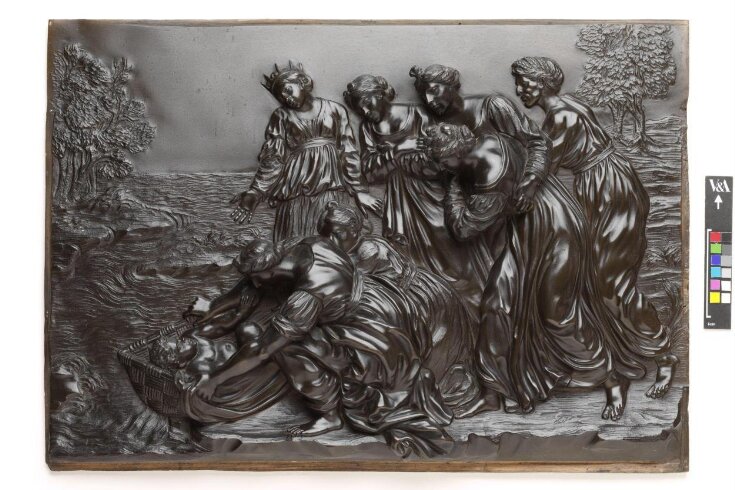
gold (‘gilding’) or silver. This relief and inv. no. A.32-1959 are based on scenes painted by Raphael in the Vatican Loggia in about 1518. The frescoes were not easy to see but prints made after them served as models for work in a variety of media. The reliefs were originally attributed to the Florentine sculptor Massimiliano Soldani-Benzi (1658–1740). However it is now believed that they were made by Giuseppe Piamontini and only cast in Soldani’s foundry.
gold (‘gilding’) or silver. This relief and inv. no. A.32-1959 are based on scenes painted by Raphael in the Vatican Loggia in about 1518. The frescoes were not easy to see but prints made after them served as models for work in a variety of media. The reliefs were originally attributed to the Florentine sculptor Massimiliano Soldani-Benzi (1658–1740). However it is now believed that they were made by Giuseppe Piamontini and only cast in Soldani’s foundry.
Object details
| Categories | |
| Object type | |
| Title | The Finding of Moses (generic title) |
| Materials and techniques | Bronze |
| Brief description | Relief, bronze, of the finding of Moses, attributed to Giuseppe Piamontini, Italian (Florence), ca. 1700-10 |
| Physical description | The scene takes place on a river bank. In the centre foreground two kneeling women clasp the basket containing the child Moses. Five female spectators stand behind him. Inscribed on the bottom edge: MAX. SOLDANUS.F.1710. |
| Dimensions |
|
| Marks and inscriptions | 'MAX. SOLDANUS.F.1710'. (Inscribed on the bottom edge:) |
| Credit line | Purchased with the assistance of the John Webb Trust |
| Object history | Bought together with A.32-1959, under the Webb Bequest, for £300. |
| Production | This relief and its companion (A.32-1959) are based on paintings in the Vatican Loggia by Raphael. They appear to form part of a set of eight reliefs by Giuseppe Piamontini, for which wax models were listed in the inventory of the Doccia ceramic factory. These reliefs were formerly believed to be by the leading Florentine sculptor, Massimiliano Soldani Benzi (1656-1740) as they were inscribed after casting in crude lettering under the base: 'MAX.SOLDANUS. F. 1710'. The inscription differs in both form and quality from all other known signatures by the artist, but the reliefs were possibly cast in his foundry. |
| Subjects depicted | |
| Summary | Patination is the process of artificially colouring the surface of the metal or changing its appearance. True patina is created by chemical changes to the surface through long exposure to the elements. Artificial patina is created through the application of drying oils, resins, pigments or acids to protect the surface or to enhance or change the colour of the metal. Heat is sometimes used in this process. The surface can also be enriched by adding gold (‘gilding’) or silver. This relief and inv. no. A.32-1959 are based on scenes painted by Raphael in the Vatican Loggia in about 1518. The frescoes were not easy to see but prints made after them served as models for work in a variety of media. The reliefs were originally attributed to the Florentine sculptor Massimiliano Soldani-Benzi (1658–1740). However it is now believed that they were made by Giuseppe Piamontini and only cast in Soldani’s foundry. |
| Associated object | A.32-1959 (Ensemble) |
| Bibliographic references |
|
| Collection | |
| Accession number | A.31-1959 |
About this object record
Explore the Collections contains over a million catalogue records, and over half a million images. It is a working database that includes information compiled over the life of the museum. Some of our records may contain offensive and discriminatory language, or reflect outdated ideas, practice and analysis. We are committed to addressing these issues, and to review and update our records accordingly.
You can write to us to suggest improvements to the record.
Suggest feedback
You can write to us to suggest improvements to the record.
Suggest feedback
| Record created | January 15, 2004 |
| Record URL |
Download as: JSONIIIF Manifest
