
Dressing Table
ca. 1754 (made)
| Artist/Maker | |
| Place of origin |
Object Type
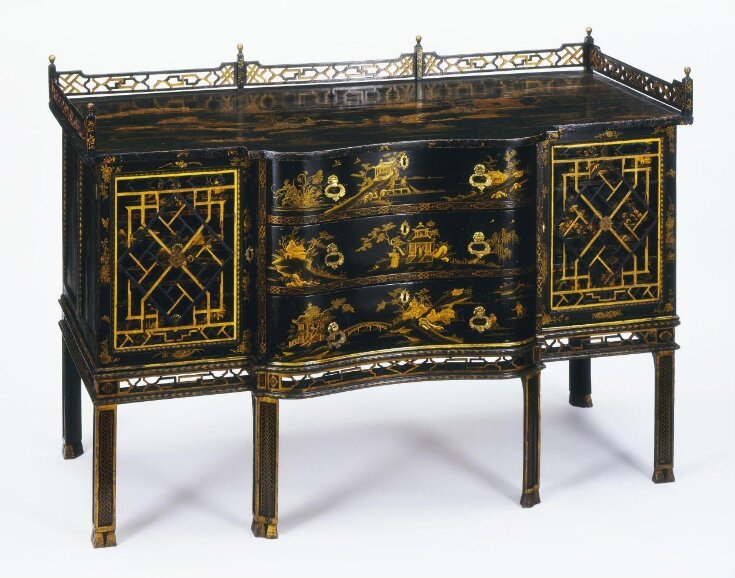
This dressing table is made of gilded, painted and japanned pinewood, with lattice doors in the Chinese style. It was made in about 1754 and is from the Duke's Bedchamber at Badminton House, Gloucestershire.
People
The dressing table was designed by John Linnell (1729 - 1796) and supplied by his father, William (1703 - 1763) to Charles Noel Somerset, 4th Duke of Beaufort (1709 - 1756) by 1754. They also made similar furniture in 1752 for Mrs Elizabeth Montagu (1720 - 1800), a leading authority on Shakespeare at that time.
Design & Designing
John Linnell had been a pupil of St. Martin's Lane Academy. A number of his furniture designs survive, including one for a chair now in V & A (museum no. E.71-1929). It is virtually identical to the set of eight 'Chinese' chairs from the Duke's bedchamber, at Badminton House.
Time
Publications like William Halfpenny's New Designs for Chinese Temples (1750) and Thomas Chippendale's Gentleman and Cabinet-Maker's Director'(1754) helped spread the fashion for all things Chinese. Mrs Montagu's Chinese-style furniture, made in 1752, was one of the earliest dated commissions of this type. Designs of Chinese Buildings, Furniture, Dresses, Machines and Utensils (1757) by Sir William Chambers (1723 -1796) offered cabinet-makers more authentic designs.
This dressing table is made of gilded, painted and japanned pinewood, with lattice doors in the Chinese style. It was made in about 1754 and is from the Duke's Bedchamber at Badminton House, Gloucestershire.
People
The dressing table was designed by John Linnell (1729 - 1796) and supplied by his father, William (1703 - 1763) to Charles Noel Somerset, 4th Duke of Beaufort (1709 - 1756) by 1754. They also made similar furniture in 1752 for Mrs Elizabeth Montagu (1720 - 1800), a leading authority on Shakespeare at that time.
Design & Designing
John Linnell had been a pupil of St. Martin's Lane Academy. A number of his furniture designs survive, including one for a chair now in V & A (museum no. E.71-1929). It is virtually identical to the set of eight 'Chinese' chairs from the Duke's bedchamber, at Badminton House.
Time
Publications like William Halfpenny's New Designs for Chinese Temples (1750) and Thomas Chippendale's Gentleman and Cabinet-Maker's Director'(1754) helped spread the fashion for all things Chinese. Mrs Montagu's Chinese-style furniture, made in 1752, was one of the earliest dated commissions of this type. Designs of Chinese Buildings, Furniture, Dresses, Machines and Utensils (1757) by Sir William Chambers (1723 -1796) offered cabinet-makers more authentic designs.
Object details
| Categories | |
| Object type | |
| Parts | This object consists of 24 parts.
|
| Materials and techniques | Pine and mahogany, with japanned decoration (painted with layers of pigmented varnish); handles of gilt bronze |
| Brief description | Japanned pinewood cabinet decorated with Chinese landscapes and figures. British (London), 1753. Designed by John Linnell and made by William Linnell. |
| Physical description | Japanned and parcel-gilt pinewood cabinet decorated with 'chinoiserie' landscapes and figures. |
| Dimensions |
|
| Style | |
| Production type | Unique |
| Gallery label |
|
| Object history | Commissioned by the 4th Duke and Duchess of Beaufort for the Chinese Bedroom at Badminton House, South Gloucestershire. Designed and supplied by the workshops of William and John Linnell, Berkeley Square, London. When Dr. Richard Pococke visited Badminton in 1754 he referred to the `Bedchamber finished and furnished very elegantly in the Chinese Manner' (Travels through England, II, p.31). The 1835 inventory (401.4.4.(2),the earliest to survive) mentions ‘a Chinese sideboard with Drawers' as being in the South Breakfast Room. The inventory of 1849 (RA1/1/10a) referrs to a `Chinese Cabinet with drawers & Secretary' as being in the Chinese Room. That of 1913 (N5/1/1) mentions a ‘4' 8" Wide Queen Anne Lac Cabinet fitted three drawers in centre at six ditto at sides the latter enclosed by trellis doors, decorated Chinese landscapes river scenes pagodas set in gilt top with pierced gallery shaped from on square legs'. It was sold at Christie's on 30th June 1921 (lot 61). Having passed through the ownership of Sir Philip Fandel Philips, Lady Ludlow and finally Mrs James Rank before being purchased by the V & A in 1952 (Sotheby's, 11th July 1952, lot 129). Historical significance: During the 1740s and 1750s, Chinese-inspired furniture was very fashionable. Engravers and aspiring cabinetmakers ranging from Battey Langley to Thomas Chippendale included designs for Chinese furniture. Joseph Goupy designed an octagonal House of Confucius at Kew, with walls made up of open lattice work. In 1750, William Halfpenny published New Designs for Chinese Temples, which included this type of Chinese lattice work. Despite her criticism of ‘the barbarous gaudy gout of the Chinese', Mrs Montague had a Chinese room at her own house in Hill Street, St. James's, decorated with very similar pieces of furniture by William Linnell, the highly fashionable cabinet maker of Berkeley Square. The Duke of Beaufort's Chinese furniture, already at Badminton by 1754, is probably the last examples of English Rococo-influenced Chinoiserie, before William Chambers, who had actually been to China, published his Designs of Chinese Buildings, Furniture, Dresses, Machines and Utensils in 1757. A pair of small china cabinets on stands, in the same Chinoiserie taste, were sold from Vaynol Hall, nr. Carnarvon, North Wales. Their history there is uncertain. |
| Production | No bill for the famous Badminton Chinoiserie room has survived but there is strong evidencefor the attribution to the Linnells. William Linnell supplied Mrs Montague with similar furniture for a Chinese Room at her house in Hill St., St. James's, London, in 1752. A design for a chair, very similar to the set of eight `Chinese' chairs, which belonged to the Duke's bedchamber, survives in a bound collection of drawings by William Linnell's son John, compiled in 1800 and now in the V&A's collection of designs (Museum number: E.71-1929). Reason For Production: Commission |
| Subjects depicted | |
| Summary | Object Type This dressing table is made of gilded, painted and japanned pinewood, with lattice doors in the Chinese style. It was made in about 1754 and is from the Duke's Bedchamber at Badminton House, Gloucestershire. People The dressing table was designed by John Linnell (1729 - 1796) and supplied by his father, William (1703 - 1763) to Charles Noel Somerset, 4th Duke of Beaufort (1709 - 1756) by 1754. They also made similar furniture in 1752 for Mrs Elizabeth Montagu (1720 - 1800), a leading authority on Shakespeare at that time. Design & Designing John Linnell had been a pupil of St. Martin's Lane Academy. A number of his furniture designs survive, including one for a chair now in V & A (museum no. E.71-1929). It is virtually identical to the set of eight 'Chinese' chairs from the Duke's bedchamber, at Badminton House. Time Publications like William Halfpenny's New Designs for Chinese Temples (1750) and Thomas Chippendale's Gentleman and Cabinet-Maker's Director'(1754) helped spread the fashion for all things Chinese. Mrs Montagu's Chinese-style furniture, made in 1752, was one of the earliest dated commissions of this type. Designs of Chinese Buildings, Furniture, Dresses, Machines and Utensils (1757) by Sir William Chambers (1723 -1796) offered cabinet-makers more authentic designs. |
| Bibliographic references |
|
| Collection | |
| Accession number | W.55:1 to 24-1952 |
About this object record
Explore the Collections contains over a million catalogue records, and over half a million images. It is a working database that includes information compiled over the life of the museum. Some of our records may contain offensive and discriminatory language, or reflect outdated ideas, practice and analysis. We are committed to addressing these issues, and to review and update our records accordingly.
You can write to us to suggest improvements to the record.
Suggest feedback
You can write to us to suggest improvements to the record.
Suggest feedback
| Record created | September 2, 1998 |
| Record URL |
Download as: JSONIIIF Manifest
