
Bowl
ca. 1220 (made)
| Artist/Maker | |
| Place of origin |
In many Islamic societies, scenes containing humans and animals were a common type of decoration in non-religious contexts. The source of this imagery was usually poetry, the most highly esteemed form of secular literature.
Luxury copies of narrative poems were often illustrated with fine paintings, and the more familiar episodes were depicted on palace walls and objects. Love lyrics accompanied portrayals of beautiful young men and women. Odes in praise of the ruler inspired enthronement scenes. The recitation of poems at court was depicted, as were princely activities such as hunting and playing polo.
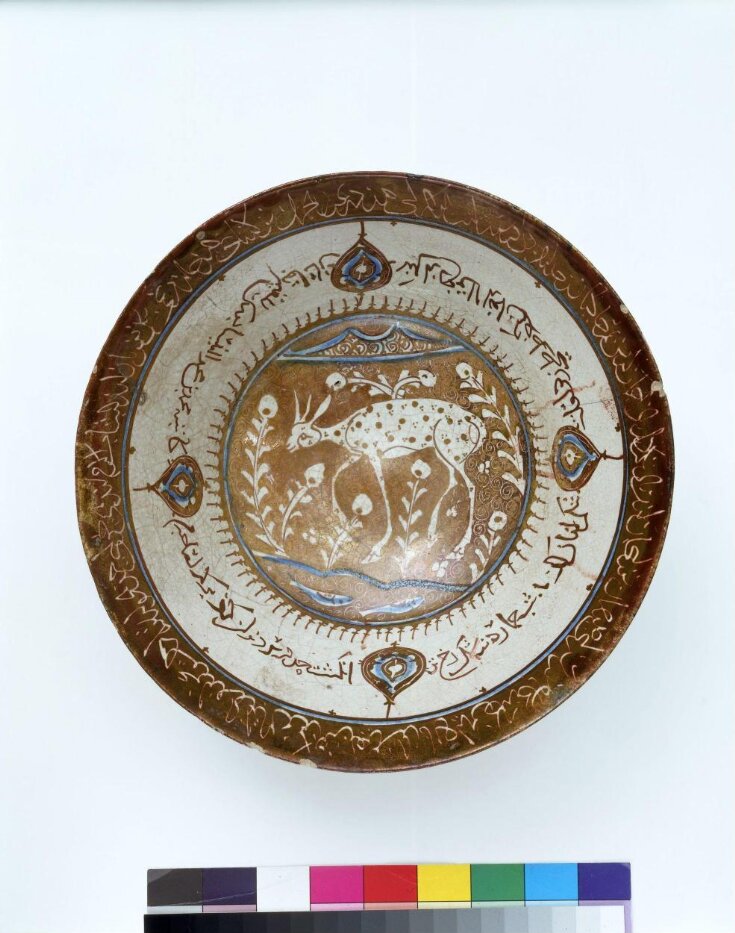
In the poetry recited at such entertainments, the gazelle was often a metaphor for elusive beauty. Appropriately, the gazelle on this bowl is surrounded by Persian verses.
Luxury copies of narrative poems were often illustrated with fine paintings, and the more familiar episodes were depicted on palace walls and objects. Love lyrics accompanied portrayals of beautiful young men and women. Odes in praise of the ruler inspired enthronement scenes. The recitation of poems at court was depicted, as were princely activities such as hunting and playing polo.
In the poetry recited at such entertainments, the gazelle was often a metaphor for elusive beauty. Appropriately, the gazelle on this bowl is surrounded by Persian verses.
Object details
| Categories | |
| Object type | |
| Materials and techniques | Fritware, with lustre decoration |
| Brief description | Bowl with lustre-painted representation of a gazelle by a stream surrounded by Persian verses, Iran (Kashan), ca. 1220. |
| Physical description | Fritware bowl with decoration in lustre highlighted with cobalt. The center of the bowl features a long-legged gazelle by a stream inhabited by two fish, while the cavetto has verses inscribed in lustre on a white background and the rim features verses in white on a lustre ground. |
| Dimensions |
|
| Styles | |
| Marks and inscriptions |
|
| Gallery label |
|
| Credit line | Given by Mr C. N. Ades MBE in memory of his wife Andrée Ades |
| Object history | This vessel was part of a hoard that was deliberately buried by its owner, probably a merchant who lived in Jurjan in north-east Iran, or who was passing through the city. In 1220, Jurjan was threatened by a Mongol invasion. The merchant packed the vessels in sand inside large storage jars and buried them for safekeeping. Soon afterwards, Jurjan was completely destroyed by the Mongols, and the owner never returned to recover the hoard.As a result, the vessels in this hoard survived together for almost 800 years, and in relatively good condition. The probable date of their burial also gives us a good indication of when the vessels in the hoard were made, as well as showing the wide variety of types of decoration that were used to make Iranian pottery at this time. Clement Ades gave a large number of objects found in the Jurjan hoard to the Victoria and Albert Museum at different times. Their object numbers are C.152 to 171-1977, and C.35 to 49-1978. |
| Historical context | This bowl was found at Jurjan, in north-east Iran, but was certainly made in Kashan. It feature many of the diagnostic elements of the fully-developed ‘Kashan style’, in which wares made throughout the thirteenth century were decorated. These include its conical shape and the use of underglaze blue for details. However, it also bears the signature of the potter Muhammad ibn Muhammad al-Nishapuri (from Nishapur), “residing at Kashan”. The main decoration features a long-legged gazelle by a stream, which is surrounded by two concentric bands containing quatrains of Persian poetry on the theme of love. |
| Subjects depicted | |
| Summary | In many Islamic societies, scenes containing humans and animals were a common type of decoration in non-religious contexts. The source of this imagery was usually poetry, the most highly esteemed form of secular literature. Luxury copies of narrative poems were often illustrated with fine paintings, and the more familiar episodes were depicted on palace walls and objects. Love lyrics accompanied portrayals of beautiful young men and women. Odes in praise of the ruler inspired enthronement scenes. The recitation of poems at court was depicted, as were princely activities such as hunting and playing polo. In the poetry recited at such entertainments, the gazelle was often a metaphor for elusive beauty. Appropriately, the gazelle on this bowl is surrounded by Persian verses. |
| Bibliographic references |
|
| Collection | |
| Accession number | C.162-1977 |
About this object record
Explore the Collections contains over a million catalogue records, and over half a million images. It is a working database that includes information compiled over the life of the museum. Some of our records may contain offensive and discriminatory language, or reflect outdated ideas, practice and analysis. We are committed to addressing these issues, and to review and update our records accordingly.
You can write to us to suggest improvements to the record.
Suggest feedback
You can write to us to suggest improvements to the record.
Suggest feedback
| Record created | September 1, 1998 |
| Record URL |
Download as: JSONIIIF Manifest
