
Bustle Pad
ca. 1875 (made)
| Artist/Maker | |
| Place of origin |
The bustle appeared in the late 1860s as part of the crinolette. As dresses became increasingly curvaceous at the back, they required more artificial aids for support. By the 1870s, the bustle became a separate undergarment in its own right. The new form of bustle was known as the 'tournure' or 'dress-improver', as Victorian ladies considered the word 'bustle' rather vulgar.
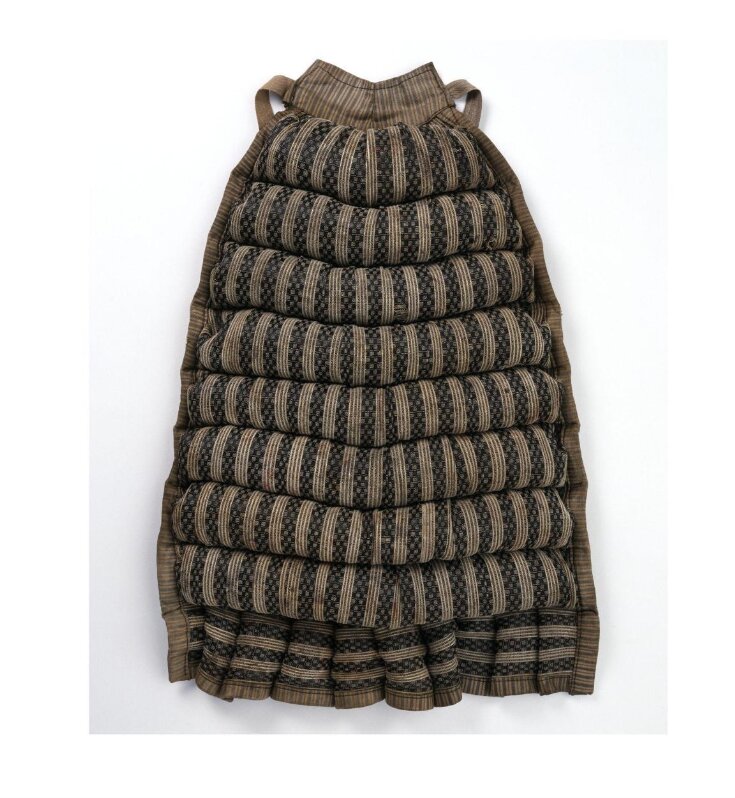
Bustles came in a variety of fabrics, including silk, cashmere, flannel, brightly printed cottons and horsehair. Some were constructed almost entirely of steel, others resembled colourful cushions. Bustles were often stiffened and padded with horsehair to retain their shape and give form to the dress. Tapes secured the bustle to the body. The wearer tied them over her petticoat around her waist, hips and often under her bottom.
Bustles came in a variety of fabrics, including silk, cashmere, flannel, brightly printed cottons and horsehair. Some were constructed almost entirely of steel, others resembled colourful cushions. Bustles were often stiffened and padded with horsehair to retain their shape and give form to the dress. Tapes secured the bustle to the body. The wearer tied them over her petticoat around her waist, hips and often under her bottom.
Object details
| Categories | |
| Object type | |
| Materials and techniques | Woven and padded horsehair, and linen |
| Brief description | Woven and padded horsehair bustle pad, England, ca. 1875 |
| Physical description | Bustle pad made from black and white horsehair fabric woven into a pattern of vertical stripes alternating with bands of checks. The edges are bound with blue and white striped cotton. The bustle is trapezoidal in shape and consists of horsehair padded bands machine stitched onto a ground of the same, and having a gathered frill at the bottom. It has tying tapes attached at the top and approximately half way down and almost at the bottom. It is machine stitched. |
| Marks and inscriptions | '1841' (Marked in pencil on a paper tag with eylet which is attached at the inside centre waist) |
| Credit line | Bequeathed by Mr E. W. Mynott |
| Summary | The bustle appeared in the late 1860s as part of the crinolette. As dresses became increasingly curvaceous at the back, they required more artificial aids for support. By the 1870s, the bustle became a separate undergarment in its own right. The new form of bustle was known as the 'tournure' or 'dress-improver', as Victorian ladies considered the word 'bustle' rather vulgar. Bustles came in a variety of fabrics, including silk, cashmere, flannel, brightly printed cottons and horsehair. Some were constructed almost entirely of steel, others resembled colourful cushions. Bustles were often stiffened and padded with horsehair to retain their shape and give form to the dress. Tapes secured the bustle to the body. The wearer tied them over her petticoat around her waist, hips and often under her bottom. |
| Collection | |
| Accession number | T.57-1980 |
About this object record
Explore the Collections contains over a million catalogue records, and over half a million images. It is a working database that includes information compiled over the life of the museum. Some of our records may contain offensive and discriminatory language, or reflect outdated ideas, practice and analysis. We are committed to addressing these issues, and to review and update our records accordingly.
You can write to us to suggest improvements to the record.
Suggest feedback
You can write to us to suggest improvements to the record.
Suggest feedback
| Record created | January 7, 2004 |
| Record URL |
Download as: JSONIIIF Manifest
