The Stoning of St Stephen
Woodcarving
ca. 1680 - ca. 1690 (carved)
ca. 1680 - ca. 1690 (carved)
| Artist/Maker | |
| Place of origin |
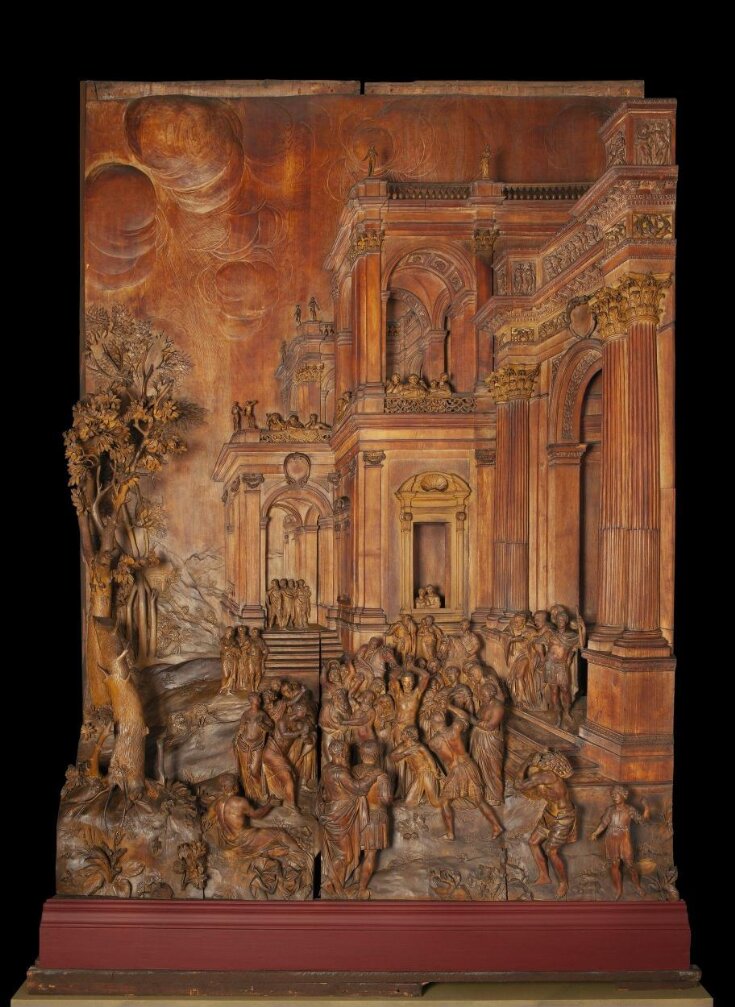
This limewood panel was carved by Grinling Gibbons, one of the most renowned woodcarvers and sculptors active in England during the second half of the seventeenth and early eighteenth centuries. The panel shows the Stoning of St Stephen, the first Christian martyr. He was put to death after arousing the wrath of the legislative council in Jerusalem by his sermon arguing for the divinity of Christ (Acts of the Apostles 7: 2-56). Stephen was one of the first seven deacons appointed by the Apostles, and is here shown in simple robes, in contrast with the classical dress of those stoning him. He is looking up to Heaven at a vision of Christ. Here, the scene takes place whithin grand Italianate buildings. Many of the diminutive figures are in classical poses and groupings, and although Gibbons never went to Rome himself, such elements show that he was familiar with both High Renaissance Painting and antique sculpture.
The panel was conceived as a decorative object, designed to be displayed on a wall. In this respect, it was like the famous panel in the Pitti Palace, Florence, which was made by Gibbons as a diplomatic gift from Charles II to Cosimo de' Medici, Grand Duke of Tuscany. Despite the biblical subject represented, it was probably intended for a secular context, rather than as a devotional piece. No record has survived of the commission for this piece and Gibbons may well have produced it for his own enjoyment, since the panel remained in the artist's possession until his death. It was probably included in the sale of his effects that took place shortly after his death in 1722 and bought at the sale by James Brydges, 1st Duke of Chandos, for his house at Cannons, Middlesex.
Grinling Gibbons (1648-1721) was born in Rotterdam, Holland and may have studied under Artus Quellinus I (1609-1668) before settling in England around 1667. He is famous for his intricate and virtuoso woodcarving, of which this piece is an outstanding example. He produced wood carvings and reliefs for royal and aristocratic patrons, such as the work carried out at Hampton Court, Windsor Castle and Petworth House, Sussex. His workshop also produced statuary and church monuments in stone and marble and statues cast in bronze.
The panel was conceived as a decorative object, designed to be displayed on a wall. In this respect, it was like the famous panel in the Pitti Palace, Florence, which was made by Gibbons as a diplomatic gift from Charles II to Cosimo de' Medici, Grand Duke of Tuscany. Despite the biblical subject represented, it was probably intended for a secular context, rather than as a devotional piece. No record has survived of the commission for this piece and Gibbons may well have produced it for his own enjoyment, since the panel remained in the artist's possession until his death. It was probably included in the sale of his effects that took place shortly after his death in 1722 and bought at the sale by James Brydges, 1st Duke of Chandos, for his house at Cannons, Middlesex.
Grinling Gibbons (1648-1721) was born in Rotterdam, Holland and may have studied under Artus Quellinus I (1609-1668) before settling in England around 1667. He is famous for his intricate and virtuoso woodcarving, of which this piece is an outstanding example. He produced wood carvings and reliefs for royal and aristocratic patrons, such as the work carried out at Hampton Court, Windsor Castle and Petworth House, Sussex. His workshop also produced statuary and church monuments in stone and marble and statues cast in bronze.
Delve deeper
Discover more about this object

interact
The Stoning of St Stephen by Grinling Gibbons
Although monumental in scale, this six foot tall carved wooden panel by Grinling Gibbons (1648 – 1721) depicts an intricately detailed, grisly crowd scene against a complex architectural backdrop. Gibbons' mastery of technique and composition give the piece an impressive illusion of depth ...

read
Grinling Gibbons – an introduction
Grinling Gibbons (1648 – 1721) is Britain's most celebrated wood carver, his name synonymous with an evergreen style of decoration that transformed the interiors of many of the nation's greatest palaces, churches and institutions. He was also a designer and ran a flourishing business suppl...
Object details
| Categories | |
| Object type | |
| Title | The Stoning of St Stephen (generic title) |
| Materials and techniques | Carved limewood and lancewood relief, with later paint |
| Brief description | Relief, carved limewood and lancewood (with some later paint), The Stoning of Saint Stephen, by Grinling Gibbons, England, c.1680-c.1690 |
| Physical description | Relief woodcarving in lime and lancewood. In the foreground there is a large group of figures, two on horseback, surrounding the dying saint, and behind are two buildings of classical design, in which are more spectators. On the left are trees, and in the background a landscape with heavy clouds. |
| Dimensions |
|
| Gallery label | This virtuoso piece of wood carving is made up of layers of wood fitted together. The fanciful architecture and use of perspective are reminiscent of of slightly earlier continental (especially the French and Italian) painting. The work was recorded by the antiquary George Vertue as having been in Gibbons' house in Bow Street, Covent Garden, in his Gallery of Pictures; it was later bought by the first Duke of Chandos, probably from the sale of Gibbons' effects shortly after the sculptor's death in 1721.(October 1993) |
| Object history | This panel was probably purchased by the Duke of Chandos at the sale of effects which took place in 1722 after Gibbons's death. It was at the Duke's seat, Canons in Middlesex, until the sale following its demolition in 1747, when it was bought by a Mr Gore; passing by descent through his family until 1839, it was in turn aquired by Mr Gordon Rebow and taken to Wivenhoe Park near Colchester. It entered the museum in 1898. |
| Subjects depicted | |
| Summary | This limewood panel was carved by Grinling Gibbons, one of the most renowned woodcarvers and sculptors active in England during the second half of the seventeenth and early eighteenth centuries. The panel shows the Stoning of St Stephen, the first Christian martyr. He was put to death after arousing the wrath of the legislative council in Jerusalem by his sermon arguing for the divinity of Christ (Acts of the Apostles 7: 2-56). Stephen was one of the first seven deacons appointed by the Apostles, and is here shown in simple robes, in contrast with the classical dress of those stoning him. He is looking up to Heaven at a vision of Christ. Here, the scene takes place whithin grand Italianate buildings. Many of the diminutive figures are in classical poses and groupings, and although Gibbons never went to Rome himself, such elements show that he was familiar with both High Renaissance Painting and antique sculpture. The panel was conceived as a decorative object, designed to be displayed on a wall. In this respect, it was like the famous panel in the Pitti Palace, Florence, which was made by Gibbons as a diplomatic gift from Charles II to Cosimo de' Medici, Grand Duke of Tuscany. Despite the biblical subject represented, it was probably intended for a secular context, rather than as a devotional piece. No record has survived of the commission for this piece and Gibbons may well have produced it for his own enjoyment, since the panel remained in the artist's possession until his death. It was probably included in the sale of his effects that took place shortly after his death in 1722 and bought at the sale by James Brydges, 1st Duke of Chandos, for his house at Cannons, Middlesex. Grinling Gibbons (1648-1721) was born in Rotterdam, Holland and may have studied under Artus Quellinus I (1609-1668) before settling in England around 1667. He is famous for his intricate and virtuoso woodcarving, of which this piece is an outstanding example. He produced wood carvings and reliefs for royal and aristocratic patrons, such as the work carried out at Hampton Court, Windsor Castle and Petworth House, Sussex. His workshop also produced statuary and church monuments in stone and marble and statues cast in bronze. |
| Bibliographic references |
|
| Collection | |
| Accession number | 446-1898 |
About this object record
Explore the Collections contains over a million catalogue records, and over half a million images. It is a working database that includes information compiled over the life of the museum. Some of our records may contain offensive and discriminatory language, or reflect outdated ideas, practice and analysis. We are committed to addressing these issues, and to review and update our records accordingly.
You can write to us to suggest improvements to the record.
Suggest feedback
You can write to us to suggest improvements to the record.
Suggest feedback
| Record created | August 20, 1998 |
| Record URL |
Download as: JSONIIIF Manifest
