The Ascension
Panel
ca. 1150-1160 (made)
ca. 1150-1160 (made)
| Artist/Maker | |
| Place of origin |
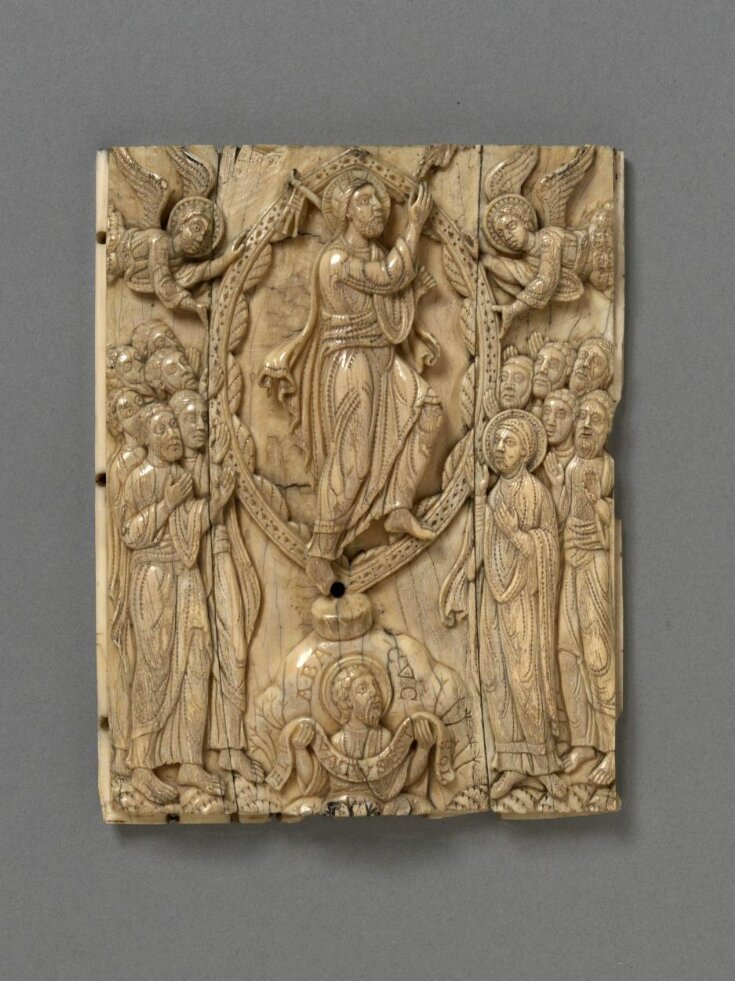
This is an ivory panel made in Cologne in about 1150-1160 representing the Ascension.
During the period 900-1200, ivories were produced all over Europe, often in monasteries and ecclesiastical or royal courts. Pieces such as these were used for liturgical purposes. Ivory carvings appeared on book covers, reliquary caskets, antependia (the panel in front of an altar) and religious icons.
Forty days after his Resurrection, Christ was taken up to heaven in a cloud by angels, leaving behind the apostles and the Virgin. Here the prophet Habakkuk is shown beneath, holding a scroll inscribed in Latin ‘The sun is risen’.
A place of production in Cologne and a date around the middle of the 12th century have been established for this and related pieces. The panel is part of six reliefs (in different museums) belonging together and which probably have once formed an altar frontal, or a setting on some other type of church furniture, such as a door or pulpit.
During the period 900-1200, ivories were produced all over Europe, often in monasteries and ecclesiastical or royal courts. Pieces such as these were used for liturgical purposes. Ivory carvings appeared on book covers, reliquary caskets, antependia (the panel in front of an altar) and religious icons.
Forty days after his Resurrection, Christ was taken up to heaven in a cloud by angels, leaving behind the apostles and the Virgin. Here the prophet Habakkuk is shown beneath, holding a scroll inscribed in Latin ‘The sun is risen’.
A place of production in Cologne and a date around the middle of the 12th century have been established for this and related pieces. The panel is part of six reliefs (in different museums) belonging together and which probably have once formed an altar frontal, or a setting on some other type of church furniture, such as a door or pulpit.
Object details
| Categories | |
| Object type | |
| Title | The Ascension (generic title) |
| Materials and techniques | Walrus ivory |
| Brief description | Panel relief, walrus ivory, The Ascension, Germany (Cologne), ca. 1150-1160 |
| Physical description | Relief in walrus ivory made up of slices of tusk fastened together; depicts the Ascension of our Saviour; Christ strides upwards in a mandorla, holding in his left hand the banner of the Resurrection. He steps up from a round stone on top of Mount Olivet, on which are incised flowers and the inscription ABACVC. This refers the prophet Habakkuk below, holding a scroll inscribed ELEVATUS EST SOL (Risen in the Sun). The mandorla is embellished with faux-jewelled effect and wisps of cloud decorate the inside. To the right are the Virgin and five apostles, to the left the other six apostles, and above are the Dextera Dei and two angels who grasp who grasp the mandorla. Panel is made up of three plaques of walrus ivory. dovetailed together. Black ink, clearly Post-Medieval fills the lines of the incised flowers below Habacuc. |
| Dimensions |
|
| Style | |
| Marks and inscriptions | 'ELEVATUS EST SOL' (Inscribed on scroll held by prophet Habacuc.)
|
| Object history | Purchased from Webb, £45. A place of production in Cologne and a date around the middle of the 12th century have been established for this and related pieces. The panel is part of six reliefs (in different museums) belonging together and which probably have once formed an altar frontal, or a setting on some other type of church furniture, such as a door or pulpit. |
| Subjects depicted | |
| Place depicted | |
| Summary | This is an ivory panel made in Cologne in about 1150-1160 representing the Ascension. During the period 900-1200, ivories were produced all over Europe, often in monasteries and ecclesiastical or royal courts. Pieces such as these were used for liturgical purposes. Ivory carvings appeared on book covers, reliquary caskets, antependia (the panel in front of an altar) and religious icons. Forty days after his Resurrection, Christ was taken up to heaven in a cloud by angels, leaving behind the apostles and the Virgin. Here the prophet Habakkuk is shown beneath, holding a scroll inscribed in Latin ‘The sun is risen’. A place of production in Cologne and a date around the middle of the 12th century have been established for this and related pieces. The panel is part of six reliefs (in different museums) belonging together and which probably have once formed an altar frontal, or a setting on some other type of church furniture, such as a door or pulpit. |
| Bibliographic references |
|
| Collection | |
| Accession number | 258-1867 |
About this object record
Explore the Collections contains over a million catalogue records, and over half a million images. It is a working database that includes information compiled over the life of the museum. Some of our records may contain offensive and discriminatory language, or reflect outdated ideas, practice and analysis. We are committed to addressing these issues, and to review and update our records accordingly.
You can write to us to suggest improvements to the record.
Suggest feedback
You can write to us to suggest improvements to the record.
Suggest feedback
| Record created | December 29, 2003 |
| Record URL |
Download as: JSONIIIF Manifest
