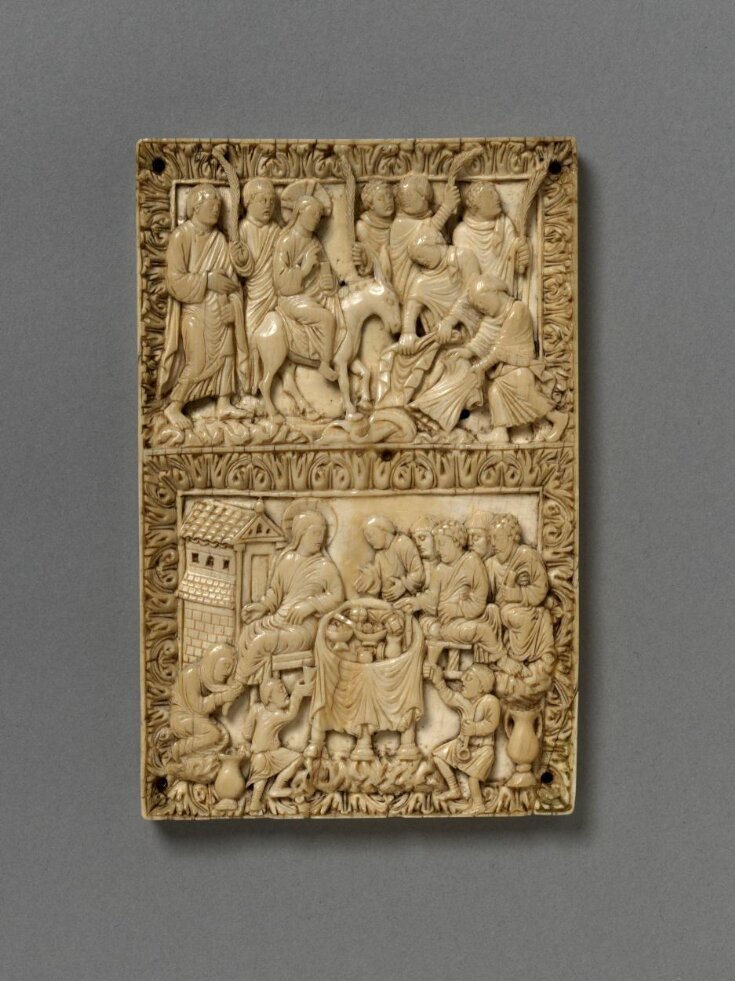
Christ in the House of Simon and the Entry into Jerusalem (obv.)
Panel
ca. 870-880 (made), late 8th century to early 9th century (made)
ca. 870-880 (made), late 8th century to early 9th century (made)
| Artist/Maker | |
| Place of origin |
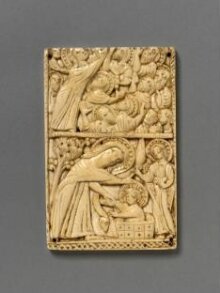
This is an ivory plaque probably made in Alto Adige / Tirol in the late eights to early ninth century and depicts the Baptism and the Ascension of Christ.
During the period 900-1200, ivories were produced all over Europe, often in monasteries and ecclesiastical or royal courts. Ivory carvings appeared on book covers, reliquary caskets, antependia (the panel in front of an altar) and religious icons. The upper half depicts the scene when Christ rode into Jerusalem on an ass. He arrived on the Sunday before Good Friday and was welcomed by the citizens with palm branches. In the lower half St Mary Magdalene is shown anointing Christ’s feet as he sits with his apostles for a meal in the house of Simon.
It has long been recognised that the present plaque is closely related stylistically to a diptych in the Musée de Cluny in Paris and a plaque showing Christ in Majesty with four angels now in the Bayerisches Nationalmuseum in Munich.
The relief was cut down at the top, losing the upper part of the Ascension which would have shown Christ, when the back was carved in the late ninth century. This face then became the reverse of the plaque, and was probably set into a recess on a book-cover. It is consequently abraded and rubbed at its highest points, especially on the faces and on the bodies of the Virgin and St. John the Baptist. The small triangular section of ivory at the bottom left corner of the plaque seems to have been added to create a square corner. This might indicate that the leaf was carved from a Late Antique diptych. The four holes in the corners were presumably made when the reverse of the plaque was put into use on a book-cover.
During the period 900-1200, ivories were produced all over Europe, often in monasteries and ecclesiastical or royal courts. Ivory carvings appeared on book covers, reliquary caskets, antependia (the panel in front of an altar) and religious icons. The upper half depicts the scene when Christ rode into Jerusalem on an ass. He arrived on the Sunday before Good Friday and was welcomed by the citizens with palm branches. In the lower half St Mary Magdalene is shown anointing Christ’s feet as he sits with his apostles for a meal in the house of Simon.
It has long been recognised that the present plaque is closely related stylistically to a diptych in the Musée de Cluny in Paris and a plaque showing Christ in Majesty with four angels now in the Bayerisches Nationalmuseum in Munich.
The relief was cut down at the top, losing the upper part of the Ascension which would have shown Christ, when the back was carved in the late ninth century. This face then became the reverse of the plaque, and was probably set into a recess on a book-cover. It is consequently abraded and rubbed at its highest points, especially on the faces and on the bodies of the Virgin and St. John the Baptist. The small triangular section of ivory at the bottom left corner of the plaque seems to have been added to create a square corner. This might indicate that the leaf was carved from a Late Antique diptych. The four holes in the corners were presumably made when the reverse of the plaque was put into use on a book-cover.
Object details
| Categories | |
| Object type | |
| Titles |
|
| Materials and techniques | Elephant ivory |
| Brief description | Panel, ivory, double-sided, depicting Christ in the House of Simon and the Entry into Jerusalem and on the reverse the Baptism and Ascension of Christ, Metz, ca. 1870-80 and (reverse) probably Alto Adige South Tirol, late 8th to early 9th century |
| Dimensions |
|
| Object history | From the Webb Collection. Formerly in the Soltikoff Collection (Sale, 1861, No.14). Purchased from Webb, £30. The relief was cut down at the top, losing the upper part of the Ascension which would have shown Christ, when the back was carved in the late ninth century. This face then became the reverse of the plaque, and was probably set into a recess on a book-cover. It is consequently abraded and rubbed at its highest points, especially on the faces and on the bodies of the Virgin and St. John the Baptist. The small triangular section of ivory at the bottom left corner of the plaque seems to have been added to create a square corner. This might indicate that the leaf was carved from a Late Antique diptych. The four holes in the corners were presumably made when the reverse of the plaque was put into use on a book-cover. |
| Historical context | It has long been recognised that the present plaque is closely related stylistically to a diptych in the Musée de Cluny in Paris and a plaque showing Christ in Majesty with four angels now in the Bayerisches Nationalmuseum in Munich. The Paris diptych has also been re-carved and its earlier side shaved down, but the outlines of the scenes are still legible and the halos visible. |
| Production | On the back is an earlier carving of the Ascension and the Baptism which is thought to be probably from Alto Adige, South Tirol, dating from the late 8th to the early 9th century. |
| Subjects depicted | |
| Summary | This is an ivory plaque probably made in Alto Adige / Tirol in the late eights to early ninth century and depicts the Baptism and the Ascension of Christ. During the period 900-1200, ivories were produced all over Europe, often in monasteries and ecclesiastical or royal courts. Ivory carvings appeared on book covers, reliquary caskets, antependia (the panel in front of an altar) and religious icons. The upper half depicts the scene when Christ rode into Jerusalem on an ass. He arrived on the Sunday before Good Friday and was welcomed by the citizens with palm branches. In the lower half St Mary Magdalene is shown anointing Christ’s feet as he sits with his apostles for a meal in the house of Simon. It has long been recognised that the present plaque is closely related stylistically to a diptych in the Musée de Cluny in Paris and a plaque showing Christ in Majesty with four angels now in the Bayerisches Nationalmuseum in Munich. The relief was cut down at the top, losing the upper part of the Ascension which would have shown Christ, when the back was carved in the late ninth century. This face then became the reverse of the plaque, and was probably set into a recess on a book-cover. It is consequently abraded and rubbed at its highest points, especially on the faces and on the bodies of the Virgin and St. John the Baptist. The small triangular section of ivory at the bottom left corner of the plaque seems to have been added to create a square corner. This might indicate that the leaf was carved from a Late Antique diptych. The four holes in the corners were presumably made when the reverse of the plaque was put into use on a book-cover. |
| Bibliographic references |
|
| Collection | |
| Accession number | 257-1867 |
About this object record
Explore the Collections contains over a million catalogue records, and over half a million images. It is a working database that includes information compiled over the life of the museum. Some of our records may contain offensive and discriminatory language, or reflect outdated ideas, practice and analysis. We are committed to addressing these issues, and to review and update our records accordingly.
You can write to us to suggest improvements to the record.
Suggest feedback
You can write to us to suggest improvements to the record.
Suggest feedback
| Record created | December 29, 2003 |
| Record URL |
Download as: JSONIIIF Manifest
