
Sir Thomas More, his household and descendants
Portrait Miniature
1593-1594 (painted)
1593-1594 (painted)
| Artist/Maker | |
| Place of origin |
Object Type
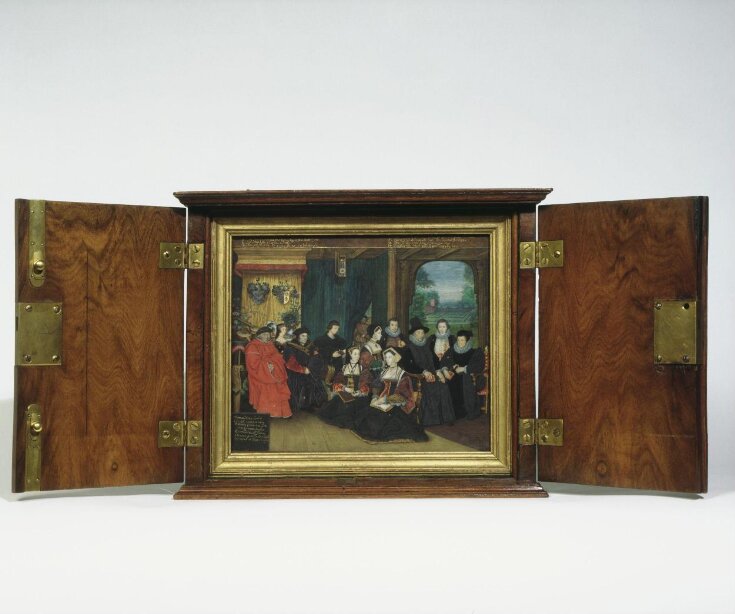
The term 'miniature' is a description of a watercolour technique rather than the size of a painting. So although this painting may seem quite large, it is a miniature because it is painted in watercolour on vellum (fine animal skin). Such large miniatures are today called 'cabinet miniatures'. This is a recent term for miniatures that would have been kept in a cupboard or a room hung with other small paintings. Both spaces were then called 'cabinets'.
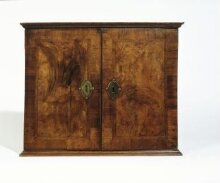
This miniature is in a frame with locking doors that was made for it by a former owner, the auctioneer John Sotheby (1740-1807).
Subjects Depicted
Sir Thomas More (1478-1535) was Lord Chancellor of England and also a distinguished scholar. In the picture he is seated beside his father, Sir John More. Behind him is his son John, holding a prayer book, and John's wife, Anne Cresacre. The three women in low-cut dresses in the centre are his daughters Cecily Heron (seated, with a closed book), Elizabeth Dauncey (standing) and Margaret Roper (seated, with an open book). The four figures with pleated ruffs are his grandson, also called Thomas More, with his wife Maria Scrope and their sons, John and Christopher Cresacre More. His 'fool' can be seen pushing through the curtain.
This is a sort of visual family tree. In fact, the four generations could not have sat together for the portrait.
Attribution
The attribution of the miniature to Rowland Lockey is linked to large oil version of this painting that is signed by him. We know that Lockey was an apprentice of Nicholas Hilliard (?1547-1619) and also practised as a miniaturist, so this miniature is likely to be by Lockey.
The term 'miniature' is a description of a watercolour technique rather than the size of a painting. So although this painting may seem quite large, it is a miniature because it is painted in watercolour on vellum (fine animal skin). Such large miniatures are today called 'cabinet miniatures'. This is a recent term for miniatures that would have been kept in a cupboard or a room hung with other small paintings. Both spaces were then called 'cabinets'.
This miniature is in a frame with locking doors that was made for it by a former owner, the auctioneer John Sotheby (1740-1807).
Subjects Depicted
Sir Thomas More (1478-1535) was Lord Chancellor of England and also a distinguished scholar. In the picture he is seated beside his father, Sir John More. Behind him is his son John, holding a prayer book, and John's wife, Anne Cresacre. The three women in low-cut dresses in the centre are his daughters Cecily Heron (seated, with a closed book), Elizabeth Dauncey (standing) and Margaret Roper (seated, with an open book). The four figures with pleated ruffs are his grandson, also called Thomas More, with his wife Maria Scrope and their sons, John and Christopher Cresacre More. His 'fool' can be seen pushing through the curtain.
This is a sort of visual family tree. In fact, the four generations could not have sat together for the portrait.
Attribution
The attribution of the miniature to Rowland Lockey is linked to large oil version of this painting that is signed by him. We know that Lockey was an apprentice of Nicholas Hilliard (?1547-1619) and also practised as a miniaturist, so this miniature is likely to be by Lockey.
Object details
| Categories | |
| Object type | |
| Title | Sir Thomas More, his household and descendants (generic title) |
| Materials and techniques | Watercolour on vellum, stuck onto card |
| Brief description | Miniature group portrait of Sir Thomas More, his household and descendants, watercolour on vellum, set in a walnut cabinet, painted by Rowland Lockey, 1593-1594. |
| Dimensions |
|
| Content description | Group portrait of a family seated in an interior. All the sitters are dressed in black with the exception of an elderly man in red on the extreme left of the scene. Behind him is a canopy of gold fabric decorated with two coats of arms. In the centre background a man peers from behind a curtain; to the right is a view of a formal garden through an arch. From left to right and as identified by the gold letters on their clothing: A: Sir John More (?1451-1530), a barrister, Serjeant at Law (1503), Judge of the Court of Common Please (1518) and one of the King’s Bench (1523); B: Sir Thomas More (1477/8-1535), Humanist and Chancellor; C: John More (?1509-47), Sir Thomas’s youngest child and only son; D: Anne Cresacre (1511-77), the only daughter and heiress of Edward Cresacre of Barnborough, Yorkshire, ward of Sir Thomas, whose son, John, she married in 1529; E: Thomas More II (1531-1606), son of John More and Anne Cresacre, who probably commissioned, from Lockey, the miniature; F: Mary Scrope (1534-1607), niece of Lord Scrope of Bolton and wife of Thomas More II; G: John More (1577-1599?) and Cresacre More (1572-1649), sons of Thomas More II; H: Cecily Heron (b. 1507), Elizabeth Dauncey (b. 1506) Margaret Roper (1505-1544), the three daughters. The figure in the background lifting the curtain is the More family jester, Henry Patenson. |
| Styles | |
| Marks and inscriptions |
|
| Credit line | Bequeathed by Anne Louise Strickland in memory of the Reverend J. E. Strickland |
| Object history | COLLECTIONS: Purchased by James Sotheby, 1705, from an unidentified Lady Gerrard, a More family descendant, for £10.15 sh; seen by Vertue in 1742 at Ecton Hall when in the possession of James Sotheby’s son: “another Curious limning being the family piece of Sr Thomas More and his Father son and 3 daughters, his sons wife. Cresacre – his grandson Thomas More. & his Lady Scroope & their two Sons. standing – a prospect of his Gardens at Chelsea appears part of his Gallery & chapel at the distance. London spires very small. above this is the names of each person writ in small – the father of Mr. Southbys. bought this limning many years ago of a Gentlewoman who was under some necessity. – and was as I hear before (sold to him by a) daughter of one of the Mores family…” (Vertue, Notebooks, V, Walpole Society, XXVI, 1937-38, pp. 10-11); thence by descent in the Sotheby family; sold Sotheby’s October 11th 1955 (lot 67) bt the Rev. J. E. Strickland; bequeathed by his widow, Anne Louise Strickland to V&A in memory of her husband, 1973. |
| Subjects depicted | |
| Summary | Object Type The term 'miniature' is a description of a watercolour technique rather than the size of a painting. So although this painting may seem quite large, it is a miniature because it is painted in watercolour on vellum (fine animal skin). Such large miniatures are today called 'cabinet miniatures'. This is a recent term for miniatures that would have been kept in a cupboard or a room hung with other small paintings. Both spaces were then called 'cabinets'. This miniature is in a frame with locking doors that was made for it by a former owner, the auctioneer John Sotheby (1740-1807). Subjects Depicted Sir Thomas More (1478-1535) was Lord Chancellor of England and also a distinguished scholar. In the picture he is seated beside his father, Sir John More. Behind him is his son John, holding a prayer book, and John's wife, Anne Cresacre. The three women in low-cut dresses in the centre are his daughters Cecily Heron (seated, with a closed book), Elizabeth Dauncey (standing) and Margaret Roper (seated, with an open book). The four figures with pleated ruffs are his grandson, also called Thomas More, with his wife Maria Scrope and their sons, John and Christopher Cresacre More. His 'fool' can be seen pushing through the curtain. This is a sort of visual family tree. In fact, the four generations could not have sat together for the portrait. Attribution The attribution of the miniature to Rowland Lockey is linked to large oil version of this painting that is signed by him. We know that Lockey was an apprentice of Nicholas Hilliard (?1547-1619) and also practised as a miniaturist, so this miniature is likely to be by Lockey. |
| Bibliographic reference | Strong, Roy. Artists of the Tudor Court: the Portrait Miniature Rediscovered 1520-1620. London: The Victoria and Albert Museum, 1983.Cat. 267, pp. 159-161. Part Citation: "... The miniature depicting Sir Thomas More, his family and descendants is a unique visual document which can only be understood be reference to the original Holbein painting of Sir Thomas and his family and to other paintings connected with it, commissioned at the same time as the miniature by Thomas More II in the late Elizabethan period. The most complete discussions of this are in S. Morison and N. Barker, The Likeness of Thomas More, London, 1963, pp. 18 ff. and Strong, Tudor and Jacobean, I, pp. 345-51.
One of Holbein’s earliest commissions when he arrived in England in 1527 was the famous, lost, Family Group of the More family. It was executed in the fragile medium of distemper and is known to us best by Holbein’s sketch sent to Erasmus as an interim report before the picture was finished in 1528... There is no doubt that it belonged to Thomas More II in the 1590s and that it was he and his relatives who probably commissioned Rowland Lockey to execute three paintings: (i) the life-size copy of the picture as it was which, signed by Rowland Lockey, is now in the collection of Lord St. Oswald; (ii) a second life-size copy of the picture which introduced, to the right, Sir Thomas’s descendants and which is now in the National Portrait Gallery. (iii) the miniature version of (ii) but again with further slight variants, in particular, the introduction of a view of a garden through an arch to the right... The portrait content of the miniature establishes that it must have originated directly with Thomas More II. ... Both large-scale picture and miniature transmute what Holbein had conceived with daring originality as a family 'conversation piece', into a genealogical family tree brought to life, accentuated by the introduction of coats of arms. In the miniature these float before the canopy over the buffet and, although, on a minute scale and damaged, recording (left) those of More (Quarterly; 1 and 4 Argent a Chevron engrailed between three Moorcocks Sable crested Gules; 2 and 3, Argent on a Chevron between three Unicorns’ Heads erased Sable as many Bezants) and (right) those of Cresacre (of three Lions rampant guardant Gules) quartering those of More.
The main difference from the large version is the dropping of the portrait of Anne Cresacre on the right in favour of a garden view...the panorama in the distance seems to be London with Old St Paul’s in the centre...All one can say is that it is a rare view of a Tudor garden, enclosed by walls with a banqueting house in one corner and the centre laid out in knots surrounded by low clipped hedges. The attribution of the miniature follows from the documentation of the large group being by Lockey and our knowledge that he was a pupil of Hilliard and practised as a miniaturist. This group must be the cornerstone for any further attributions to him." |
| Collection | |
| Accession number | P.15-1973 |
About this object record
Explore the Collections contains over a million catalogue records, and over half a million images. It is a working database that includes information compiled over the life of the museum. Some of our records may contain offensive and discriminatory language, or reflect outdated ideas, practice and analysis. We are committed to addressing these issues, and to review and update our records accordingly.
You can write to us to suggest improvements to the record.
Suggest feedback
You can write to us to suggest improvements to the record.
Suggest feedback
| Record created | August 12, 1998 |
| Record URL |
Download as: JSONIIIF Manifest
