
The Castlereagh Inkstand
Inkstand
1817-1819 (made)
1817-1819 (made)
| Artist/Maker | |
| Place of origin |
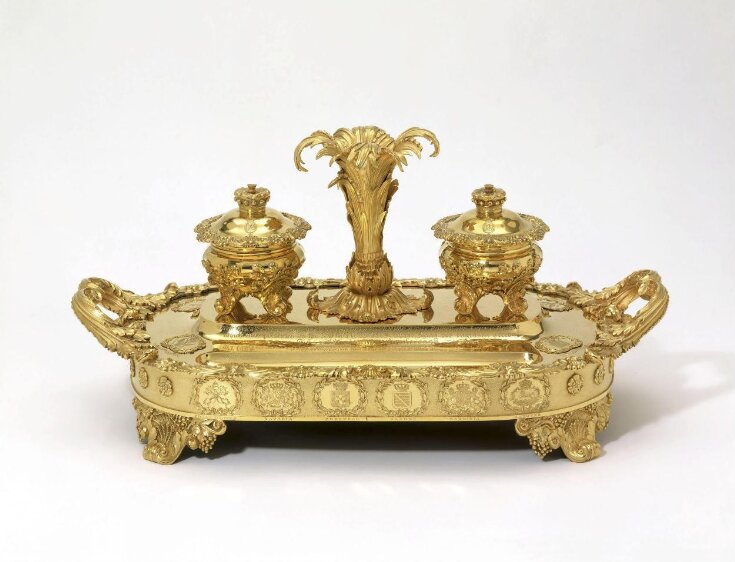
The Castlereagh inkstand is a magnificent memorial to diplomacy in the age of Napoleon. Its origins are set out in an inscription on the stand:
'This inkstand is composed of the gold taken from the portrait snuff boxes which were presented by the SOVEREIGNS of Europe whose Arms are engraved hereon to Viscount Castlereagh upon the signature of the several treaties concluded in the Years 1813, 1814, & 1815'
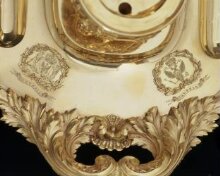
Castlereagh's tireless efforts as Foreign Secretary to negotiate the alliances and treaties which culminated in the Treaties of Paris in 1814 and 1815, and the Treaty of Vienna in 1815, made him one of the principal architects of the defeat of Napoleon and of the reconstruction of Europe. The arms engraved on top of the platform of the inkstand are those of the four great Continental powers--Austria, Prussia, Russia and restored Bourbon France. On the sides are the arms of the Roman States--Bavaria, Portugal, Saxony, Sardinia, Hanover, Sweden, Württemberg, Naples, Spain, Denmark and the Netherlands.
Twenty-one of the gold boxes which Castlereagh had received from the sovereigns were deposited with Rundell's, the royal goldsmiths, on 6 March 1817. The inkstand was completed in 1819 at a cost of £1135 9s, with a further £15 12s for the engraved arms. A note from Rundell's in the Londonderry papers explains that the inkstand had been envisaged at a weight of 100 troy oz., but that Castlereagh had modified the original design of two tripods and one vase to a design incorporating two vases and the splendid palm tree taperstick, taking the weight to 148 troy oz..
'This inkstand is composed of the gold taken from the portrait snuff boxes which were presented by the SOVEREIGNS of Europe whose Arms are engraved hereon to Viscount Castlereagh upon the signature of the several treaties concluded in the Years 1813, 1814, & 1815'
Castlereagh's tireless efforts as Foreign Secretary to negotiate the alliances and treaties which culminated in the Treaties of Paris in 1814 and 1815, and the Treaty of Vienna in 1815, made him one of the principal architects of the defeat of Napoleon and of the reconstruction of Europe. The arms engraved on top of the platform of the inkstand are those of the four great Continental powers--Austria, Prussia, Russia and restored Bourbon France. On the sides are the arms of the Roman States--Bavaria, Portugal, Saxony, Sardinia, Hanover, Sweden, Württemberg, Naples, Spain, Denmark and the Netherlands.
Twenty-one of the gold boxes which Castlereagh had received from the sovereigns were deposited with Rundell's, the royal goldsmiths, on 6 March 1817. The inkstand was completed in 1819 at a cost of £1135 9s, with a further £15 12s for the engraved arms. A note from Rundell's in the Londonderry papers explains that the inkstand had been envisaged at a weight of 100 troy oz., but that Castlereagh had modified the original design of two tripods and one vase to a design incorporating two vases and the splendid palm tree taperstick, taking the weight to 148 troy oz..
Delve deeper
Discover more about this object

Object details
| Categories | |
| Object type | |
| Parts | This object consists of 7 parts.
|
| Title | The Castlereagh Inkstand (popular title) |
| Materials and techniques | Cast, raised, embossed, chased, and engraved gold; wood support inside stand |
| Brief description | Gold inkstand with two vases flanking a palm tree, supplied by Rundell, Bridge & Rundell, London, 1817-1819 |
| Dimensions |
|
| Style | |
| Credit line | Accepted by HM Government in lieu of Tax and allocated to the Victoria and Albert Museum, 2003, with additional funding provided by the National Lottery Heritage Fund, Art Fund (with a contribution from the Wolfson Foundation), the Friends of the V&A, and the Barber, Bryan and Vallentin Funds |
| Subjects depicted | |
| Summary | The Castlereagh inkstand is a magnificent memorial to diplomacy in the age of Napoleon. Its origins are set out in an inscription on the stand: 'This inkstand is composed of the gold taken from the portrait snuff boxes which were presented by the SOVEREIGNS of Europe whose Arms are engraved hereon to Viscount Castlereagh upon the signature of the several treaties concluded in the Years 1813, 1814, & 1815' Castlereagh's tireless efforts as Foreign Secretary to negotiate the alliances and treaties which culminated in the Treaties of Paris in 1814 and 1815, and the Treaty of Vienna in 1815, made him one of the principal architects of the defeat of Napoleon and of the reconstruction of Europe. The arms engraved on top of the platform of the inkstand are those of the four great Continental powers--Austria, Prussia, Russia and restored Bourbon France. On the sides are the arms of the Roman States--Bavaria, Portugal, Saxony, Sardinia, Hanover, Sweden, Württemberg, Naples, Spain, Denmark and the Netherlands. Twenty-one of the gold boxes which Castlereagh had received from the sovereigns were deposited with Rundell's, the royal goldsmiths, on 6 March 1817. The inkstand was completed in 1819 at a cost of £1135 9s, with a further £15 12s for the engraved arms. A note from Rundell's in the Londonderry papers explains that the inkstand had been envisaged at a weight of 100 troy oz., but that Castlereagh had modified the original design of two tripods and one vase to a design incorporating two vases and the splendid palm tree taperstick, taking the weight to 148 troy oz.. |
| Bibliographic reference | Telesko, Werner. 'The Visual "Afterlife" of the Congress of Vienna', in Agnes Husslein-Arco, Sabine Grabner and Werner Telesko, eds, Europe in Vienna: The Congress of Vienna 1814/15 [Catalogue of the exhibition held February 20 - June 21 2015, at the Orangery and the Lower Belvedere, Vienna]. Munich: Hirmer Verlag, 2015, pp. 327-381 (plate 238, p. 376). ISBN 978 3 902805 66 9. |
| Collection | |
| Accession number | M.8:1 to 7-2003 |
About this object record
Explore the Collections contains over a million catalogue records, and over half a million images. It is a working database that includes information compiled over the life of the museum. Some of our records may contain offensive and discriminatory language, or reflect outdated ideas, practice and analysis. We are committed to addressing these issues, and to review and update our records accordingly.
You can write to us to suggest improvements to the record.
Suggest feedback
You can write to us to suggest improvements to the record.
Suggest feedback
| Record created | December 17, 2003 |
| Record URL |
Download as: JSONIIIF Manifest
