
Inrõ
ca. 1775-1800 (made)
| Artist/Maker | |
| Place of origin |
The inro is a container made up of tiers. Japanese men used them because the traditional Japanese garment, the kimono, had no pockets. From the late 1500s onwards, Japanese men wore the inro suspended from their sash by a silk cord and a netsuke (toggle). They originally used it to hold their seal and ink or a supply of medicines. However, it rapidly became a costly fashion accessory of little or no practical use. Most inro are rectangular with gently curving sides. This example is unusually wide and short.
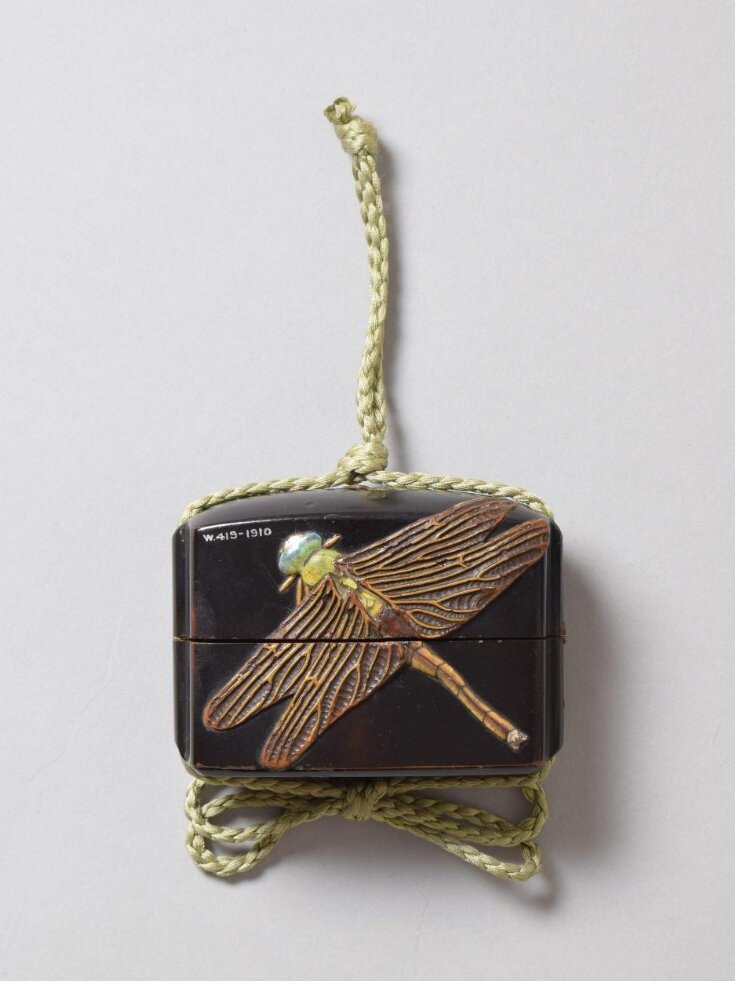
Lacquer was most commonly used in the manufacture of inro since it was highly suitable for storing medicines. Lacquer is the sap from the tree Rhus verniciflua that grows mainly in East Asia. After processing, it is applied in many thin layers to a base material. The craft of lacquering, as well as making inro bodies, is highly complex, time-consuming and expensive. This example is decorated with dragonflies in lacquer, encrusted with glazed pottery.
From the 1700s onwards, many artists signed the inro they made. This example is signed Mochizuki Hanzan. Hanzan (1743-90?) was one of the most talented followers of Ogawa Haritsu (1663-1747), though he was neither a son nor pupil of his. Haritsu was a highly individual and innovative lacquer craftsman whose work is characterised by the inlay of a wide variety of materials, such as glazed pottery. This inro shows that Hanzan had an innovative approach to his work like that of the master he admired.
Lacquer was most commonly used in the manufacture of inro since it was highly suitable for storing medicines. Lacquer is the sap from the tree Rhus verniciflua that grows mainly in East Asia. After processing, it is applied in many thin layers to a base material. The craft of lacquering, as well as making inro bodies, is highly complex, time-consuming and expensive. This example is decorated with dragonflies in lacquer, encrusted with glazed pottery.
From the 1700s onwards, many artists signed the inro they made. This example is signed Mochizuki Hanzan. Hanzan (1743-90?) was one of the most talented followers of Ogawa Haritsu (1663-1747), though he was neither a son nor pupil of his. Haritsu was a highly individual and innovative lacquer craftsman whose work is characterised by the inlay of a wide variety of materials, such as glazed pottery. This inro shows that Hanzan had an innovative approach to his work like that of the master he admired.
Object details
| Categories | |
| Object type | |
| Materials and techniques | Black, gold, brown and red lacquer and glazed pottery |
| Brief description | Inrõ, depicting dragonflies in black, gold, brown and red lacquer with glazed pottery, signed Mochizuki Hanzan, ca.1775 - 1800 |
| Physical description | Inrõ or small container, black, gold and brown lacquer and glazed pottery with a dragonfly decorating the surface. |
| Dimensions |
|
| Styles | |
| Credit line | Salting Bequest |
| Object history | Bequeathed by Mr. George Salting, accessioned in 1910. This acquisition information reflects that found in the Asia Department registers, as part of a 2022 provenance research project. |
| Subject depicted | |
| Summary | The inro is a container made up of tiers. Japanese men used them because the traditional Japanese garment, the kimono, had no pockets. From the late 1500s onwards, Japanese men wore the inro suspended from their sash by a silk cord and a netsuke (toggle). They originally used it to hold their seal and ink or a supply of medicines. However, it rapidly became a costly fashion accessory of little or no practical use. Most inro are rectangular with gently curving sides. This example is unusually wide and short. Lacquer was most commonly used in the manufacture of inro since it was highly suitable for storing medicines. Lacquer is the sap from the tree Rhus verniciflua that grows mainly in East Asia. After processing, it is applied in many thin layers to a base material. The craft of lacquering, as well as making inro bodies, is highly complex, time-consuming and expensive. This example is decorated with dragonflies in lacquer, encrusted with glazed pottery. From the 1700s onwards, many artists signed the inro they made. This example is signed Mochizuki Hanzan. Hanzan (1743-90?) was one of the most talented followers of Ogawa Haritsu (1663-1747), though he was neither a son nor pupil of his. Haritsu was a highly individual and innovative lacquer craftsman whose work is characterised by the inlay of a wide variety of materials, such as glazed pottery. This inro shows that Hanzan had an innovative approach to his work like that of the master he admired. |
| Bibliographic reference | Greenhalgh, Paul (Ed.), Art Nouveau: 1890-1914. London: V&A Publications, 2000
|
| Collection | |
| Accession number | W.419-1910 |
About this object record
Explore the Collections contains over a million catalogue records, and over half a million images. It is a working database that includes information compiled over the life of the museum. Some of our records may contain offensive and discriminatory language, or reflect outdated ideas, practice and analysis. We are committed to addressing these issues, and to review and update our records accordingly.
You can write to us to suggest improvements to the record.
Suggest feedback
You can write to us to suggest improvements to the record.
Suggest feedback
| Record created | December 16, 2003 |
| Record URL |
Download as: JSONIIIF Manifest
