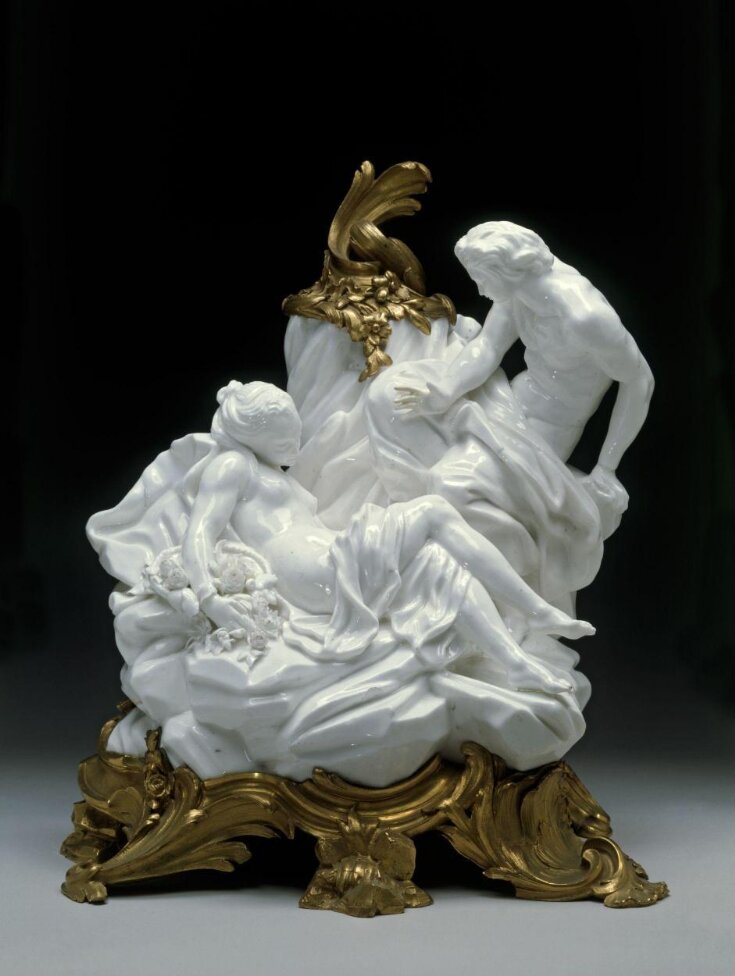
L'Heure du Berger
Figure Group
1750-1755 (made)
1750-1755 (made)
| Artist/Maker | |
| Place of origin |
The most important French porcelain factory was founded in 1740 in the royal chateau of Vincennes. In 1756 it was transferred to Sèvres, the other side of Paris, and shortly after was bought by Louis XV. The support and protection of the king and his mistress, Madame de Pompadour, enabled it to secure the best artists, sculptors, designers and chemists. Sèvres porcelain soon became the most sought after in Europe.
The royal manufactory at Sèvres specialised in luxury porcelains, many of which were destined for the French court. Each year it displayed its newest models in the king's apartments at Versailles. The factory was very responsive to changes in fashion and introduced many innovations in design and decoration. Its products were admired throughout Europe and its style was widely imitated.
This figure group is one of Vincennes' earliest productions, probably made before the introduction of biscuit porcelain for sculptural work in 1751. It showcases the factory's much admired ivory white 'soft-paste' body. Like other 'soft-pastes' (imitation porcelains), this was made with a variety of ingredients other than kaolin and china stone. These includes sand, saltpetre and alabaster, which could be fused together for up to 50 hours, ground up for about three weeks, dried and crushed again, before being mixed with clay. Incredibly expensive and labout intensive to produce - and also vulnerable to damage during firing and use - this was eventually phased out after the discovery of kaolin at Limoges and the subsequent manufacture of 'hard paste' in the 1770s.
The royal manufactory at Sèvres specialised in luxury porcelains, many of which were destined for the French court. Each year it displayed its newest models in the king's apartments at Versailles. The factory was very responsive to changes in fashion and introduced many innovations in design and decoration. Its products were admired throughout Europe and its style was widely imitated.
This figure group is one of Vincennes' earliest productions, probably made before the introduction of biscuit porcelain for sculptural work in 1751. It showcases the factory's much admired ivory white 'soft-paste' body. Like other 'soft-pastes' (imitation porcelains), this was made with a variety of ingredients other than kaolin and china stone. These includes sand, saltpetre and alabaster, which could be fused together for up to 50 hours, ground up for about three weeks, dried and crushed again, before being mixed with clay. Incredibly expensive and labout intensive to produce - and also vulnerable to damage during firing and use - this was eventually phased out after the discovery of kaolin at Limoges and the subsequent manufacture of 'hard paste' in the 1770s.
Delve deeper
Discover more about this object
Object details
| Categories | |
| Object type | |
| Title | L'Heure du Berger (assigned by artist) |
| Materials and techniques | Biscuit porcelain, with gilt metal mount |
| Brief description | L'Heure du Berger group, perhaps representing Zephyrus and Flora, although previously thought to be Venus and Adonis, biscuit porcelain with gilt metal mount,Vincennes manufactory, France, 1750-1755. |
| Physical description | L'Heure du Berger group, perhaps representing Zephyrus and Flora, biscuit porcelain with gilt metal mount,Vincennes manufactory, France, c.1748-1755 |
| Dimensions |
|
| Style | |
| Credit line | Given by J. H. Fitzhenry |
| Object history | This model has been identified from the Vincennes records as a figure of L'Heure du Berger, probably inspired by the engraving Le repos de Diane by Jean Pelletier (1736-?) after the painting by François Boucher. For the engraving see Pierrette Jean-Richard, L'oeuvre grave de Francois Boucher dans la Collection Edmond de Rothschild, 1978, pp. 350-351, no. 1454. The Vincennes inventory of 1st October 1752 lists seventeen 'Groupes heures du Berger', priced at 40 livres each (Tamara Préaud and Antoine d'Albis, La Porcelaine de Vincennes, 1991, p. 169, no. 167). Other examples of the figure group are in (1) the Musée National de Céramique, Sèvres (illustrated in Tamara Préaud and Antoine d'Albis, La Porcelaine de Vincennes, 1991, p. 169, no. 167); (2) the Fitzwilliam Museum, Cambridge, EC.3-1944. Sold at Sotheby's London, The property of a Lady, 14th July 1944, lot 28 purchased by Friends of the Fitzwilliam. (3) the Philadelphia Museum of Art (1984-135-10). |
| Subjects depicted | |
| Summary | The most important French porcelain factory was founded in 1740 in the royal chateau of Vincennes. In 1756 it was transferred to Sèvres, the other side of Paris, and shortly after was bought by Louis XV. The support and protection of the king and his mistress, Madame de Pompadour, enabled it to secure the best artists, sculptors, designers and chemists. Sèvres porcelain soon became the most sought after in Europe. The royal manufactory at Sèvres specialised in luxury porcelains, many of which were destined for the French court. Each year it displayed its newest models in the king's apartments at Versailles. The factory was very responsive to changes in fashion and introduced many innovations in design and decoration. Its products were admired throughout Europe and its style was widely imitated. This figure group is one of Vincennes' earliest productions, probably made before the introduction of biscuit porcelain for sculptural work in 1751. It showcases the factory's much admired ivory white 'soft-paste' body. Like other 'soft-pastes' (imitation porcelains), this was made with a variety of ingredients other than kaolin and china stone. These includes sand, saltpetre and alabaster, which could be fused together for up to 50 hours, ground up for about three weeks, dried and crushed again, before being mixed with clay. Incredibly expensive and labout intensive to produce - and also vulnerable to damage during firing and use - this was eventually phased out after the discovery of kaolin at Limoges and the subsequent manufacture of 'hard paste' in the 1770s. |
| Bibliographic reference | Greenhalgh, Paul (Ed.), Art Nouveau: 1890-1914 . London: V&A Publications, 2000
|
| Collection | |
| Accession number | C.356-1909 |
About this object record
Explore the Collections contains over a million catalogue records, and over half a million images. It is a working database that includes information compiled over the life of the museum. Some of our records may contain offensive and discriminatory language, or reflect outdated ideas, practice and analysis. We are committed to addressing these issues, and to review and update our records accordingly.
You can write to us to suggest improvements to the record.
Suggest feedback
You can write to us to suggest improvements to the record.
Suggest feedback
| Record created | December 16, 2003 |
| Record URL |
Download as: JSONIIIF Manifest
