
The Stein Collection
Banner Head
9th century to 10th century (made)
9th century to 10th century (made)
| Artist/Maker | |
| Place of origin |
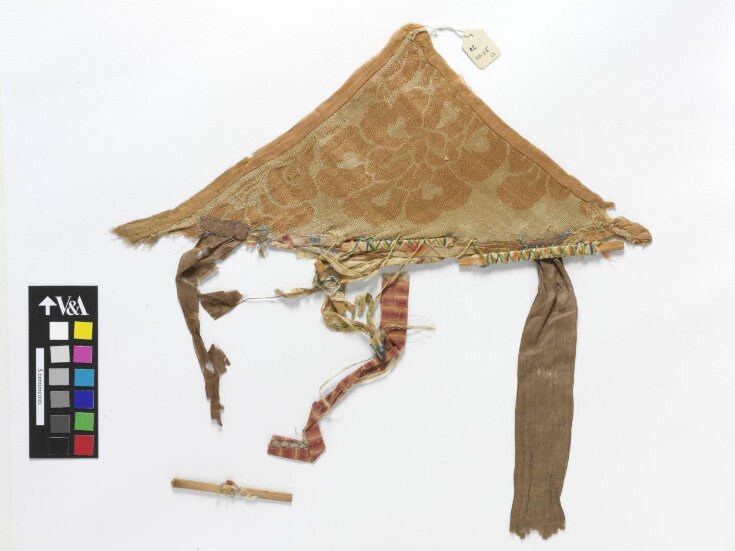
This triangular silk textile would once have formed the top part of a Buddhist ritual banner. These banners were carried aloft hooked on a staff, and they also fluttered from the tops of stupa (domed memorial shrines).
It was recovered from Cave 17 of the Mogao Grottoes, situated near the oasis town of Dunhuang. This shrine site is one of China's great Buddhist pilgrimage complexes. It is part of an area of Central Asia we now call the Silk Road, a series of overland trade routes that crossed Asia from China to Europe. The Silk Road was also important for the exchange of ideas. While silk textiles travelled west from China, Buddhism travelled east, entering China from India.
The explorer and archaeologist Sir Marc Aurel Stein (1862-1943) brought this textile back from Central Asia. The V&A has around 600 ancient and medieval textiles recovered by Stein at the beginning of the 20th century. Some, like this piece, are silk, while others are made from the wool of a variety of different animals.
It was recovered from Cave 17 of the Mogao Grottoes, situated near the oasis town of Dunhuang. This shrine site is one of China's great Buddhist pilgrimage complexes. It is part of an area of Central Asia we now call the Silk Road, a series of overland trade routes that crossed Asia from China to Europe. The Silk Road was also important for the exchange of ideas. While silk textiles travelled west from China, Buddhism travelled east, entering China from India.
The explorer and archaeologist Sir Marc Aurel Stein (1862-1943) brought this textile back from Central Asia. The V&A has around 600 ancient and medieval textiles recovered by Stein at the beginning of the 20th century. Some, like this piece, are silk, while others are made from the wool of a variety of different animals.
Object details
| Categories | |
| Object type | |
| Title | The Stein Collection (named collection) |
| Materials and techniques | pattern and plain woven silk |
| Brief description | Triangular headpiece of a Buddhist ritual banner, from Dunhuang, 9th to 10th century |
| Physical description | Triangular headpiece of a banner; bicoloured damask weave, orange and white silk with edges of monochrome plain weave orange silk. The base of the triangle has four pieces of a strengthening bamboo rod attached and these are bound with different coloured silk threads. Remnants of two monochrome plain weave brown silk streamers with rolled edges are stitched to the base corners of triangle. There are the fragmentary remains of a central tail of undyed plain weave silk, brightly painted predominantly with stripes and floral motif. Weave structures: 1. Head border Warp: silk, single, light orange, 30 warps/cm; Weft: silk, single, light orange, 33 wefts/cm. Weave structure: 1/1 plain weave 2. Infill with medallions Warp: silk, single, light red, 37 warps/cm; Weft: silk, single, beige and red, 10 wefts/cm. Weave structure: 1/5S double faced twill 3. Streamer Warp: silk, single, dark brown, 52 warps/cm; Weft: silk, single, dark brown, 29 wefts/cm. Weave structure: 1/1 plain weave 4. Silk in plain weave with striped pattern Warp: silk, single, undyed, 38 warps/cm; Weft: silk, single, undyed, 35 wefts/cm. Weave structure: 1/1 plain weave |
| Dimensions |
|
| Styles | |
| Credit line | Stein Textile Loan Collection. On loan from the Government of India and the Archaeological Survey of India. Copyright: Government of India. |
| Object history | Attached to fragment is a tag label showing Stein number possibly in Stein's handwriting or that of his assistant, Miss F.M.G Lorimer. |
| Historical context | Dunhuang is at the eastern end of the southern Silk Road, in present-day Gansu Province. It lies between the western reaches of China and the Tarim Basin. When China began to expand into Central Asia during the Han Dynasty (206 BC-220 AD), Dunhuang served as a base for military operations and trade. In the succeeding centuries, Buddhist shrines were established southeast of Dunhuang in a series of man-made caves called Qianfodong, "Caves of the Thousand Buddhas" (today also known as the Mogao Grottoes). Here spectacular cave temples were cut out of the cliffs, beginning in the fourth century AD. Over a period of several centuries, communities of Buddhist monks filled the caves with splendid sculpture and wall paintings. These included colossal Buddha statues, painted clay sculptures of deities, elaborate murals of Buddhist legends, and thousands of tiny painted Buddha images; all of which gave the site its name, Qianfodong. Buddhist cave temples had first been established in at Bamiyan (Afghanistan) and Gandhara (formerly in India, now Pakistan). At Qianfodong, Stein found paintings of graceful figures in the Gandharan style among landscapes and buildings that were distinctly Chinese; a fusion of Indian and Chinese art, which he had noted elsewhere along the Silk Road. In 1900, a Daoist monk named Wang Yuanlu discovered a secret cave at Qianfodung, which contained thousands of documents and paintings. Stein purchased a significant amount of this material from Wang during his visit to the Dunhuang in 1907. Among the many religious works were Buddhist, Jewish, Nestorian, Daoist and Confucian texts; all of which dated from approximately 400 to 1000 A.D. Numerous languages were represented as well, including Chinese, Sanskrit, Tibetan and Hebrew. Stein also acquired many textile pieces. Most of these were silk, for Dunhuang lay on the main trade route between silk-growing regions of China and Central Asia. Elaborate embroideries depicted Buddhist legends and processions of donors. Patterned silks included Chinese and Sassanian (Persian) designs. From China came floral and geometric patterns, combined with figures of animals and birds. Sassanian motifs included pairs of confronted ducks, lions, and other beasts, combined with medallions and quatrefoils. Stein also found undecorated silks used as processional banners and valances for decorating bases of statues. The cave was sealed soon after 1000 A.D., apparently to protect the contents from invading armies. The V&A holds, on loan, a large number of textiles from Dunhuang, including plain and pattern woven silks in many colours, painted Buddhist banners and canopies, and wrappers for Buddhist texts. |
| Production | Found in Cave 17 of the Mogao Grottoes (Caves of the Thousand Buddhas). |
| Subject depicted | |
| Association | |
| Summary | This triangular silk textile would once have formed the top part of a Buddhist ritual banner. These banners were carried aloft hooked on a staff, and they also fluttered from the tops of stupa (domed memorial shrines). It was recovered from Cave 17 of the Mogao Grottoes, situated near the oasis town of Dunhuang. This shrine site is one of China's great Buddhist pilgrimage complexes. It is part of an area of Central Asia we now call the Silk Road, a series of overland trade routes that crossed Asia from China to Europe. The Silk Road was also important for the exchange of ideas. While silk textiles travelled west from China, Buddhism travelled east, entering China from India. The explorer and archaeologist Sir Marc Aurel Stein (1862-1943) brought this textile back from Central Asia. The V&A has around 600 ancient and medieval textiles recovered by Stein at the beginning of the 20th century. Some, like this piece, are silk, while others are made from the wool of a variety of different animals. |
| Bibliographic references |
|
| Other number | Ch.00165.a - Stein number |
| Collection | |
| Accession number | LOAN:STEIN.637 |
About this object record
Explore the Collections contains over a million catalogue records, and over half a million images. It is a working database that includes information compiled over the life of the museum. Some of our records may contain offensive and discriminatory language, or reflect outdated ideas, practice and analysis. We are committed to addressing these issues, and to review and update our records accordingly.
You can write to us to suggest improvements to the record.
Suggest feedback
You can write to us to suggest improvements to the record.
Suggest feedback
| Record created | November 19, 2003 |
| Record URL |
Download as: JSONIIIF Manifest
