Bowl
1630-60 (made)
| Artist/Maker | |
| Place of origin |
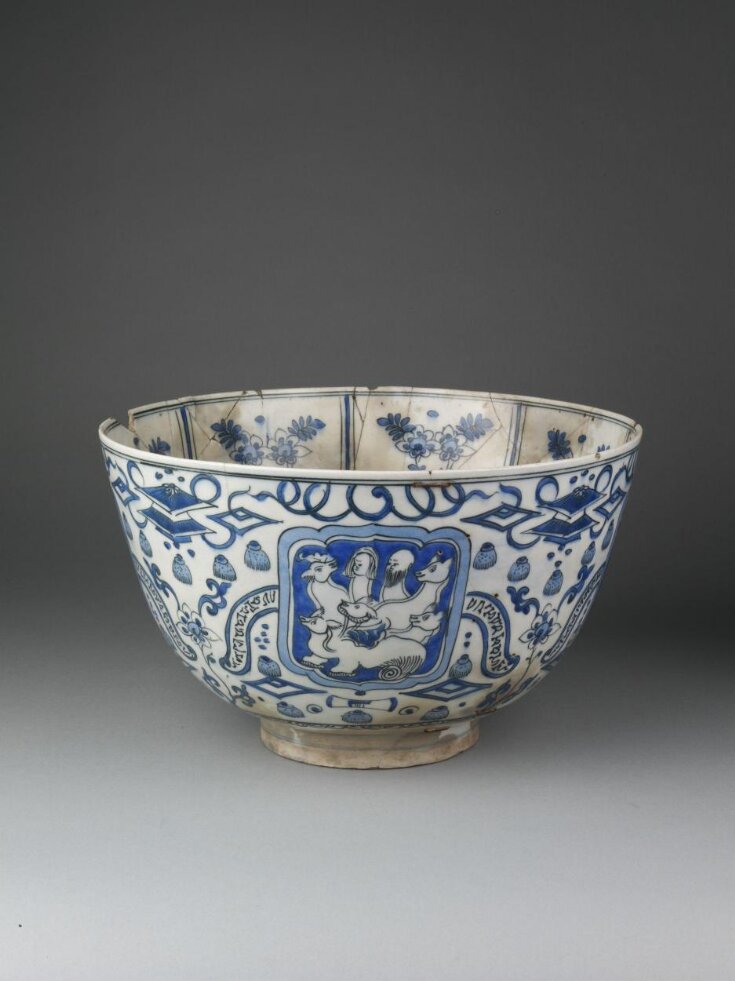
The decoration on this bowl imitates a rare group of Chinese export bowls and dishes, of about 1600-20, with heraldic-style shields containing seven-headed monsters, including five beasts and two human portraits and latin inscriptions. The source of the original commission has not been identified. Examples appear in Lisbon where a dish is in the ceiling of the Santos Palace installed in the 1660s, a bowl appears in a Dutch still-life dated 1638 by Willem Claesz Heda (1594-c.1681) in the Hamburger Kunsthalle (JHH 2009), and there is a bowl in the British Museum (OA 1957,1216.19). As well there was a bowl available to the Iranian potter, who made this bowl. The inscription is 'SAPIENTI NIHIL NOVUM' (sic) (To the wise man nothing is new). The rest of the decoration is Chinese in character with Buddhist motifs and lotus flowers. The Iranian potter faithfully imitates the design, but the inscription is completely illegible as it was in a foreign script. The bowl is an important document in the history of international trade, evidence that a design made for one customer could be copied and sold to others of different nationalities. For an Iranian variation on this design see 2911-1876.
Object details
| Category | |
| Object type | |
| Materials and techniques | Fritware with underglaze painting in blue and black |
| Brief description | Bowl, fritware, painted in underglaze blue and black, the design follows a Chinese porcelain original with Latin inscription and European heraldic shield, Iran, 1630-60 |
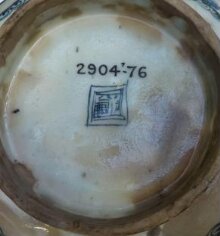
| Physical description | Bowl of fritware, painted in blue outlined with black under a clear glaze. On the outside four panels are reserve-painted with a winged hydra and its five heads surrounding a couple of busts. Lateral bands simulate the original motto: Sapienti nihil novum. The rest of the surface is painted with ribbons, jewelled strings, pairs of books, lozenges, tassels and flowering branches with finials. Inside are divided into eight panels each with a leafy branch and two flowers rising from a rock. A central medallion with a bald-headed rider on a mule amidst flames. The design is of European origin, with inscription originally in Latin; probably copied from a Chinese bowl with this decoration. Imitation Chinese square mark in black. |
| Dimensions |
|
| Style | |
| Production | Label |
| Subjects depicted | |
| Summary | The decoration on this bowl imitates a rare group of Chinese export bowls and dishes, of about 1600-20, with heraldic-style shields containing seven-headed monsters, including five beasts and two human portraits and latin inscriptions. The source of the original commission has not been identified. Examples appear in Lisbon where a dish is in the ceiling of the Santos Palace installed in the 1660s, a bowl appears in a Dutch still-life dated 1638 by Willem Claesz Heda (1594-c.1681) in the Hamburger Kunsthalle (JHH 2009), and there is a bowl in the British Museum (OA 1957,1216.19). As well there was a bowl available to the Iranian potter, who made this bowl. The inscription is 'SAPIENTI NIHIL NOVUM' (sic) (To the wise man nothing is new). The rest of the decoration is Chinese in character with Buddhist motifs and lotus flowers. The Iranian potter faithfully imitates the design, but the inscription is completely illegible as it was in a foreign script. The bowl is an important document in the history of international trade, evidence that a design made for one customer could be copied and sold to others of different nationalities. For an Iranian variation on this design see 2911-1876. |
| Bibliographic references |
|
| Collection | |
| Accession number | 2904-1876 |
About this object record
Explore the Collections contains over a million catalogue records, and over half a million images. It is a working database that includes information compiled over the life of the museum. Some of our records may contain offensive and discriminatory language, or reflect outdated ideas, practice and analysis. We are committed to addressing these issues, and to review and update our records accordingly.
You can write to us to suggest improvements to the record.
Suggest feedback
You can write to us to suggest improvements to the record.
Suggest feedback
| Record created | November 19, 2003 |
| Record URL |
Download as: JSONIIIF Manifest
