Dish
ca. 1590 (made)
| Artist/Maker | |
| Place of origin |
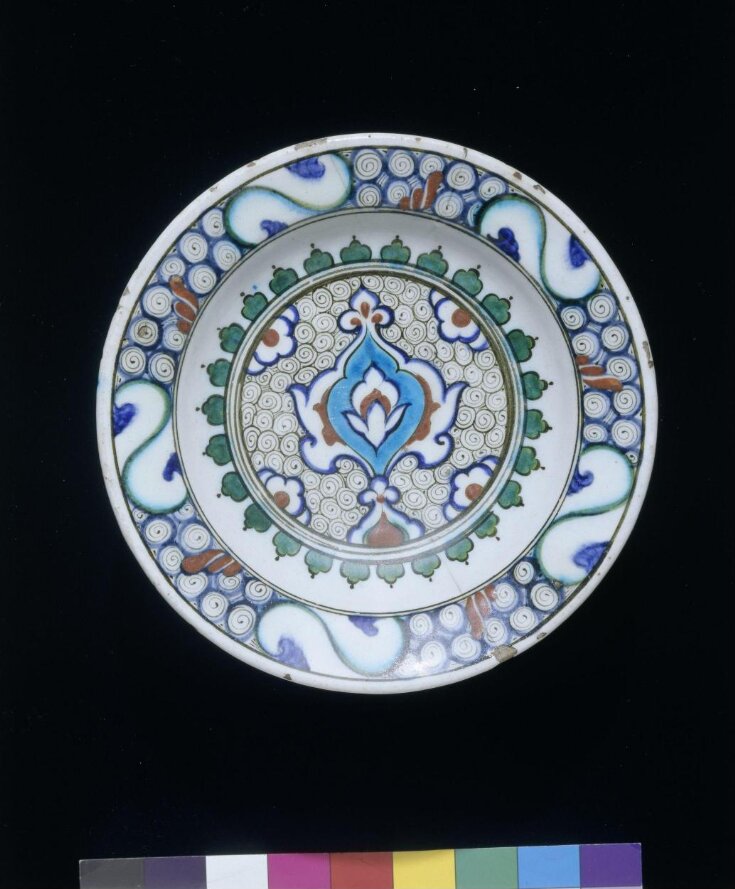
The patterns on Iznik ceramics often combine Islamic and Chinese motifs. On this dish, the arabesques are Islamic, while the background has a wave scroll inspired by Chinese models. The rim is decorated with a version of the Chinese rock and wave design.
The small town of Iznik in north-west Anatolia has given its name to some of the most accomplished ceramics produced in the Islamic Middle East. In the mid 15th century, potters there specialised in modest earthenware imitations of Chinese blue-and-white porcelain. But in the 1460s or 1470s, under the patronage of Sultan Mehmet the Conqueror, they began to manufacture bowls, dishes and other pieces of fritware. These were elegant in shape and decoration and often very large.
The Ottoman court renewed its patronage of Iznik ceramics during the construction of the Süleymaniye mosque in Istanbul in 1550 to 1557. The first Iznik tiles were produced, and potters added a bright red to the range of colours painted under the glaze. This was achieved with a slip made from a special clay.
In the following decades, tiles of high quality were decorated in red, green and tones of blue on a white ground. Dishes, bottles and other vessels had similar decoration on white or coloured grounds.
The small town of Iznik in north-west Anatolia has given its name to some of the most accomplished ceramics produced in the Islamic Middle East. In the mid 15th century, potters there specialised in modest earthenware imitations of Chinese blue-and-white porcelain. But in the 1460s or 1470s, under the patronage of Sultan Mehmet the Conqueror, they began to manufacture bowls, dishes and other pieces of fritware. These were elegant in shape and decoration and often very large.
The Ottoman court renewed its patronage of Iznik ceramics during the construction of the Süleymaniye mosque in Istanbul in 1550 to 1557. The first Iznik tiles were produced, and potters added a bright red to the range of colours painted under the glaze. This was achieved with a slip made from a special clay.
In the following decades, tiles of high quality were decorated in red, green and tones of blue on a white ground. Dishes, bottles and other vessels had similar decoration on white or coloured grounds.
Object details
| Categories | |
| Object type | |
| Materials and techniques | Fritware, polychrome underglaze painted, glazed |
| Brief description | Dish with finial-shaped motif against ground of spirals, Turkey (probably Iznik), ca. 1590. |
| Physical description | Dish with finial-shaped motif against ground of spirals. |
| Dimensions |
|
| Styles | |
| Gallery label |
|
| Credit line | Salting Bequest |
| Historical context | Iznik potters of the late 1570s and 1580s liked to fill the backgrounds of their ceramic designs with motifs like fish-scales or, as here, tightly rolled spirals, possibly inspired by earlier attempts to emulate Chinese wave-forms. This piece has a central motif that may be a stylized finial. |
| Subjects depicted | |
| Summary | The patterns on Iznik ceramics often combine Islamic and Chinese motifs. On this dish, the arabesques are Islamic, while the background has a wave scroll inspired by Chinese models. The rim is decorated with a version of the Chinese rock and wave design. The small town of Iznik in north-west Anatolia has given its name to some of the most accomplished ceramics produced in the Islamic Middle East. In the mid 15th century, potters there specialised in modest earthenware imitations of Chinese blue-and-white porcelain. But in the 1460s or 1470s, under the patronage of Sultan Mehmet the Conqueror, they began to manufacture bowls, dishes and other pieces of fritware. These were elegant in shape and decoration and often very large. The Ottoman court renewed its patronage of Iznik ceramics during the construction of the Süleymaniye mosque in Istanbul in 1550 to 1557. The first Iznik tiles were produced, and potters added a bright red to the range of colours painted under the glaze. This was achieved with a slip made from a special clay. In the following decades, tiles of high quality were decorated in red, green and tones of blue on a white ground. Dishes, bottles and other vessels had similar decoration on white or coloured grounds. |
| Bibliographic references |
|
| Collection | |
| Accession number | C.2016-1910 |
About this object record
Explore the Collections contains over a million catalogue records, and over half a million images. It is a working database that includes information compiled over the life of the museum. Some of our records may contain offensive and discriminatory language, or reflect outdated ideas, practice and analysis. We are committed to addressing these issues, and to review and update our records accordingly.
You can write to us to suggest improvements to the record.
Suggest feedback
You can write to us to suggest improvements to the record.
Suggest feedback
| Record created | November 18, 2003 |
| Record URL |
Download as: JSONIIIF Manifest
