Polito's Menagerie
Figure Group
ca. 1830 (made)
ca. 1830 (made)
| Place of origin |
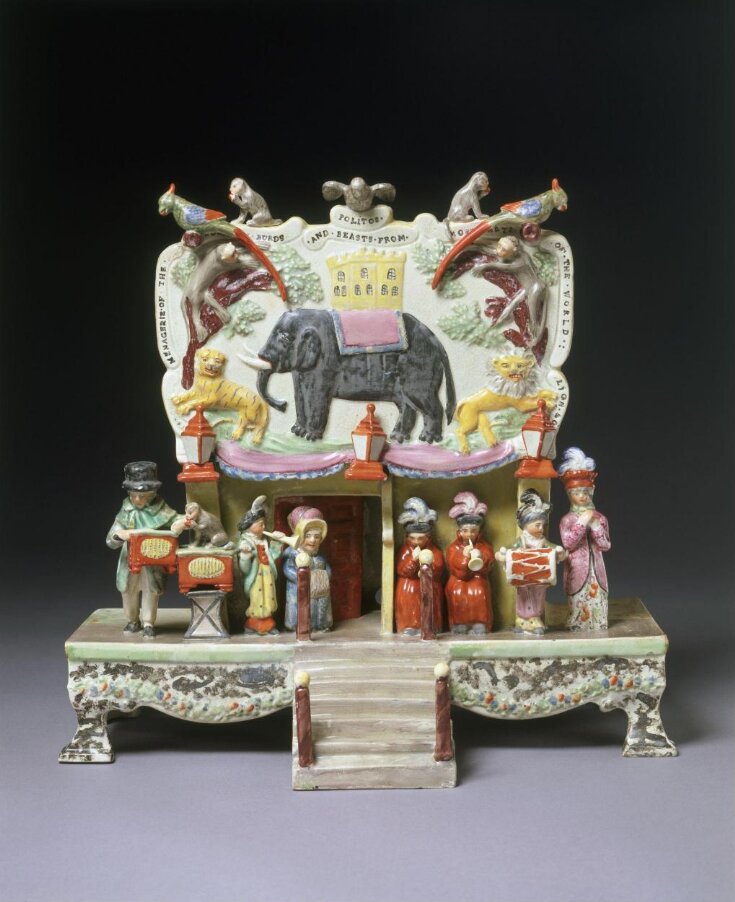
This splendid mantelpiece ornament is probably the most celebrated and certainly the most elaborate of early nineteenth-century Staffordshire figure groups. It represents a high point in quality and elaboration of those models made for a wide market before makers increasingly concentrated on the very much cheaper 'flatbacks' (figures with only rudimentary details on the reverse, made using fewer and simpler moulds). Although made of earthenware, an inexpensive material, all the figures and architectural components would have been formed in separate two-part moulds, then carefully assembled by a 'repairer' before firing and decoration with painted and sponged enamels, so the group would have been relatively costly to produce.
The subject is the entrance of one of the famous travelling menageries of Stephen Polito. Polito was briefly the owner - between 1810 and 1814 - of Britain's most celebrated menagerie, which had been established by the self-styled 'modern Noah' Gilbert Pidcock in the Strand, London. Polito's family continued to tour and exhibit animals under the Polito name during the 1820s and 1830s, chiefly abroad. The banner may show the elephant Chunee, Pidcock's star attraction, which was admired by Lord Byron but which killed his keeper and was destroyed in 1826.
The subject is the entrance of one of the famous travelling menageries of Stephen Polito. Polito was briefly the owner - between 1810 and 1814 - of Britain's most celebrated menagerie, which had been established by the self-styled 'modern Noah' Gilbert Pidcock in the Strand, London. Polito's family continued to tour and exhibit animals under the Polito name during the 1820s and 1830s, chiefly abroad. The banner may show the elephant Chunee, Pidcock's star attraction, which was admired by Lord Byron but which killed his keeper and was destroyed in 1826.
Delve deeper
Discover more about this object

Object details
| Categories | |
| Object type | |
| Title | Polito's Menagerie (assigned by artist) |
| Materials and techniques | Moulded lead-glazed earthenware, painted in enamel colours |
| Brief description | Figure group, Polito's Royal Menagerie..., moulded lead-glazed earthenware, painted in enamel colours, England (Staffordshire), ca. 1830 |
| Physical description | A large group entitled Polito's Royal Menagerie of the wonderfull Burds and Beasts from most parts of the World. Lions etc, and showing the front of a travelling menagerie with musicians and a door keeper, under a large sign showing animals and birds. Moulded lead-glazed earthenware, painted in enamel colours. |
| Dimensions |
|
| Credit line | Purchased through the Julie and Robert Breckman Staffordshire Fund |
| Subjects depicted | |
| Summary | This splendid mantelpiece ornament is probably the most celebrated and certainly the most elaborate of early nineteenth-century Staffordshire figure groups. It represents a high point in quality and elaboration of those models made for a wide market before makers increasingly concentrated on the very much cheaper 'flatbacks' (figures with only rudimentary details on the reverse, made using fewer and simpler moulds). Although made of earthenware, an inexpensive material, all the figures and architectural components would have been formed in separate two-part moulds, then carefully assembled by a 'repairer' before firing and decoration with painted and sponged enamels, so the group would have been relatively costly to produce. The subject is the entrance of one of the famous travelling menageries of Stephen Polito. Polito was briefly the owner - between 1810 and 1814 - of Britain's most celebrated menagerie, which had been established by the self-styled 'modern Noah' Gilbert Pidcock in the Strand, London. Polito's family continued to tour and exhibit animals under the Polito name during the 1820s and 1830s, chiefly abroad. The banner may show the elephant Chunee, Pidcock's star attraction, which was admired by Lord Byron but which killed his keeper and was destroyed in 1826. |
| Bibliographic reference | Object Information File C.128-2003: extract from Pat Halfpenny and Stella Beddoe, Circus and Sport, Kentucky, 1990, pp. 7-8; and from Myrna Schkolne, People, Passions, Pastimes and Pleasures, Staffordshire Figures, 1810-1835, 2006, pp.102-105. |
| Collection | |
| Accession number | C.128-2003 |
About this object record
Explore the Collections contains over a million catalogue records, and over half a million images. It is a working database that includes information compiled over the life of the museum. Some of our records may contain offensive and discriminatory language, or reflect outdated ideas, practice and analysis. We are committed to addressing these issues, and to review and update our records accordingly.
You can write to us to suggest improvements to the record.
Suggest feedback
You can write to us to suggest improvements to the record.
Suggest feedback
| Record created | November 14, 2003 |
| Record URL |
Download as: JSONIIIF Manifest
