Rosenborg Lion
Lion
ca. 1885 (made)
ca. 1885 (made)
| Artist/Maker | |
| Place of origin |
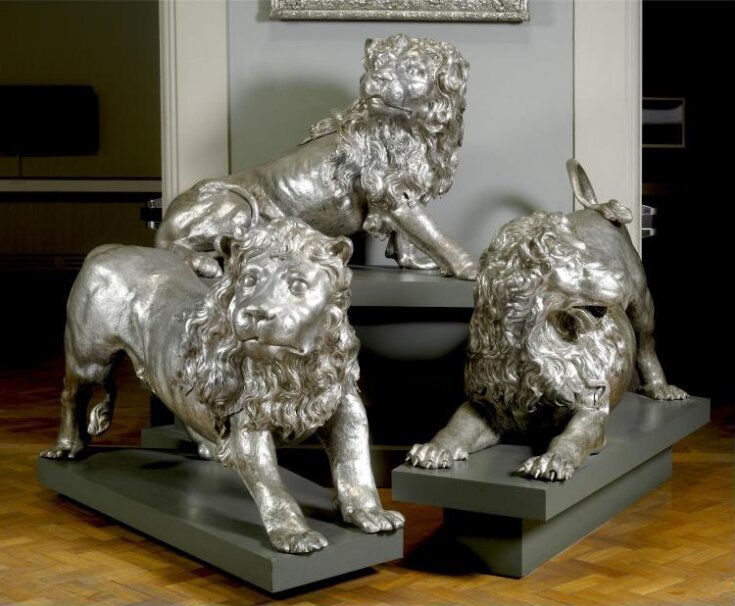
These enchanting animal figures reproduce two of the three silver
lions--one seated, one standing and one crouching--made between 1665 and 1670 by the Copenhagen silversmith Ferdinand Kyblich to 'protect' the royal Danish thrones at Rosenborg Castle. The lions symbolize the Great Belt, the Little Belt and the Sound, the three territorial boundaries that then demarcated Scandinavian sovereignty.
Electrotype copies of metalwork, particularly goldsmith's work, formed an important part of the Museum's growing collection of reproductions, complementing the plaster casts and photographs of original works. From the 1840s Birmingham-based Elkington & Co. dominated the English trade in electrotyping--an electrical equivalent of casting--and many of the Museum's electrotypes, including these two lions, were produced by Elkington in the 1870s and 1880s. The firm was particularly successful with large-scale electrotypes, which are technically very difficult to make.
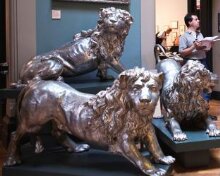
Electrotypes--also called Galvanoplastic copies, named for Luigi Galvini (Italian, 1737-1798), whose early experiments stimulated research on electricity--are closely related to electroplating. A mould (initially of wax, but later of metal) is taken from the object to be reproduced; copper is deposited on the mould in a plating vat; the mould is then removed, revealing a reproduction in copper of the original work. Ordinarily, the copper reproduction would be gilded or silver (as with the lions) to imitate the material of the original. The age tarnished lions were photographed before they were cleaned back to silver.
lions--one seated, one standing and one crouching--made between 1665 and 1670 by the Copenhagen silversmith Ferdinand Kyblich to 'protect' the royal Danish thrones at Rosenborg Castle. The lions symbolize the Great Belt, the Little Belt and the Sound, the three territorial boundaries that then demarcated Scandinavian sovereignty.
Electrotype copies of metalwork, particularly goldsmith's work, formed an important part of the Museum's growing collection of reproductions, complementing the plaster casts and photographs of original works. From the 1840s Birmingham-based Elkington & Co. dominated the English trade in electrotyping--an electrical equivalent of casting--and many of the Museum's electrotypes, including these two lions, were produced by Elkington in the 1870s and 1880s. The firm was particularly successful with large-scale electrotypes, which are technically very difficult to make.
Electrotypes--also called Galvanoplastic copies, named for Luigi Galvini (Italian, 1737-1798), whose early experiments stimulated research on electricity--are closely related to electroplating. A mould (initially of wax, but later of metal) is taken from the object to be reproduced; copper is deposited on the mould in a plating vat; the mould is then removed, revealing a reproduction in copper of the original work. Ordinarily, the copper reproduction would be gilded or silver (as with the lions) to imitate the material of the original. The age tarnished lions were photographed before they were cleaned back to silver.
Object details
| Categories | |
| Object type | |
| Title | Rosenborg Lion (popular title) |
| Materials and techniques | Electroplated copper, silvered |
| Brief description | Electrotype Copies of a Rosenborg Castle Lion, electroplated copper, silvered, Elkington & Co., England (Birmingham), ca. 1885 |
| Physical description | Electrotype Copies of a Rosenborg Castle Lion, electroplated copper, silvered, 98 x 170 x 64cm. |
| Dimensions |
|
| Object history | Image emailed to British Heritage Magazine, 12/11/99 |
| Subject depicted | |
| Association | |
| Summary | These enchanting animal figures reproduce two of the three silver lions--one seated, one standing and one crouching--made between 1665 and 1670 by the Copenhagen silversmith Ferdinand Kyblich to 'protect' the royal Danish thrones at Rosenborg Castle. The lions symbolize the Great Belt, the Little Belt and the Sound, the three territorial boundaries that then demarcated Scandinavian sovereignty. Electrotype copies of metalwork, particularly goldsmith's work, formed an important part of the Museum's growing collection of reproductions, complementing the plaster casts and photographs of original works. From the 1840s Birmingham-based Elkington & Co. dominated the English trade in electrotyping--an electrical equivalent of casting--and many of the Museum's electrotypes, including these two lions, were produced by Elkington in the 1870s and 1880s. The firm was particularly successful with large-scale electrotypes, which are technically very difficult to make. Electrotypes--also called Galvanoplastic copies, named for Luigi Galvini (Italian, 1737-1798), whose early experiments stimulated research on electricity--are closely related to electroplating. A mould (initially of wax, but later of metal) is taken from the object to be reproduced; copper is deposited on the mould in a plating vat; the mould is then removed, revealing a reproduction in copper of the original work. Ordinarily, the copper reproduction would be gilded or silver (as with the lions) to imitate the material of the original. The age tarnished lions were photographed before they were cleaned back to silver. |
| Bibliographic references |
|
| Collection | |
| Accession number | REPRO.1885-195 |
About this object record
Explore the Collections contains over a million catalogue records, and over half a million images. It is a working database that includes information compiled over the life of the museum. Some of our records may contain offensive and discriminatory language, or reflect outdated ideas, practice and analysis. We are committed to addressing these issues, and to review and update our records accordingly.
You can write to us to suggest improvements to the record.
Suggest feedback
You can write to us to suggest improvements to the record.
Suggest feedback
| Record created | November 10, 2003 |
| Record URL |
Download as: JSONIIIF Manifest
