
Handkerchief
ca. 1600 (made)
| Artist/Maker | |
| Place of origin |
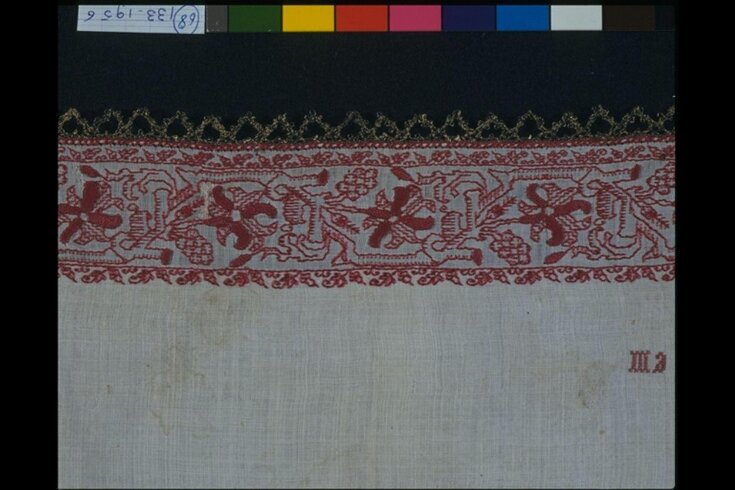
Handkerchiefs made of plain linen served the same function in the 16th century as they do today. However, if they were decorated they could also be carried purely as fashionable accessories and given as gifts. Queen Elizabeth I frequently received sets of embroidered handkerchiefs on New Year's Day. The embroidery here, creating a pattern of stylised honeysuckle and grapevines, is partly worked in double running stitch. This is a double sided stitch, creating identical patterns on the front and back of the fabric. The metal lace adds to the showy effect, and its weight would have made the handkerchief drape gracefully. The initials 'E. M.' may indicate its maker, or its recipient, who could have been a man or a woman.
Object details
| Categories | |
| Object type | |
| Materials and techniques | Linen, embroidered with silk and trimmed with metal thread bobbin lace |
| Brief description | Man's or woman's linen handkerchief, c1600, English; embroidered with crimson silk, silve- gilt bobbin lace trim |
| Physical description | Handkerchief of fine bleached linen (approx 50 threads per cm, balanced plain weave) with a 1⅞-inch (4.7 cm) border, embroidered with crimson silk floss. The embroidery is reversible, worked in counted thread, double running stitch and detached buttonhole stitches. It is trimmed with ½-inch wide (1.3 cm) silver-gilt bobbin lace. |
| Dimensions |
|
| Marks and inscriptions | em (embroidering; silk thread) |
| Historical context | Handkerchiefs made of plain linen served the same function in the sixteenth century as they do today. However, if they were decorated they could also be carried purely as fashionable accessories and given as gifts. Queen Elizabeth I frequently received sets of embroidered handkerchiefs on new Year's Day. The embroidery here, creating a pattern of stylised honeysuckle and grapevines, is partly worked in double running stitch. This is a double sided stitch, creating identical patterns on the front and back of the fabric. The metal lace adds to the showy effect, and its weight would have made the handkerchief drape gracefully. The initials 'em' may indicate its maker, or its recipient (male or female) as a gift. |
| Production | initialled 'em' |
| Subjects depicted | |
| Summary | Handkerchiefs made of plain linen served the same function in the 16th century as they do today. However, if they were decorated they could also be carried purely as fashionable accessories and given as gifts. Queen Elizabeth I frequently received sets of embroidered handkerchiefs on New Year's Day. The embroidery here, creating a pattern of stylised honeysuckle and grapevines, is partly worked in double running stitch. This is a double sided stitch, creating identical patterns on the front and back of the fabric. The metal lace adds to the showy effect, and its weight would have made the handkerchief drape gracefully. The initials 'E. M.' may indicate its maker, or its recipient, who could have been a man or a woman. |
| Collection | |
| Accession number | T.133-1956 |
About this object record
Explore the Collections contains over a million catalogue records, and over half a million images. It is a working database that includes information compiled over the life of the museum. Some of our records may contain offensive and discriminatory language, or reflect outdated ideas, practice and analysis. We are committed to addressing these issues, and to review and update our records accordingly.
You can write to us to suggest improvements to the record.
Suggest feedback
You can write to us to suggest improvements to the record.
Suggest feedback
| Record created | November 10, 2003 |
| Record URL |
Download as: JSONIIIF Manifest
