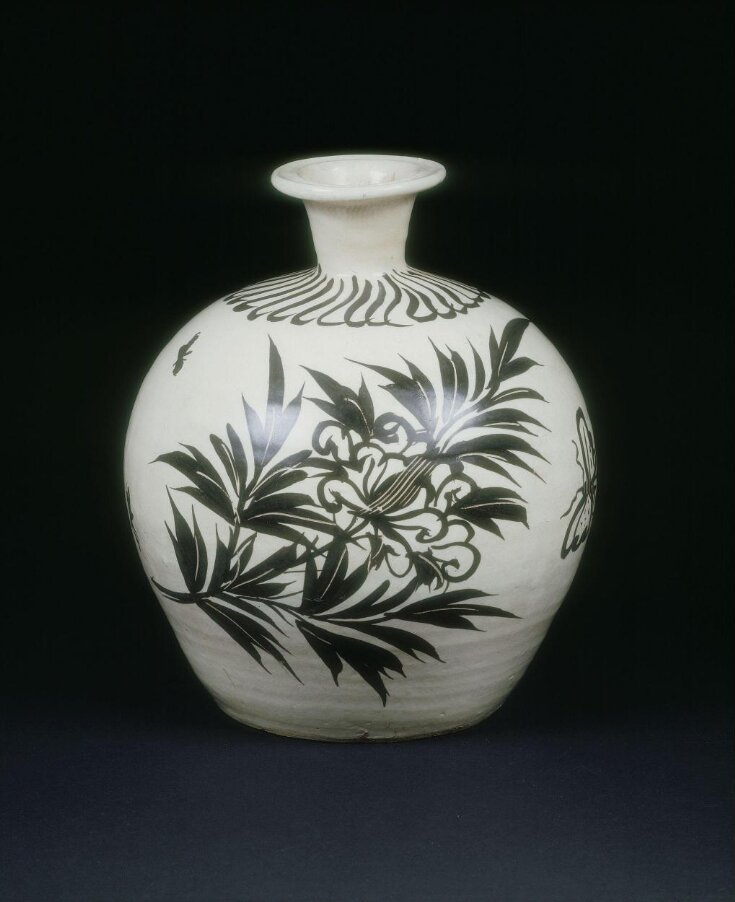
Vase
1115-1200 (made)
| Artist/Maker | |
| Place of origin |
This vase was made some time between 960 and 1279, the classical period in the history of Chinese ceramics. Kilns appeared in all parts of China, each kiln with its own specialized products. Centuries later they were much sought after by collectors. A systematic classification of the different wares was already well established in the 1400s, whereby ceramics were named after the town in which the kilns operated. The best known wares are Ru, Ding, Jun, Yaozhou, Cizhou, Yue, Guan, Longquan, Jian, Jizhou and Qingbai. This piece is a Cizhou ware.
Object details
| Categories | |
| Object type | |
| Materials and techniques | Stoneware, painted and glazed |
| Brief description | Cizhou ware |
| Dimensions |
|
| Style | |
| Gallery label | Vase with floral design
Jin dynasty (1115-1200)
Cizhou kilns, north China
Stoneware painted in iron black
Museum no.C.32-1935
From the Eumorfopoulos collection, purchased with the assistance of The Art Fund, the Vallentin Bequest, Sir Percival David and the Universities China Committee(2007) |
| Credit line | Purchased with Art Fund support, the Vallentin Bequest, Sir Percival David and the Universities China Committee |
| Subjects depicted | |
| Summary | This vase was made some time between 960 and 1279, the classical period in the history of Chinese ceramics. Kilns appeared in all parts of China, each kiln with its own specialized products. Centuries later they were much sought after by collectors. A systematic classification of the different wares was already well established in the 1400s, whereby ceramics were named after the town in which the kilns operated. The best known wares are Ru, Ding, Jun, Yaozhou, Cizhou, Yue, Guan, Longquan, Jian, Jizhou and Qingbai. This piece is a Cizhou ware. |
| Bibliographic references |
|
| Collection | |
| Accession number | C.32-1935 |
About this object record
Explore the Collections contains over a million catalogue records, and over half a million images. It is a working database that includes information compiled over the life of the museum. Some of our records may contain offensive and discriminatory language, or reflect outdated ideas, practice and analysis. We are committed to addressing these issues, and to review and update our records accordingly.
You can write to us to suggest improvements to the record.
Suggest feedback
You can write to us to suggest improvements to the record.
Suggest feedback
| Record created | November 7, 2003 |
| Record URL |
Download as: JSONIIIF Manifest
