
Woven Silk
7th century to 8th century (made)
| Artist/Maker | |
| Place of origin |
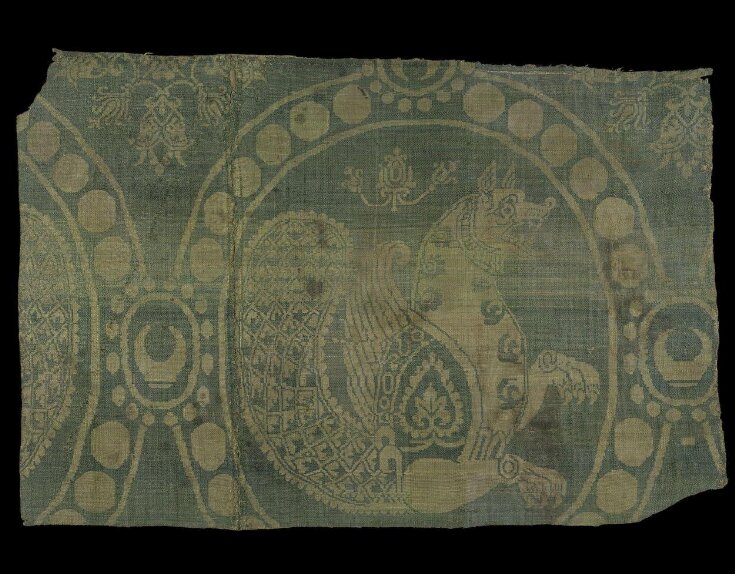
Fragment of a silk textile with a woven-in pattern in yellow against a faded bluish-green ground. The main feature is a composite beast facing right and set within a roundel with a pearl border. At the four points where these roundels touch, there is a smaller roundel with a pearl border containing a crescent motif. A plant-based motif with eight extensions fills the interstices between the main roundels, but this is only partly visible in this cutting.
The composite beast, which is often identified with the mythical bird of Iranian legend called the sēnmurw or sīmurgh, has a peacock's tail, a dog's head and a lion's legs.
The silk is a weft-faced compound twill. The main and binding warp are z-twist, while the weft has no discernible twist. There are several weaving mistakes (at least 8 points) where the warp has not lifted as the design required.
The composite beast, which is often identified with the mythical bird of Iranian legend called the sēnmurw or sīmurgh, has a peacock's tail, a dog's head and a lion's legs.
The silk is a weft-faced compound twill. The main and binding warp are z-twist, while the weft has no discernible twist. There are several weaving mistakes (at least 8 points) where the warp has not lifted as the design required.
Object details
| Categories | |
| Object type | |
| Materials and techniques | weft-faced compound silk twill, one repeat |
| Brief description | Fragment of a silk with a woven-in pattern showing a large composite beast in a roundel with a pearl border, Iran or Central Asia, 7th or 8th century |
| Physical description | Fragment of a silk textile with a woven-in pattern in yellow against a faded bluish-green ground. The main feature is a composite beast facing right and set within a roundel with a pearl border. At the four points where these roundels touch, there is a smaller roundel with a pearl border containing a crescent motif. A plant-based motif with eight extensions fills the interstices between the main roundels, but this is only partly visible in this cutting. The composite beast, which is often identified with the mythical bird of Iranian legend called the sēnmurw or sīmurgh, has a peacock's tail, a dog's head and a lion's legs. The silk is a weft-faced compound twill. The main and binding warp are z-twist, while the weft has no discernible twist. There are several weaving mistakes (at least 8 points) where the warp has not lifted as the design required. |
| Dimensions |
|
| Style | |
| Marks and inscriptions |
|
| Object history | This fragment is said to have been found in the reliquary of the head of St Helena, which was kept in the church of St Leu in Paris until the French Revolution. Technical analysis confirms that it is from the same weaving as two other fragments associated with the relics of St Helena, which has the same composite beast but facing left. The two other fragments are now in the Musée des Arts décoratifs in Paris. This would date the V&A textile to the 8th century at the latest. The beast depicted on this textile has been consistently identified with the sēnmurw, the Middle Persian term for a bird later called the sīmurgh that played an important role in the legendary history of ancient Iran. There is, though, no evidence that links the term with this image -- we simply do not know how Iranians of the Sasanian period (AD 224-651) depicted the sēnmurw, if at all. Yet the composite beast on this silk can definitely be associated with members of the Sasanian dynasty as it appears on the coat worn by its last significant member, Khusraw II (r. AD 590-628), in the rock reliefs at Taq-i Bustan near Kermanshah, for example. Sasanian motifs including this composite bird are found on the costumes worn by three figures in a painting found at Afrasiab (the ancient site of Samarqand), who have been identified as visiting ambassadors from the region south of Uzbekistan. The painting can be dated to the late 7th century by a inscription in Sogdian, the local Iranian language (L.I. Al'baum (Albaoum), Zhivopis' Afrasiaba, Tashkent, 1975). This textile is grouped with others showing similar iconography and style, the Paris fragments, the Shroud of St Rémi now in Rheims, a garment from a tribal grave at Moshchevaya Balka in the North Caucasus. (No such silks have been found in Iran, but see the evidence cited above.) Silks with smaller-scale polychrome patterns that include the "sēnmurw" have survived in greater numbers (see V&A: 761-1893). When the Arabs conquered Iran in the 7th century AD, they took over the Sasanid workshops and the existing repertoire of designs was incorporated into the silk weavings made for them with little modification. It is therefore not surprising to find a Sasanian motif on an Islamic silk made a century or more later. It has been argued that early Central Asian silks are distinguished by the use of floss, gummed silk for the paired warp, but by the 7th to 8th century warp groupings of three to four z-twisted threads are found. |
| Production | Iran or Central Asia |
| Subjects depicted | |
| Associated object | 761-1893 (Version) |
| Bibliographic references |
|
| Collection | |
| Accession number | 8579-1863 |
About this object record
Explore the Collections contains over a million catalogue records, and over half a million images. It is a working database that includes information compiled over the life of the museum. Some of our records may contain offensive and discriminatory language, or reflect outdated ideas, practice and analysis. We are committed to addressing these issues, and to review and update our records accordingly.
You can write to us to suggest improvements to the record.
Suggest feedback
You can write to us to suggest improvements to the record.
Suggest feedback
| Record created | November 7, 2003 |
| Record URL |
Download as: JSONIIIF Manifest
