The Chelsea Carpet
Carpet
1500-1550 (made)
1500-1550 (made)
| Artist/Maker | |
| Place of origin |
The beautiful carpet was woven in Iran, probably in the first half of the sixteenth century, during the reign of the Safavid dynasty. While it does not have any inscriptions linking it with a specific patron, place or date, the design holds many parallels with the arts of the book in early Safavid Iran, and with similar hunting carpets.
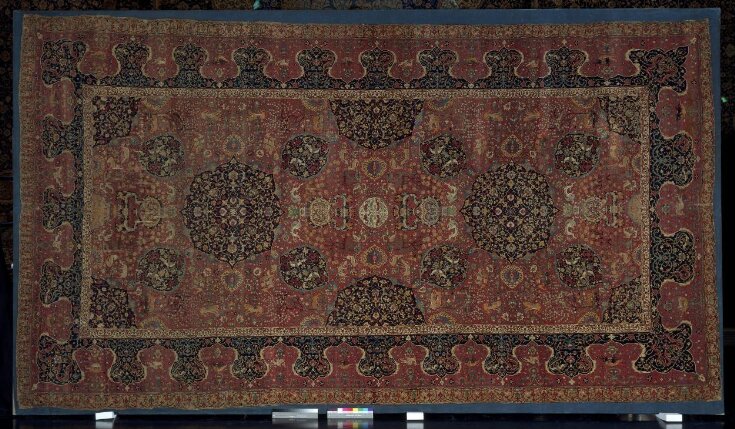
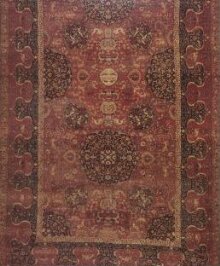
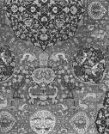
Despite its large scale, this medallion carpet has a fine and complex design that rewards very close inspection. In its general layout, there are two lobed black medallions down the central axis, with four diagonal radiating oval pendants each, all set against a dark red main field. These medallions are then repeated by quarter-medallions in the four corners of the field, and by two half-medallions on either side. Each medallion is filled with a very refined radial design of yellow strapwork and large flowers, while each oval pendant is occupied by fluttering birds and Chinese-style cloudbands. Below this medallion superstructure, the red main field is a rich and varied garden landscape of trees and wildlife. There are trees with white blossoms, and others filled with ripe pomegranates. There are also leafy spiralling stems, with large lotus flowers. Among this greenery, the carpet is filled with animals and birds: there are resting pairs of spotted goats, lions and treetop birds. Predominantly though, the main field is full of hunting scenes: leopards killing horned goats, hawks killing long-legged water birds and lions killing stags. Down the central axis of the design, there are ornate Chinese style vases, formed of dragons, lions and peacocks, and lobed ponds full of fish.
Beyond the main field, the main border features a reciprocal pattern, of an interlocking arcade in red versus black (or rather extremely dark blue indigo). On a slightly more condensed scale to the main field, this border also features hunting pairs: a snow leopard attacking a horned goat, and a lion pinning down a bull. A beautifully drawn pair of supernatural creatures confront each other in the dark blue arcading: a Chinese-style dragon opposite a long-tailed phoenix. Throughout the main and two minor borders, the design also features overlaid designs of leafy plant scrolls and Chinese cloudband motifs.
Despite its large scale, this medallion carpet has a fine and complex design that rewards very close inspection. In its general layout, there are two lobed black medallions down the central axis, with four diagonal radiating oval pendants each, all set against a dark red main field. These medallions are then repeated by quarter-medallions in the four corners of the field, and by two half-medallions on either side. Each medallion is filled with a very refined radial design of yellow strapwork and large flowers, while each oval pendant is occupied by fluttering birds and Chinese-style cloudbands. Below this medallion superstructure, the red main field is a rich and varied garden landscape of trees and wildlife. There are trees with white blossoms, and others filled with ripe pomegranates. There are also leafy spiralling stems, with large lotus flowers. Among this greenery, the carpet is filled with animals and birds: there are resting pairs of spotted goats, lions and treetop birds. Predominantly though, the main field is full of hunting scenes: leopards killing horned goats, hawks killing long-legged water birds and lions killing stags. Down the central axis of the design, there are ornate Chinese style vases, formed of dragons, lions and peacocks, and lobed ponds full of fish.
Beyond the main field, the main border features a reciprocal pattern, of an interlocking arcade in red versus black (or rather extremely dark blue indigo). On a slightly more condensed scale to the main field, this border also features hunting pairs: a snow leopard attacking a horned goat, and a lion pinning down a bull. A beautifully drawn pair of supernatural creatures confront each other in the dark blue arcading: a Chinese-style dragon opposite a long-tailed phoenix. Throughout the main and two minor borders, the design also features overlaid designs of leafy plant scrolls and Chinese cloudband motifs.
Object details
| Categories | |
| Object type | |
| Title | The Chelsea Carpet (popular title) |
| Materials and techniques | Warp: Z2S, silk
Weft: three shoots, silk but query second weft
Wool pile: 470 knots/square inch, asymmetrical open to the left, 13 colours.
Side and end finish: missing |
| Brief description | Carpet. Medallion carpet known as the 'Chelsea Carpet', wool knotted pile on silk or possibly cotton foundation, central field design of hunting animals, trees and black medallions on red ground, possibly Tabriz, Safavid Iran, 1500-1550 |
| Physical description | Carpet, wool knotted pile on silk warp and weft, repeat medallion design on red ground filled with animals, birds and trees, main border with reciprocal design. |
| Dimensions |
|
| Style | |
| Gallery label |
|
| Object history | The Chelsea Carpet is so called because the Museum purchased it from a dealer in Chelsea (in southwest London), named Alfred Cohen, in 1890. Aside from this, the carpet's provenance is not known, but its quality of design and production strongly suggests a court-level workshop in early sixteenth-century Iran. |
| Subjects depicted | |
| Summary | The beautiful carpet was woven in Iran, probably in the first half of the sixteenth century, during the reign of the Safavid dynasty. While it does not have any inscriptions linking it with a specific patron, place or date, the design holds many parallels with the arts of the book in early Safavid Iran, and with similar hunting carpets. Despite its large scale, this medallion carpet has a fine and complex design that rewards very close inspection. In its general layout, there are two lobed black medallions down the central axis, with four diagonal radiating oval pendants each, all set against a dark red main field. These medallions are then repeated by quarter-medallions in the four corners of the field, and by two half-medallions on either side. Each medallion is filled with a very refined radial design of yellow strapwork and large flowers, while each oval pendant is occupied by fluttering birds and Chinese-style cloudbands. Below this medallion superstructure, the red main field is a rich and varied garden landscape of trees and wildlife. There are trees with white blossoms, and others filled with ripe pomegranates. There are also leafy spiralling stems, with large lotus flowers. Among this greenery, the carpet is filled with animals and birds: there are resting pairs of spotted goats, lions and treetop birds. Predominantly though, the main field is full of hunting scenes: leopards killing horned goats, hawks killing long-legged water birds and lions killing stags. Down the central axis of the design, there are ornate Chinese style vases, formed of dragons, lions and peacocks, and lobed ponds full of fish. Beyond the main field, the main border features a reciprocal pattern, of an interlocking arcade in red versus black (or rather extremely dark blue indigo). On a slightly more condensed scale to the main field, this border also features hunting pairs: a snow leopard attacking a horned goat, and a lion pinning down a bull. A beautifully drawn pair of supernatural creatures confront each other in the dark blue arcading: a Chinese-style dragon opposite a long-tailed phoenix. Throughout the main and two minor borders, the design also features overlaid designs of leafy plant scrolls and Chinese cloudband motifs. |
| Bibliographic references |
|
| Collection | |
| Accession number | 589-1890 |
About this object record
Explore the Collections contains over a million catalogue records, and over half a million images. It is a working database that includes information compiled over the life of the museum. Some of our records may contain offensive and discriminatory language, or reflect outdated ideas, practice and analysis. We are committed to addressing these issues, and to review and update our records accordingly.
You can write to us to suggest improvements to the record.
Suggest feedback
You can write to us to suggest improvements to the record.
Suggest feedback
| Record created | November 4, 2003 |
| Record URL |
Download as: JSONIIIF Manifest
