'Polonaise' carpet
Carpet
1600-1625 (made)
1600-1625 (made)
| Artist/Maker | |
| Place of origin |
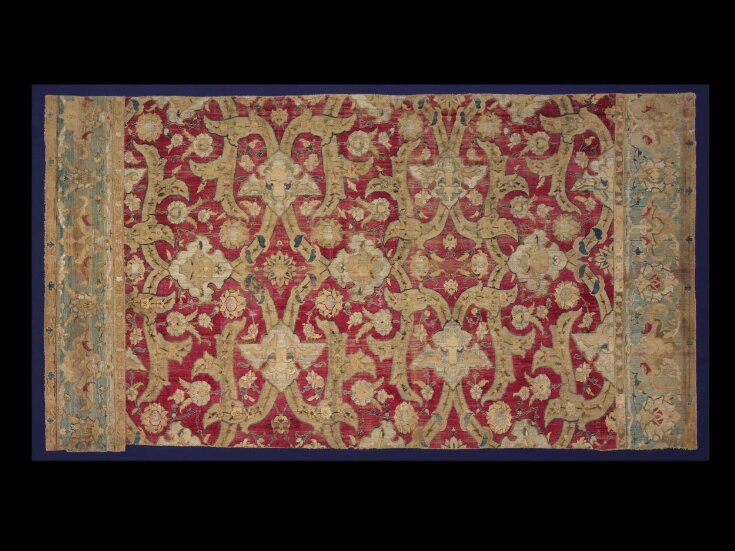
This type of carpet is known as a ‘Polonaise carpet’ even though it was made in Iran. The design of this fragment is nearly identical to that of a huge carpet donated to the shrine at Najaf in Iraq, probably by Shah Abbas the Great.
The misleading name arose because carpets of this type came to Europe in the early 17th century through trade or as royal gifts. Many were found in Poland and were later mistaken for Polish products. This gave rise to the term ‘Polonaise carpet’.
The misleading name arose because carpets of this type came to Europe in the early 17th century through trade or as royal gifts. Many were found in Poland and were later mistaken for Polish products. This gave rise to the term ‘Polonaise carpet’.
Object details
| Category | |
| Object type | |
| Title | 'Polonaise' carpet (generic title) |
| Materials and techniques | Silk warp and weft, silk pile with metal-wrapped thread |
| Brief description | Carpet fragment, silk knotted pile on silk foundation with metal-wrapped thread brocading, 'Polonaise' strapwork design on red ground with borders on two sides, probably Isfahan, Safavid Iran, 1600-1625 |
| Physical description | A large rectangular carpet fragment with borders on two sides. Strapwork design in red and yellow silk with gold- and silver-wrapped thread. |
| Dimensions |
|
| Style | |
| Gallery label | Jameel Gallery
Carpet Fragment with Red Ground
Iran, probably Isfahan
1600-25
Carpets of this type were taken to Europe in the early 17th century through trade or as royal gifts. Many were found in Poland and were later mistaken for Polish products. Yet the design is nearly identical to that of a huge carpet donated to the shrine at Najaf in Iraq, probably by Shah Abbas the Great.
Silk warps (Z2S), silk wefts and pile, and metal-wrapped thread
Museum no. T.36-1954(Jameel Gallery) |
| Object history | Sold to the Museum in May 1954, by Lady Christabel Aberconway for £2,000; the carpet had been in the collection of Lady Aberconway at least since 1931, when she lent it to the Exhibition of Persian Art in 1931. |
| Production | The term 'Polonaise carpet' arose when carpets of this type were found in Polish collections. |
| Summary | This type of carpet is known as a ‘Polonaise carpet’ even though it was made in Iran. The design of this fragment is nearly identical to that of a huge carpet donated to the shrine at Najaf in Iraq, probably by Shah Abbas the Great. The misleading name arose because carpets of this type came to Europe in the early 17th century through trade or as royal gifts. Many were found in Poland and were later mistaken for Polish products. This gave rise to the term ‘Polonaise carpet’. |
| Bibliographic references |
|
| Collection | |
| Accession number | T.36-1954 |
About this object record
Explore the Collections contains over a million catalogue records, and over half a million images. It is a working database that includes information compiled over the life of the museum. Some of our records may contain offensive and discriminatory language, or reflect outdated ideas, practice and analysis. We are committed to addressing these issues, and to review and update our records accordingly.
You can write to us to suggest improvements to the record.
Suggest feedback
You can write to us to suggest improvements to the record.
Suggest feedback
| Record created | November 4, 2003 |
| Record URL |
Download as: JSONIIIF Manifest
