
Handkerchief
ca. 1600 (made)
| Artist/Maker | |
| Place of origin |
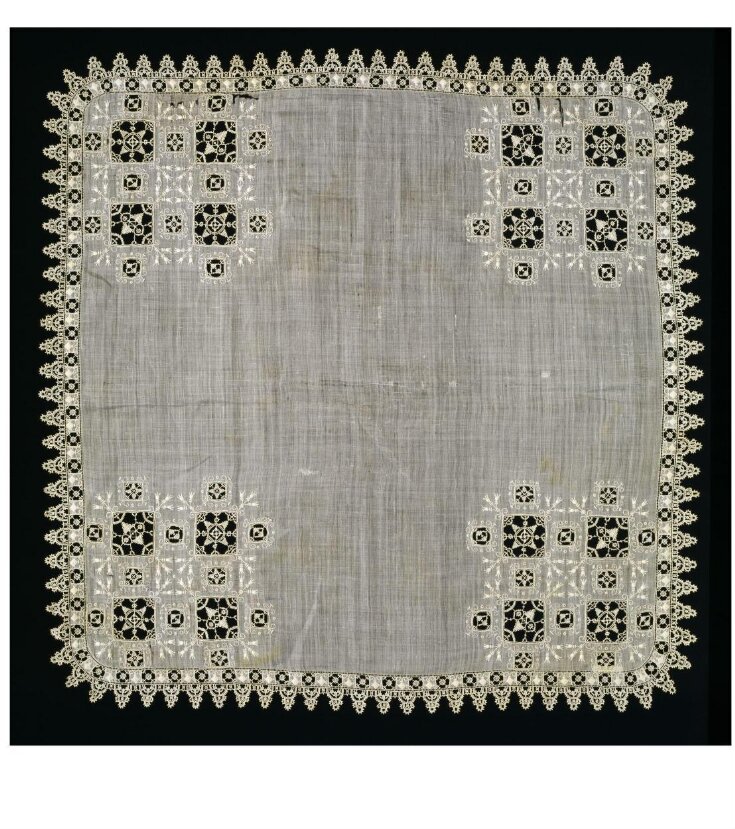
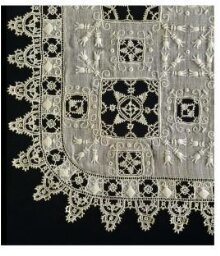
Handkerchiefs made of plain linen served the same function in the sixteenth century as they do today. However, if they were decorated they could also be carried purely as fashionable accessories and given as gifts.This example has whitework embroidery, worked in detached buttonhole and satin stitches, needle lace and cutwork decoration. Cutwork is the earliest form of needle lace. It is based on a woven ground, from which areas have been cut away. Elaborate cutwork was an important decoration on fashionable dress for both men and women from about 1570 to 1620.
Delve deeper
Discover more about this object

Object details
| Categories | |
| Object type | |
| Materials and techniques | Linen, with cutwork, needle lace and embroidery |
| Brief description | White linen handkerchief decorated with cutwork, needle lace and embroidery, Italian, ca. 1600 |
| Physical description | Handkerchief of fine linen with decoration at the four corners : cutwork with needle lace fillings, and whitework embroidery in detached buttonhole and satin stitches; edged with needle lace. |
| Dimensions |
|
| Gallery label | Handkerchief
About 1600
During courtship, the couple exchanged symbolic gifts such as gloves, ribbons, rings and handkerchiefs. The acceptance of a gift indicated a binding commitment and be could used as proof of betrothal in the case of any disputes. Although a splendid handkerchief was seen as an intimate item, it could also be held in the hand as a display object. [59 words]
Italy
Linen with cutwork, needle lace and embroidery
V&A: 288-1906(5 Oct 2006 - 7 Jan 2007) |
| Object history | The handkerchief was purchased from the lace dealer Samuel Chick in 1906. Historical significance: The fine quality of the handkerchief's decoration reflects the importance of embroidery and lace in this period of ostentatious display in dress. Decorated in this way the handkerchief had a function beyond its everyday use, and could be carried as a fashionable accessory. The technique of cutwork used here was the creation of a delicate structure of needle lace stitches across the spaces cut in a fine linen ground. It reached the height of its popularity in the late sixteenth and early seventeeth century, when it was used to decorate every type of linen and in particular to draw attention to the face and throat in the form of collars and ruffs. |
| Historical context | Handkerchiefs made of plain linen served the same function in the sixteenth century as they do today. However, if they were decorated they could also be carried purely as fashionable accessories and given as gifts. Queen Elizabeth I frequently received gifts of embroidered handkerchiefs on New Years' Day. |
| Summary | Handkerchiefs made of plain linen served the same function in the sixteenth century as they do today. However, if they were decorated they could also be carried purely as fashionable accessories and given as gifts.This example has whitework embroidery, worked in detached buttonhole and satin stitches, needle lace and cutwork decoration. Cutwork is the earliest form of needle lace. It is based on a woven ground, from which areas have been cut away. Elaborate cutwork was an important decoration on fashionable dress for both men and women from about 1570 to 1620. |
| Bibliographic references |
|
| Collection | |
| Accession number | 288-1906 |
About this object record
Explore the Collections contains over a million catalogue records, and over half a million images. It is a working database that includes information compiled over the life of the museum. Some of our records may contain offensive and discriminatory language, or reflect outdated ideas, practice and analysis. We are committed to addressing these issues, and to review and update our records accordingly.
You can write to us to suggest improvements to the record.
Suggest feedback
You can write to us to suggest improvements to the record.
Suggest feedback
| Record created | October 29, 2003 |
| Record URL |
Download as: JSONIIIF Manifest
