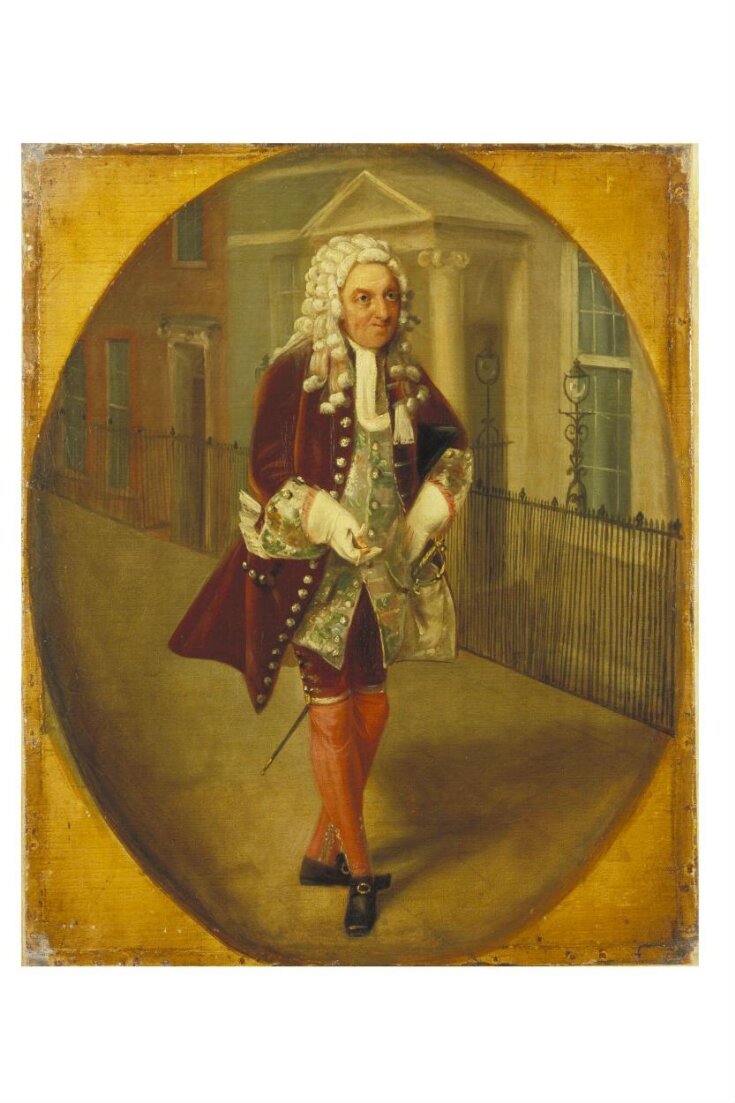

Richard Suett as Bayes in The Rehearsal by George Villiers, 2nd Duke of Buckingham
Painting
1796 (made)
1796 (made)
| Artist/Maker | |
| Place of origin |
Full length portrait of Richard Suett in costume as Bayes in The Rehearsal. He is in early 18th century dress, with a curled wig, red velvet jacket and breeches, and matching waistcoat and cuffs, and is walking down a Georgian street.
Object details
| Categories | |
| Object type | |
| Title | Richard Suett as Bayes in <i>The Rehearsal</i> by George Villiers, 2nd Duke of Buckingham (generic title) |
| Materials and techniques | oil on canvas |
| Brief description | Portrait entitiled "Richard Suett as Bayes in 'The Rehearsal' by George Villiers, Second Duke of Buckingham.", John Graham,1796. |
| Physical description | Full length portrait of Richard Suett in costume as Bayes in The Rehearsal. He is in early 18th century dress, with a curled wig, red velvet jacket and breeches, and matching waistcoat and cuffs, and is walking down a Georgian street. |
| Dimensions |
|
| Style | |
| Credit line | Bequeathed by Rev. Alexander Dyce |
| Object history | Bequeathed by Rev. Alexander Dyce, 1869 Bequeathed to the Department of Science and Art, South Kensington Museums in 1859 by the Reverand Alexander Dyce. The painting was bequeathed as part of the Dyce collection of 3347 works of art, including paintings, miniatures, watercolours and prints as well as his library of 14,000 volumes. Reverend Alexander Dyce (1798-1869), literary scholar and art collector, was the son of a major, later lieutenant general in the Madras infantry of the East India Company. Raised by two maternal aunts in Aberdeen following his parent’s departure for India in 1799, Dyce read classics at Exeter College, Oxford. At his father’s insistence he was ordained as an Anglican priest in 1823, having rejected a career in the East India Company. He developed a career in publishing by translating Greek texts. However he is probably best known for his editions of sixteenth and seventeenth century poetry. Dyce collected many rare books covering English, Italian and Classical literature. His collection of paintings and works on paper is very varied. In his collection of paintings, Dyce indulged his enthusiasm for the theatre, acquiring portraits of leading actors, while his drawings collection focuses on Old Master drawings from European schools. The Dyce bequest was one of the earliest of a collection of fine art given to the museum. It followed the Sheepshanks collection, which was given to the museum two years earlier in 1857. While the Sheepshanks collection was mainly of contemporary Victorian art, Dyce’s collection focused on British eighteenth and early nineteenth art as well as paintings from Italian, Dutch and Flemish Schools. This bequest therefore helped to broaden the collection, which the museum was already beginning to do by purchasing works from British and Continental Schools. Historical significance: John Graham, (1754-1817) painter. He was apprenticed to the leading coach painter of his native Edinburgh, Farquhar and afterwards pursued the same profession in London. He studied at the schools of the Royal Academy, London, where he exhibited from 1780 to 1797. He painted two works for Boydell's 'Shakespeare Gallery'. In 1793 Graham was appointed a teacher 'of the higher branches of design' at the recommendation of Sir William Forbes. He was a successful teacher. His pupils included David Wilkie (1785-1841) ,John Burnet(1784-1868) and his brother James (1788-1816). His academy was opened on 27th November 1799 in a room on St. Jame's Square, Edinburgh. One of his first pupils was David Wilkie. In 1800 the entire Trustee's Academy was placed under Graham's charge. He held this appointment until his death. His works combine a correct observation of detail with quite broadly handled paint. |
| Subjects depicted | |
| Bibliographic reference | Ashton, Geoffrey. Catalogue of Paintings at the Theatre Museum, London. ed. James Fowler, London : Victoria and Albert Museum, 1992. Cat.14, pp.22-3. ISBN 1851771026 |
| Collection | |
| Accession number | DYCE.81 |
About this object record
Explore the Collections contains over a million catalogue records, and over half a million images. It is a working database that includes information compiled over the life of the museum. Some of our records may contain offensive and discriminatory language, or reflect outdated ideas, practice and analysis. We are committed to addressing these issues, and to review and update our records accordingly.
You can write to us to suggest improvements to the record.
Suggest feedback
You can write to us to suggest improvements to the record.
Suggest feedback
| Record created | October 27, 2003 |
| Record URL |
Download as: JSONIIIF Manifest
