Dish
1540-1550 (made)
| Artist/Maker | |
| Place of origin |
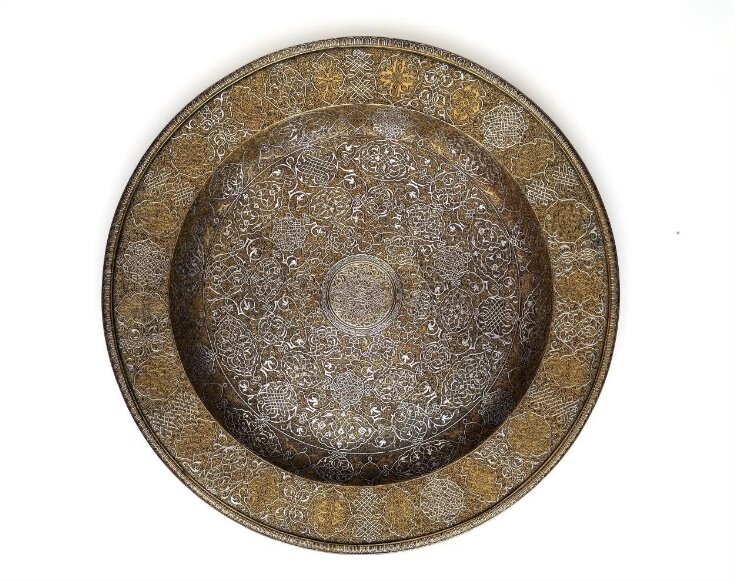
Many metal wares that are referred to as ‘Veneto-Saracenic’ were in fact produced in Islamic lands. But this broad-rimmed dish was clearly made by a Venetian. We know this because of the character of ‘arabesque’ ornament that is engraved and inlaid on the surface. This has a tendency to form European-looking cartouches, volutes and shields.
Object details
| Categories | |
| Object type | |
| Materials and techniques | brass chased and overlaid |
| Brief description | Brass charger with 'Veneto-Saracenic' decoration, Italy (probably Venice), 1540-50. |
| Physical description | Round brass dish with broad rim, decorated with silver wire in a European imitation of arabesque designs. |
| Dimensions |
|
| Style | |
| Gallery label |
|
| Historical context | Much so-called "Veneto-Saracenic" metalwork was actually produced in Mamluk lands for export to Europe. This example, though, is the product of a Venetian craftsman working in a Mamluk-inspired idiom, as can be seen in the highly Europeanizing arabesque. |
| Summary | Many metal wares that are referred to as ‘Veneto-Saracenic’ were in fact produced in Islamic lands. But this broad-rimmed dish was clearly made by a Venetian. We know this because of the character of ‘arabesque’ ornament that is engraved and inlaid on the surface. This has a tendency to form European-looking cartouches, volutes and shields. |
| Bibliographic references |
|
| Collection | |
| Accession number | 259-1894 |
About this object record
Explore the Collections contains over a million catalogue records, and over half a million images. It is a working database that includes information compiled over the life of the museum. Some of our records may contain offensive and discriminatory language, or reflect outdated ideas, practice and analysis. We are committed to addressing these issues, and to review and update our records accordingly.
You can write to us to suggest improvements to the record.
Suggest feedback
You can write to us to suggest improvements to the record.
Suggest feedback
| Record created | October 24, 2003 |
| Record URL |
Download as: JSONIIIF Manifest
